
September 2025 Newsletter
September brought a mix of caution and recalibration across the U.S. economy. A partial government shutdown is disrupting key data releases, leaving investors and policymakers reliant on alternative sources. The Federal Reserve (The Fed) responded to weakening labor conditions with a 25-basis-point rate cut, signaling a shift toward stimulus amid persistent inflationary pressures. Meanwhile, real estate markets showed signs of bifurcation, with multifamily rents softening and retail assets hitting record pricing.
Economic Overview
We examine inflation, employment, Fed policy, and yield curve behavior to assess the macro backdrop.
Data:
Inflation (CPI): Fed Chair Jerome Powell highlighted the risk of persistent inflation due to tariffs, which could lead to higher costs for construction materials and other real estate-related expenses.
Employment: The labor market is experiencing a slowdown, with potential downside risks such as higher layoffs and unemployment. August added just 22,000 jobs; unemployment rose to 4.3%, highest since Oct 2021.
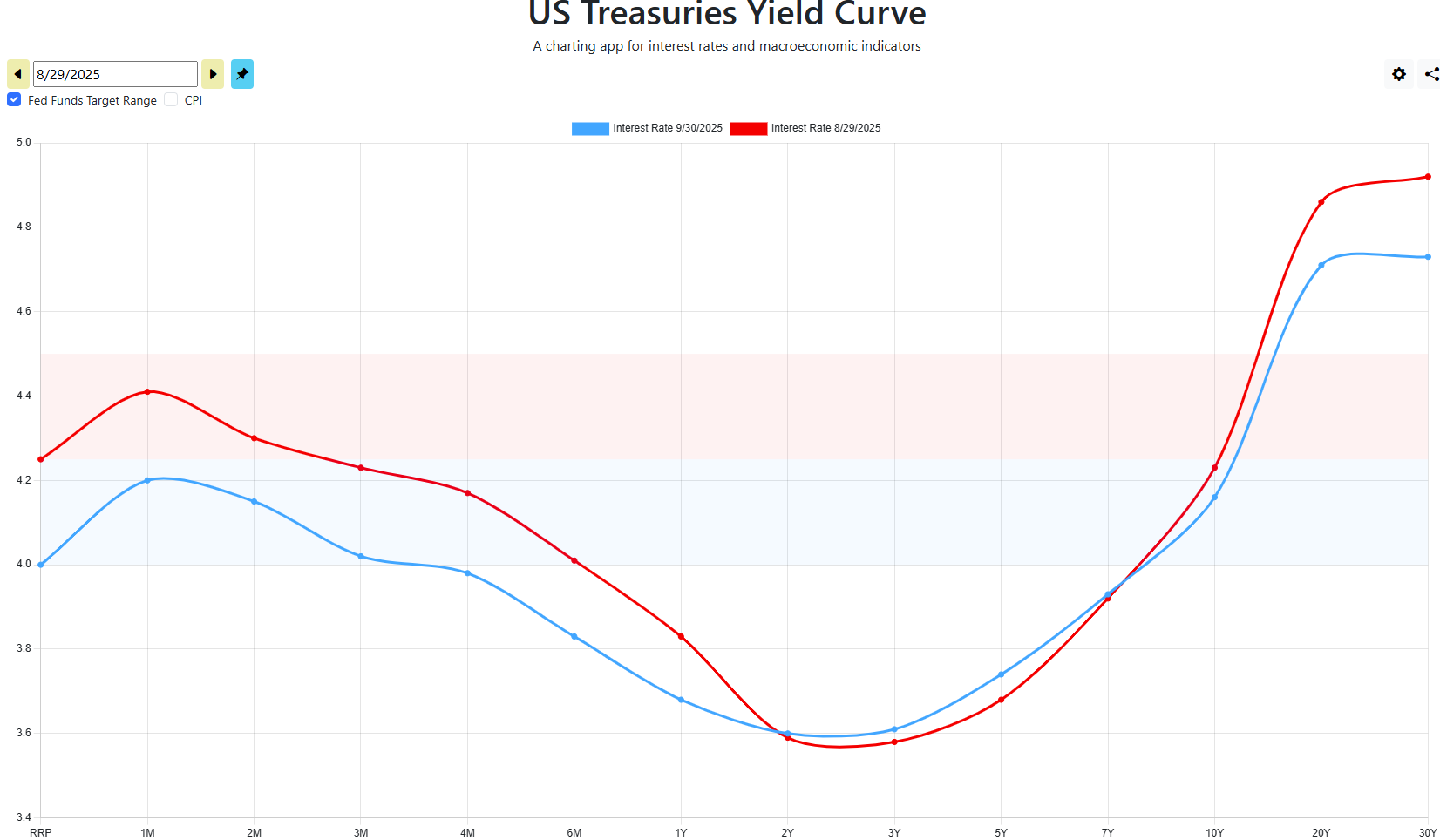
Fed Decision: The Fed has cut interest rates for the first time since last December, aiming to stabilize a wobbling labor market despite the ongoing inflationary pressures caused by tariffs. This decision brings the rates down to a range of 4% to 4.25%, the lowest since November 2022. The Fed funds rate is now projected to end 2025 at 3.6%, with two more 25 bps cuts estimated.
Geopolitical/Policy: Tariffs continue to pressure goods prices; government shutdown delays official data. Further fueling a year of uncertainty.
Yield Curve: Remains inverted on the front end and rising in longer term maturities, signaling rising belief of recession risk in the future.
Implication:
The Fed’s pivot (rate decrease) reflects growing concern over labor market softness. With inflation still above target and data gaps from the shutdown, investors must rely on private sources of information only, causing investors to pause. The inverted yield curve and cautious hiring suggest a late-cycle environment (a period of slowing expansion before a recession).
Possible Action:
Expect volatility, be conservative and approach investment markets with a focus on risk management and investments that are generally protective in inflationary environments like gold, real estate, commodities, and debt.
Real Estate Market Impact
Multifamily rents declined in September, with average asking rents falling $6 to $1,750. Annual growth slowed to 0.6%, the weakest September since 2009. Occupancy held steady at 94.7%, but Sun Belt markets like Denver and Austin saw notable drops. Build-to-rent rates also fell, reflecting affordability pressures.
Retail, in contrast, surged. Grocery-anchored centers and necessity-based retail drove a 15% YoY increase in sold pricing. Hospitality assets showed modest Revenue per available room (RevPAR) growth (2.8% YoY), especially in urban markets benefiting from returning business travel.
Conservative in Uncertain Times
What has created these uncertain times?
We are seeing political and economic changes like nothing we have ever experienced. We found a paper by Bridgewater that explained this dynamic period as “Modern Mercantilism.” What this means is the global economy has moved away from decades of laissez-faire, high globalization, and secular disinflation for an increase in State intervention that focuses on accumulating national wealth, pursuing geopolitical strength, and achieving economic self-sufficiency. Trade deficits and strategic sectors (technology, innovation, energy) are central concerns. This is creating fear that these changes will require sacrifices that could cause a recession globally, not just in the US. The administration is trying to maneuver The Fed to lower rates to ease the upfront pain, but these actions will be inflationary, and we will have to pay that bill sometime in the future.
Through constant dialogue with our networks, we saw many of these stresses begin to take hold at the end of 2024. We took a very conservative stance on valuations, LTVs, and borrower profiles. These conservative actions combined with borrowers not actively seeking funding for purchase or refinance has created a cash drag on the portfolio for the better part of the year. Regardless of this larger-than-normal cash position, the inefficient space of micro-balance commercial bridge loans has this year and will continue to outperform many broad investment categories, including broad private debt.
The MSTR Levered Loan Index (MSTR LL) is the best indicator used by market professionals for private debt. Year-to-Date (YTD) the MSTR LL index is up 4.63%. Although this year the Kirkland Income Fund’s net return is lower versus previous years due to market pressures and a conservative portfolio stance, we are still outperforming the MSTR LL with the fund returning 6.49% net compounded return YTD. The fund has also outperformed the SPDR Aggregate Bond Index, which has a net compounded return of 1.91% YTD.
The stress of geo-political occurrences has reached far and wide. We have been talking to borrowers, loan brokers, investors, other funds, and small businesses in our network and no one feels they are on solid ground. This uncertainty has affected the costs of debt, cost of materials, valuations, ability to obtain financing, slowing of consumer activity, and massive job layoffs across multiple industries, with the tech industry being specifically hit hard. Regardless of these events seeping into all environments, the Kirkland Income Fund still portrays low correlations to a vast number of other investments.
The chart below shows the Kirkland Income Fund’s monthly loan quotes issued, loans that were accepted for term sheet underwriting and the loans that were accepted for official term sheet issuance, all based on their loan value. To note, an issued term sheet does not mean that the borrower will receive a loan, but it implies that if the investor accepts the initial term sheet, their loan request will go into the full underwriting process.
Given all this information from our research, you can see that our early conservative stance in November 2024 proved to be the right move. However, deal flow from quality borrowers diminished and remained a persistent challenge throughout 2025 until August. As we have stated throughout this year, we were seeing large amounts of loan demand, but our initial filters turned away more loans than ever in the past 5 years of operation. We have observed a rise in the number of distressed borrowers displaying aggressive efforts to secure loans.
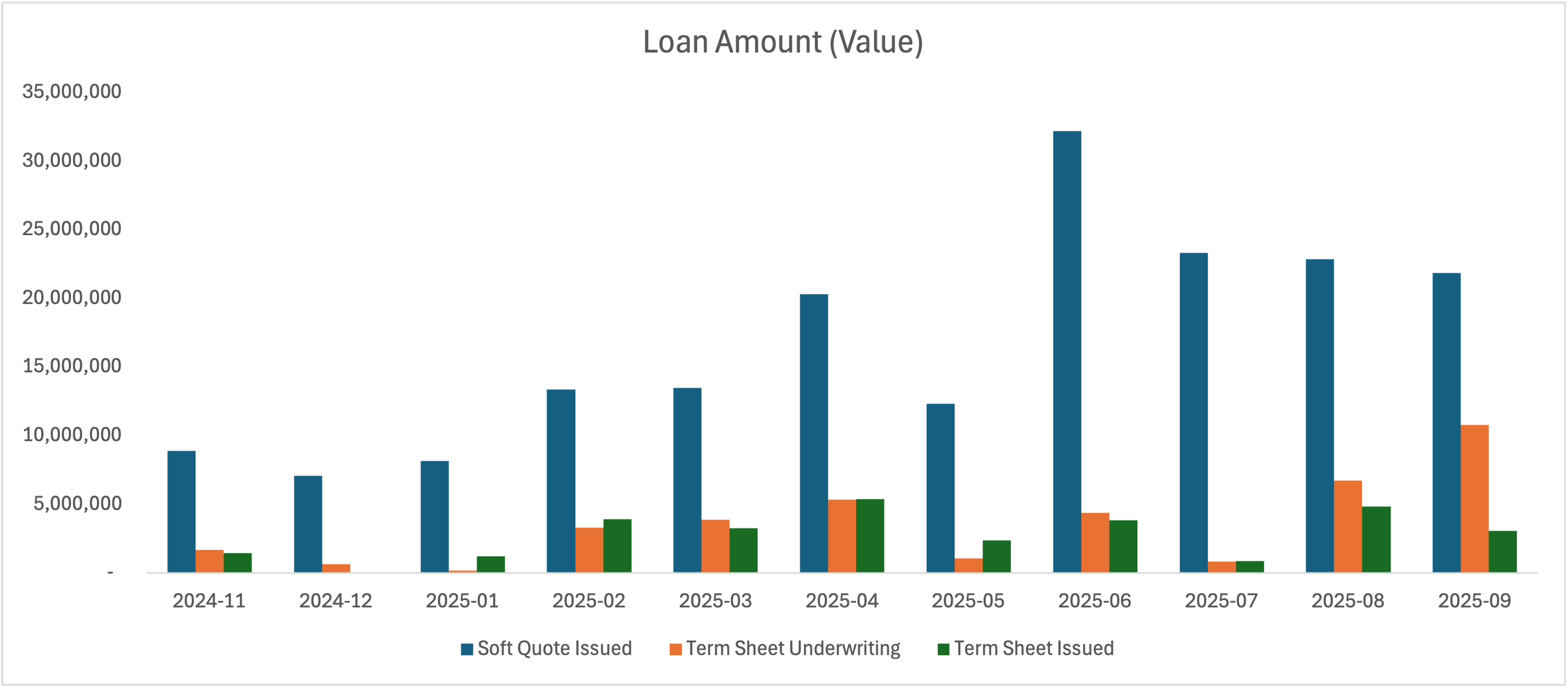
We are a risk-first shop and regardless of the cash position created by this conservative stance we operate in a niche inefficient space that has continued to allow us to provide an excess return compared to the broad fixed income market.
What is not going to Change? Demand for Private Debt.
Private debt has seen tremendous growth over the years and will have its periods of retracement but there is no event in sight that shows demand for private debt will slow down.
Why has demand for private debt continued to grow?
Investors demand income from a strongly equity-driven time period (since 2008).
Investors’ desire for diversification. Most investors and money managers found themselves with almost 100% equity allocations.
Market Volatility. Private debt is less volatile than traditional public markets. There is less emotion pulling and pushing the valuations of private assets. (This is where a lack of liquidity benefits a portfolio.)
Changing regulations and the evolution of bank lending under these new restrictive rules.
Borrowers’ demand for capital. Investment opportunities are still abundant.
Borrowers’ demand for customization. Not all loans fit in the bank lending box.
These demands and structures have not changed, if anything these factors have been amplified with current markets and the increase in volatility due to growth of uncertainty.
Private debt is still a strong addition to investors’ portfolios, and even more so when the debt is backed by real asset collateral. Going forward conservative underwriting will be very important as it has always been critical in our process.
Private debt is not going away, but it is also not immune to global market impacts and the headwinds of rapid growth. Prolonged macro events as we are seeing in today’s markets have certainly had an effect across all aspects of private debt. Stress caused by uncertainty in both financial and political markets has had negative impacts on many sectors and that is bound to create slowdowns.
Private credit will continue to push forward as a valuable investment and tool for the market space, as certainty of funding and customization of lending will continue to be in demand, especially in uncertain times.
Due Diligence Note
One concern we have for investors is something I learned years ago when building and trading a portfolio of Business Development Companies (BDC) for investors.
Investments that have fixed high yields and are subject to market stress should be of concern. Can these investments maintain their high payouts if the stress is prolonged?
In my experience, these types of investments struggle to maintain high payouts when market stress persists. As their ability to expand leverage lines dries up and interest payments from the loan portfolio fall short of expectations, the investment (BDC) is often forced to lower its yield or may even miss a distribution altogether. Investors with these investment exposures should look under the hood and ask the managers the following:
A return attribution of the fund.
What is the leverage level of the fund?
What is the default level of the loan portfolio?
How many loans are past payment even if only 30 days?
What is the average term of the loans?
Does the fund hold real estate equity positions?
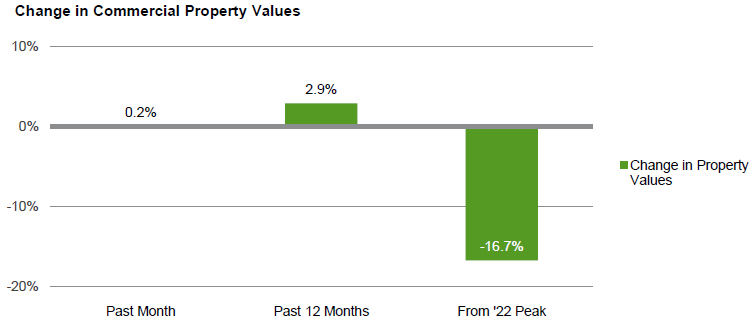
What are the current valuations of the equity positions compared to the original valuations? Request a breakdown of the debt on those equity positions. The chart below from Green Street shows a recent assessment of commercial real estate (CRE) values. Not a bad time to check on your manager’s assumptions as they could be affecting your returns and performance fees if any.
If a fund offers fixed payments but relies on variable collections—and its leverage line is either maxed out or exceeds acceptable limits—then it could be at risk of operational failure if market stresses persist.
