August 2025 Newsletter
August brought a clear shift in investor sentiment: cautious optimism tempered by signs of economic deceleration. The labor market softened more than expected, inflation nudged upward, and the Fed is now widely expected to cut rates in September.
Despite equities trading near all-time highs and credit spreads remaining tight, signals from the dollar, yield curve, and gold suggest rising risk and a flight to quality. The Federal Reserve Banks’ inflation forecasts have shifted only marginally from 3% to 2.9%, with inflation seemingly unaffected by tariffs or increasing US debt.
Geopolitical risks persist, posing potential catalysts for market volatility. Many investors, familiar only with post-financial crisis (2008) markets, are leading much of the investing. Are these younger investors effectively adapting to a changing regime they have never seen before? Conversations across sectors—from agriculture to healthcare—reveal heightened caution and growing concerns, with businesses and dealmakers seeking wider margins and adopting more conservative approaches to compensate for their perceived risk.
These developments raise a critical question:
How should private credit investors respond to a cooling economy and a likely rate cut?
This month’s newsletter explores:
Key macroeconomic signals.
Real estate sector adjustments.
Kirkland Income Fund’s positioning and performance.
Regulatory developments.
Economic Overview
August’s economic data revealed a slowing labor market and persistent inflation, prompting expectations of monetary easing.
Inflation: Headline Consumer Price Index (CPI) was up +0.4% in August and up 2.9% for the last 12 months. Economists mostly attribute the increase to tariffs.
Unemployment: Increased to 4.3%, the highest since October 2021.
Job Creation: Nonfarm payrolls added just 22,000 jobs, far below the ~75,000 forecast.
Wage Growth: Slowed to 3.7% Year-on-Year (YoY), down from 4.0%.
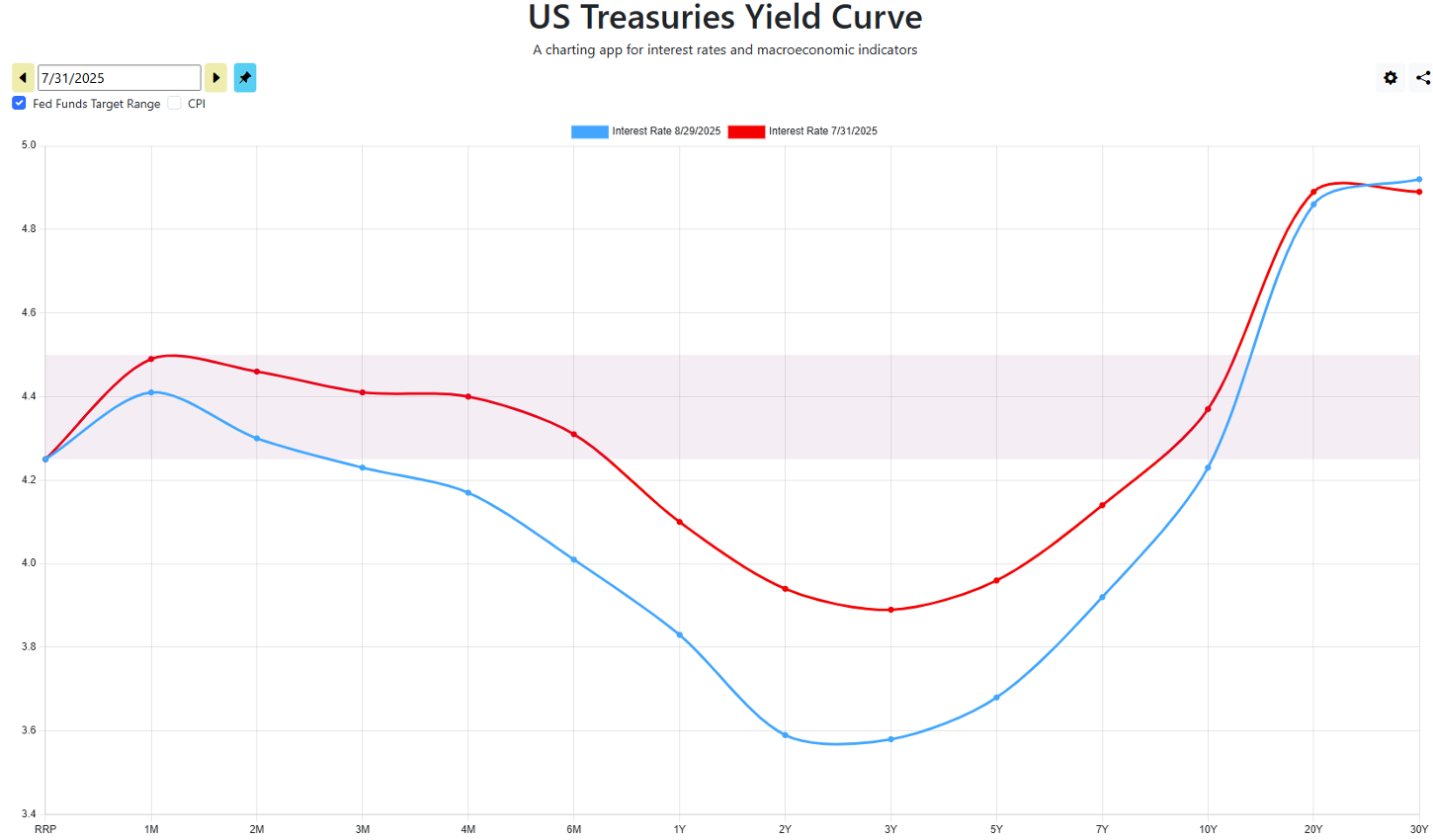
Yield Curve: Treasury yields fell sharply, with 2-year notes dropping to 3.59%, signaling rate cut anticipation.
The Fed is expected to cut rates by 25–50 bps in September. While this may ease borrowing costs, it also reflects growing concern about economic fragility that might be present.
Investors should review their portfolios and assess whether the risk level is appropriate for future uncertain economic times. Reassess exposure to long-duration and volatile assets. If prudent consider rebalancing toward shorter duration, or lower volatility investments such as private debt.
Battle Royal: Federal Reserve versus the Executive Branch
In August 2025, a significant conflict has erupted between the executive branch and the Federal Reserve, raising concerns about the independence and credibility of the U.S. central bank. President Trump’s decision to remove Federal Reserve governor Lisa Cook, citing alleged misrepresentations in her past mortgage applications, has sparked controversy and an impending legal battle over whether such a dismissal is lawful.
The case brings into question whether the president has the authority to remove Fed governors at will, or if existing statutory protections for the central bank’s independence still apply.
Amid this turmoil, President Trump has increased efforts to pressure Fed chair Jerome Powell to aggressively lower interest rates, beyond the modest quarter-point rate cut expected at the upcoming policy meeting.
These developments have serious implications for financial markets. Central bank independence is critical for market stability, shaping expectations around inflation, currency values, and interest rates. If the precedent is set that a president can remove governors for loosely defined reasons, the Fed’s autonomy could be threatened, increasing political risks and unsettling bond and equity markets.
Although substantial interest rate cuts might boost risk assets in the short term, they could compromise the central bank’s ability to manage inflation and maintain long-term economic stability.
Investors should remain vigilant and be prepared for rapid shifts in market sentiment. Kirkland Capital Group, in the face of dynamic shifts, is not easing the underwriting parameters as we have seen many other investment platforms do. We will continue to maintain a conservative and defensive stance, true to the objective of the Kirkland Income Fund.
Uncertainty and Flight to Quality
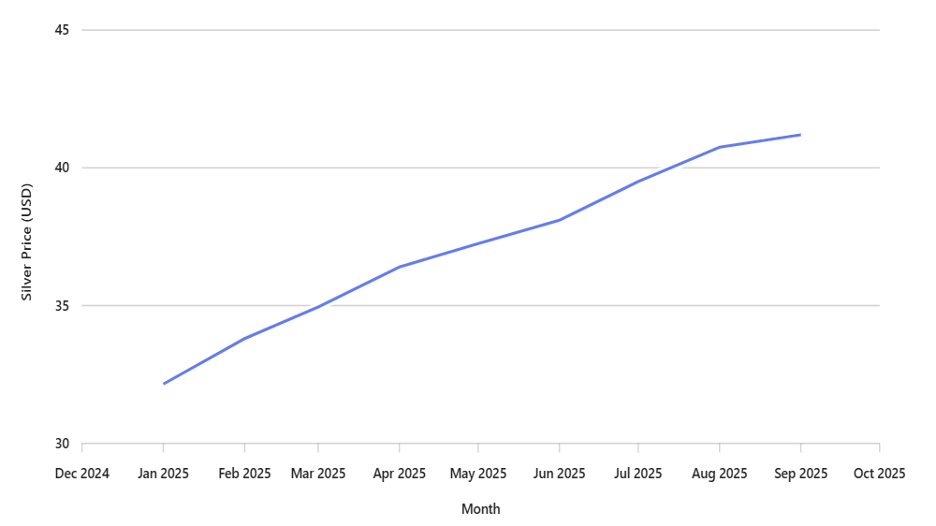
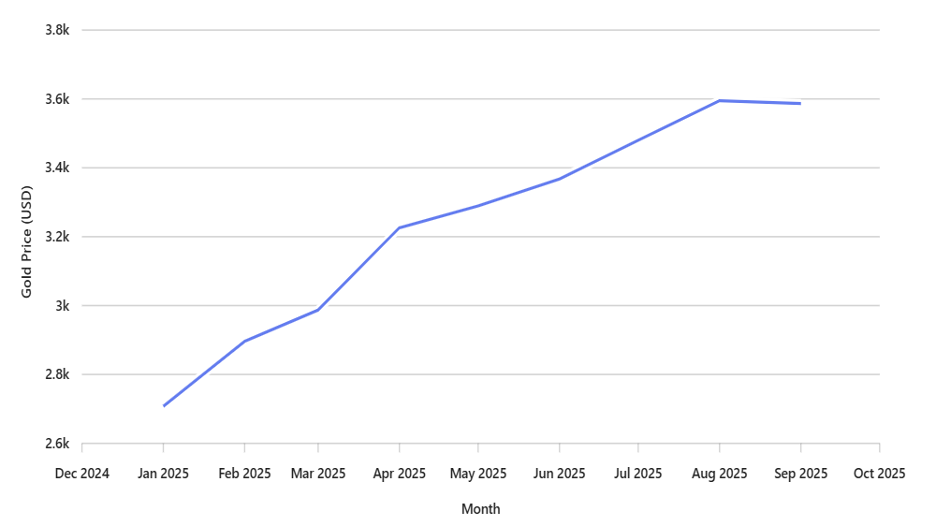
The erosion of Fed autonomy and the surge in tariffs have heightened market uncertainty. This environment has driven investors toward hard assets like gold and silver, which are seen as safe havens in times of turmoil.
Silver has risen 28.2% in 2025 YTD.
Gold has risen 36.7% in 2025 YTD.
While uncertainty has been a dominant theme in 2025, this uncertainty creates opportunity, as we have seen in precious metals, but for many asset classes, including real estate, it keeps many investors on the sidelines. Those looking to complete deals need greater spreads/margins to operate safely. This is a trend we have seen as loan requests have increased.
Real Estate Market Impact
The cooling labor market and anticipated rate cuts are already influencing commercial real estate dynamics.
Multifamily: Vacancy rose to 8.1%, with absorption steady at 512,000 units. Class B assets are outperforming, while Class A faces elevated vacancies.
Retail: Net absorption turned negative, and vacancy increased to 4.3%. Despite this, retail maintained the fastest rent growth at 1.8% among major sectors.
Hospitality: Occupancy held at 62.9%, still below pre-pandemic levels. However, Revenue per Available Room (RevPAR) and Average Daily Rate (ADR) exceeded 2019 benchmarks, signaling profitability recovery.
Borrower Behavior: Borrowers are increasingly requesting rate locks and shorter terms. Several have paused refinancing plans, awaiting clarity on Fed policy.
Risks
Oversupply in Sun Belt multifamily.
Retail contraction in discretionary categories.
Opportunities
Workforce housing in Midwest metros.
Hospitality assets in urban convention hubs.
What This Means for Kirkland Income Fund
We remain focused on working with reliable borrowers to preserve capital, maintaining a conservative approach to underwriting new loans. Our emphasis on “as-is” valuations help mitigate speculative risk and supports principal preservation. Although loan applications have increased, our approval rate has declined, resulting in reduced returns. For instance, in August we declined several loan packages due to inflated pro forma valuations and insufficient borrower equity. Additionally, some loans were paid off during August. While this indicates that capital remains available for long-term financing exits from our short-term loans, the money returned to the Kirkland Income Fund could not be redeployed into new loans at this time. Given ongoing market uncertainty, we believe our cautious strategy is prudent, and we will continue to prioritize risk management over short-term capital deployment, even if this results in lower returns for a period.
We’re thrilled to announce that Saiyani T. Mukombe joined Kirkland Capital Group in August as Managing Counsel — Loan Servicing & Default Management. Saiyani brings a wealth of legal and strategic expertise, most recently serving as Counsel & Assistant Vice President at Wells Fargo’s corporate headquarters, where he led a multi-state mortgage litigation portfolio and spearheaded initiatives to reduce risk and improve operational efficiency. His background also includes running his own law firm and teaching criminal justice at North Carolina A&T State University, reflecting a deep commitment to both legal excellence and community impact.
In his first month, Saiyani has immersed himself in our foreclosure operations—meeting extensively with internal teams and stakeholders to map out a game plan for accelerating timelines and streamlining processes. Over the next 90 days, he’ll also take ownership of key servicing workflows, including loan modifications, and forbearance processing. He’ll also lead initiatives around process improvements, compliance audits, and strategic portfolio management—ensuring KCG is positioned to move faster, reduce risk, and deliver even greater value to our investors and borrowers.
Regulatory & Legislative Updates
Executive Order increasing Access for 401Ks into alternative assets.
President Trump issued an Executive Order on August 7, 2025, which opens a path for an investor’s 401(k) to invest into alternative assets such as real estate, crypto, and private equity. The Order states the following, “It is the policy of the United States that every American preparing for retirement should have access to funds that include investments in alternative assets…”
The Order defines alternative assets as private equity, private debt, real estate, digital assets (crypto), commodities, and infrastructure. These “alternative” investment assets do not trade on a public stock market and even though an investor’s 401(k) can already own a private asset under law, the federal regulatory framework has caused most 401(k) providers to restrict these assets. The Order seeks to provide a new regulatory framework that would encourage the adoption of alternative assets in 401(k)s.
This action is opening the door further for big funds to push their products into 401(k) custodial platforms. This could be a good thing for your company's 401(k) to increase diversification, but this will also require the investor to perform more due diligence on the options available to them in their 401(k).
