July 2025 Newsletter
Navigating Complexity with Confidence
July brought a mix of optimism and caution across financial markets. While major equity indices posted gains and corporate earnings remained resilient, underlying economic signals of inflation pressures and employment softness continue to create uncertainty. These macroeconomic dynamics are shaping real estate markets and how the Kirkland Income Fund (KIF) moves dynamically to manage risk and create continued opportunity.
Strong Markets and Economy in Check
Equity Markets
Despite a late-month pullback, major indices posted gains in July:
S&P 500: Up 2.17%, hitting ten new highs in the month and peaking on the 28th.
Nasdaq Composite: Gained 3.4%, also showcasing a number of new highs.
Dow Jones Industrial Average: Rose 0.08%, ending just 2% below its all-time high.
In July 2025, equity markets demonstrated notable resilience despite underlying economic uncertainties. The combination of resilient earnings, and hopes for monetary policy support were paramount factors driving equity performance in July.
Inflation
In July 2025, headline Consumer Price Index (CPI) rose by 0.2%, resulting in a year-over-year increase of 2.7%. Core CPI, which excludes the more volatile food and energy prices, advanced by 0.3% on the month and 3.1% compared to a year earlier. The primary drivers behind these inflation outcomes included steady upward pressure from shelter costs and select service sectors, as well as the early effects of new tariffs that began influencing input prices. While goods inflation remained muted and energy fell, persistent demand for services and shelter fueled core price acceleration, keeping inflation above the Federal Reserve’s long-term target.
Employment
Non-farm payrolls increased by just 73,000, a figure notably below expectations ranging from 100,000 to 115,000 new jobs. The unemployment rate remained unchanged at 4.2%, reflecting a steady but subdued labor market. Job growth was overwhelmingly concentrated in healthcare and social assistance, which together accounted for 94% of the month's gains, adding 55,000 and 18,000 jobs respectively. In contrast, federal government employment continued its downward trajectory, with a loss of 12,000 positions in July and a cumulative decline of 84,000 jobs since January. The primary drivers behind these outcomes were persistent demand for healthcare and social services, highlighting sectoral resilience despite broader economic uncertainty.
Major Revision of Past Data
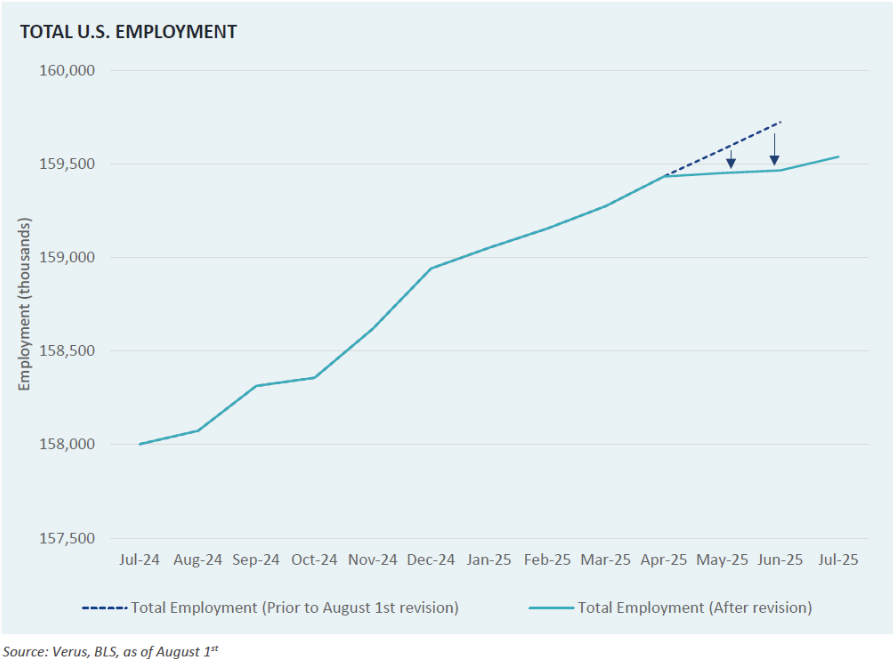
The May and June payrolls were revised down by 258,000 jobs. The largest correction since 1968. The chart below supplied by Verus shows the adjustment in US Employment from original forecasts. Perhaps jobs are not as strong as first believed. Could this be a catalyst that supports a rate ease in September.
Federal Reserve
The Federal Open Market Committee (FOMC) held rates steady at 4.25%–4.50%, citing elevated uncertainty and early signs of tariff-induced inflation. Notably, two Fed governors advocating for a rate cut—the first such split since 1993.
Yield Curve
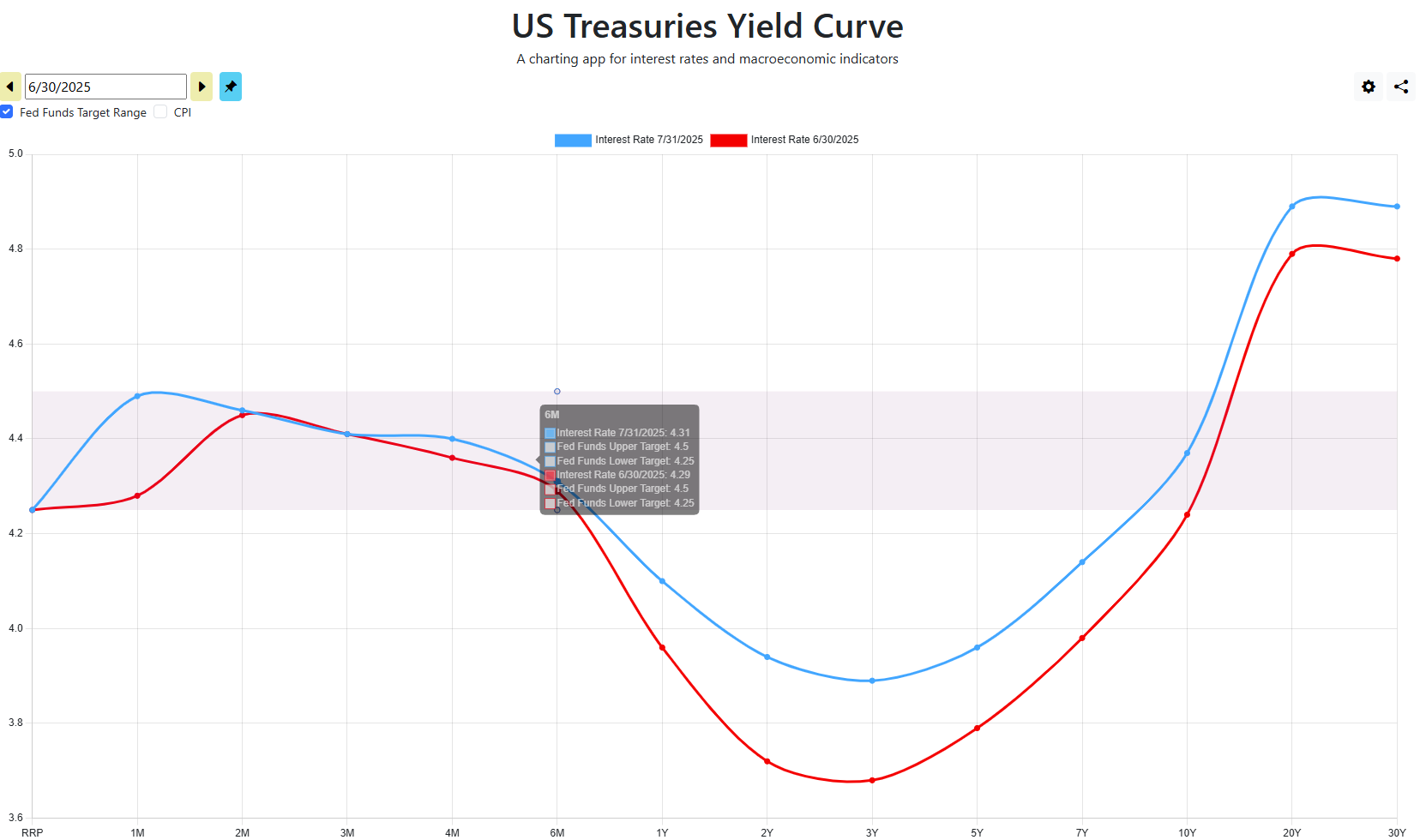
Below you will see the yield curve for July 31st (blue line) compared to the yield curve as of June 30th (red line).
2-year Treasury yield: Rose to 3.96%
10-year Treasury yield: Increased to 4.38%
The 2s10s spread narrowed to +42 bps, indicating a flattening curve and investor caution.
Geopolitical Developments Affecting Interest Rate and Inflation Fears
U.S. tariffs surged to an average effective rate of 18.2%, the highest since 1934. We still believe much of the tariff talk is part of dynamic deal making. For example, Japan just completed a 2025 trade deal with the US surrounding automobiles and auto parts that lowered their tariffs from 25% to 15%.
Trade tensions have redrawn global supply chains, with China and Mexico redirecting exports away from the U.S.
Issues in Iran are subsiding but according to the World Economic Forum there are still 110 armed conflicts globally adding geopolitical instability.
Impact on Real Estate Markets and the Kirkland Income Fund
Key Challenges
Elevated interest rates continue to pressure financing costs and cap rates.
Construction costs remain high, limiting new development.
Policy uncertainty, especially around tariffs, is delaying investment decisions.
Most of these challenges more directly relate to equity investments, but as a lender, our borrowers are also squeezed by these factors. This has been a component of lower quality loan demand versus the previous year as better borrowers can afford to wait if they cannot make deal metrics pencil out. However, there are signals of recovery, as we experienced our highest monthly deal flow in July since January 2024. A more detailed loan pipeline commentary can be seen below.
Property Type Performance
Multifamily remains the most resilient sector. Vacancy rates are projected to end 2025 at 4.9%, with rent growth of 2.6% nationally.
Retail shows signs of stabilization, but performance is bifurcated by asset quality and lease durability.
Industrial continues to perform well, though demand is moderating.
Hospitality has been weak and seen a 3.3% decline in RevPar (Revenue per available Room) and an over-all drop-in demand of 1.8%. Extended Stay and in particular the economy segment were flat for the same time period. National occupancy across all hospitality was 71.6% or down 1.9% since July 2024.
The Kirkland Income Fund maintains a diversified portfolio to ensure we have exposure to a number of opportunities but also the fund does not get caught in an idiosyncratic risk event like we have seen happen to Hospitality and Office.
“I am a Bill Just a Bill sitting on the Hill”
Governmental action has been heavy of late: first the One Big Beautiful Bill, and now more government action is in the works. Here is a quick summary of events and why it might be important to real estate and the Kirkland Income Fund in the future.
GENIUS Act of 2025
Overview
Signed into law on July 18, 2025, the GENIUS Act is the first comprehensive federal legislation in the United States to regulate payment using stablecoins—digital assets pegged to a fixed monetary value and used for payments. It replaces a fragmented state-by-state approach with a unified framework that balances innovation, consumer protection, and financial stability.
The GENIUS Act of 2025 marks a pivotal shift in U.S. digital asset policy. By establishing a clear, enforceable framework for stablecoins, it unlocks new opportunities for blockchain innovation, institutional adoption, and investor participation. For investors, the Act signals a maturing market—one where regulatory clarity and compliance infrastructure will be key drivers of long-term value.
The Act creates a regulatory foundation that significantly enhances the viability and scalability of Tokenized Real-World Assets (RWAs) and on-chain finance by legitimizing and stabilizing the use of payment using stablecoins. In English, there are now rules and regulations being formed to govern the tokenization of both equity and debt in real estate. Investors will have the opportunity to participate in a wider range of asset classes and create greater diversification.
Here is an example of the potential impact when it comes to tokenizing a commercial real estate property:
Tokenization: A $10M building is fractionalized into 10,000 tokens, each representing $1,000 of equity.
Investor Purchase: An investor buys 100 tokens using a GENIUS-compliant stablecoin (e.g. USDC).
Settlement: The transaction settles instantly on-chain using the stablecoin, with no need for wire transfers or escrow.
Yield Distribution: Rental income is distributed monthly in stablecoins, ensuring fast, low-cost, cross-border payments.
Secondary Market: Tokens can be traded on a compliant exchange, with stablecoins used for liquidity and settlement.
This model:
Reduces friction and cost in asset transfers.
Enables global investor access to U.S. real estate.
Provides real-time auditability and compliance.
CLARITY ACT
Further steps to establish a comprehensive regulatory framework for digital assets. This Act goes hand in hand with the impact of the GENIUS ACT.
This act will give dual oversite.
Commodity Futures Trading Commission (CFTC): Granted exclusive jurisdiction over digital commodities, including spot and cash markets.
SEC: Retains authority over restricted digital assets (i.e., securities-like tokens) and intermediaries such as brokers and Alternative Trading Systems (ATS)
The ACT requires registration of brokers, dealers, custodians, and exchanges with the CFTC. It will also mandate segregation of customer assets, AML/KYC compliance, and cybersecurity standards.
There is also a clause for a $75 million exempt offering that could easily be used to facilitate the raising of capital for real estate funds or one-off equity real estate deals.
These regulatory measures are essential for establishing confidence in emerging markets, and they will likely influence the tokenization of real estate assets as well as potentially impact investment funds.
These two bills will help build transparency and trust over time. With the expansion of Real World Asset (RWA) tokenization under appropriate regulations, the Kirkland Income Fund may have access to additional sources of capital, which could assist in building a diversified portfolio and providing increased liquidity.
Equal Opportunity for All Investors Act of 2025 (H.R. 3339)
The Act is aimed at expanding access to private investment opportunities by redefining who qualifies as an accredited investor under U.S. securities law.
The bill seeks to:
Broaden the definition of “accredited investor” beyond traditional income and net worth thresholds.
Introduce a certification pathway for individuals to qualify based on financial knowledge and sophistication.
The SEC has been tasked with developing and implementing an exam that will assess financial sophistication as a determination of suitability to invest in alternative investments. The plan is to launch this in the next year.
This change allows investors who previously did not meet income or asset requirements to access private investments. At KCG, we've met many investors just short of accredited status who were unable to join the Kirkland Income Fund, but with this new legislation, they can now participate.
“Democratizing Access to Alternative Assets for 401(k) Investors”
On August 7th Trump signed an order to expand access to the Alternative investments such as private equity, crypto currencies, and real estate for 401K and other IRA retirement plans. This could create greater diversification and returns for investors in their 401ks, but it will also incur higher fees, lower liquidity, and potentially greater volatility especially generated by crypto. (Bitcoin’s annualized volatility as of July 30th was 28.53%.)
This will not really affect smaller funds such as Kirkland Income Fund, but the larger fund houses will certainly be soliciting the larger plan custodians to be listed in their 401K offerings. Watch out!
Real Estate Cycles
Recently, I was asked about the real estate cycles and what we are seeing in our secondary and tertiary markets.
Real estate markets typically move through four phases:
Recovery – Low occupancy, minimal new construction, rising rents.
Expansion – High demand, increasing construction, strong rent growth.
Hyper Supply – Overbuilding, slowing rent growth, rising vacancies.
Recession – Declining rents, high vacancies, distressed sales.
In 2025, many secondary and tertiary markets are in the late recovery or early expansion phase, offering opportunities for well-capitalized investors. However, rising interest rates and tighter credit conditions may accelerate transitions into hyper supply or recession in some submarkets.
Quality loan flow has presented challenges this year, as reflected in the current state of our pipeline.
Loan Pipeline Update & Outlook
Our current loan pipeline reflects a noticeable uptick in broker engagement and loan requests, with July marking a record number of inquiries into our program. For the first time this year, loan submissions have exceeded the 30-mark in consecutive months, and early data from August indicates that this positive momentum is continuing. The last time this happened was in Q1 2024. While borrowers have taken longer to move forward—evidenced by loans initiated as far back as January now reaching closing—there has been an acceleration in recent weeks. The rise in purchase loan requests signals a renewed confidence among investors, suggesting that activity is trending in a favorable direction.
Despite some loans closing in under 30 days, the average closing timeline remains around 80 days from quote to completion. Our pipeline remains robust and has shown consistent growth since April, even as paid-off loans temporarily impact our interest income. This payoff activity, while reducing short-term returns, is a testament to healthy market conditions and positions us to redeploy capital into new opportunities. With historical trends on our side and a steadily growing pipeline, we are confident in our ability to get back to our target returns and continue providing value to our investor family as the market evolves.
