June 2025 Newsletter
Introduction
As we close out the second quarter of 2025, the economic landscape remains complex. Markets have rebounded strongly, yet underlying uncertainties persist. In this month’s newsletter, we examine how macroeconomic trends are influencing real estate markets and how the Kirkland Income Fund (KIF) remains strategically positioned. Our focus continues to be on delivering income-focused returns while preserving investor capital through disciplined underwriting and short-duration lending.
The Economy – Mixed Signals and Market Volatility
June brought a strong rebound in equity markets. The S&P 500 rose 5.1%, the Nasdaq gained 1.72%, and the Dow Jones Industrial Average increased 4.49%, capping off a robust second quarter. Market optimism was fueled by easing trade tensions, strong corporate earnings, and continued enthusiasm around AI-driven innovation.
Inflation still monitored and a focus of The Federal Reserve (The Fed). The Consumer Price Index (CPI) was up 0.3%, with the 12-month CPI at 2.7%. Core inflation was revised upward to 2.9%. The primary drivers were shelter and food with energy slightly lower. The Fed decided to keep the Fed Funds Rate unchanged at 4.25%–4.50%, pointing to ongoing inflation concerns and a careful approach due to the lack of a clear direction moving forward. The Fed is now forecasting a 1.4% GDP growth for 2025, along with a 3.0% inflation rate and an unemployment rate of 4.5%, mainly influenced by the recent changes in tariffs. The upcoming Federal Open Market Committee (FOMC) meeting is scheduled for July 29th and 30th.
The labor market continues to show resilience as Unemployment remains stable at 4.1%.
The yield curve is lower than a month ago and considerably lower than the beginning of the year. The curve in June remains in a U shape, but with even greater steepness added.
2-Year Treasury: 3.72%
10-Year Treasury: 4.24%
30-Year Treasury: 4.78%
The U-shaped curve still implies the expectation of short-term rates to remain elevated. Therefore, it is unlikely that The Fed will ease rates. The higher long-term rates and the steepening suggest growing investor confidence in the long-term outlook, despite some caution in the short and mid-term.

Geopolitical events are still driving most feelings of uncertainty and perceived risk. Even with the concerns we saw progress on many fronts this month. U.S.-China trade framework was agreed upon in London, pausing new tariffs for 90 days. Meanwhile, a ceasefire in the Middle East helped stabilize oil prices. Domestically, the Digital Asset Market Clarity Act advanced in Congress, signaling a more structured regulatory environment for crypto markets.
Markets Partially Numb to Tariff Announcements
Increasing tariffs are an issue that many sectors of investment should monitor. They certainly have created increased volatility in the markets but they have turned out to be a fair amount of saber rattling by the administration.
The Administration recently announced blanket tariffs of 15 to 20% and markets hardly moved. The markets are taking a broader view with the understanding that while the short-term might be turbulent, there is a prevailing belief that the long-term outlook will stabilize and prevent any lasting detrimental effects. Market incumbents have also been taking moves to mitigate some of this volatility as well by increasing reserves of resources that might fall under a tariff.
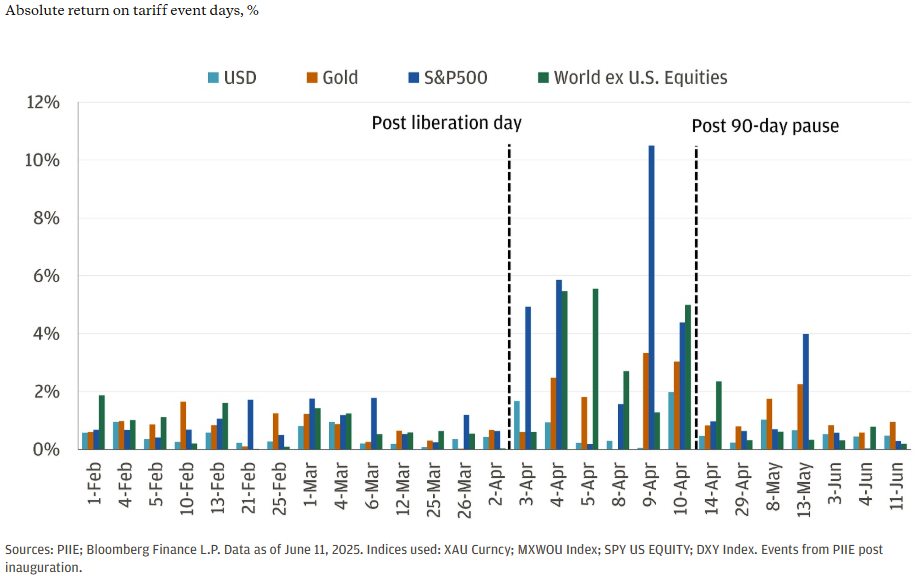
As the element of uncertainty starts to fade, it is evident from the chart below that the markets are gradually becoming desensitized to the rapid and potentially unsettling tariff-related news. The challenging period of adjustment in April had to be endured. As mentioned earlier, this is a moderating effect, but we should remain vigilant as there will still be repercussions from these developments. The key aspect to monitor going forward is the potential impact of inflation and economic struggles that could pave the way for a recession.
The chart below from JPM's latest research shows the volatility of various indices on different days before, during, and after the tariff announcements. As can be seen, volatility around announcements is greatly muted.
Impact on Real Estate Markets
The current economic backdrop keeps us cautious, but opportunities for the Kirkland Income Fund are increasing.
Elevated interest rates continue to pressure borrowing costs, while construction costs remain high due to persistent labor shortages and material inflation. Tighter credit conditions and uncertainty have reduced transaction volumes comparably, but we are seeing a sizable increase in loan demand recently compared to previous months this year. Financing structures like the Kirkland Income Fund are still playing a pivotal role. Borrowers are looking for fixed-rate, short-duration financing as they increase their demand for opportunistic distressed assets at attractive valuations. We are pleased to see this coming back in favor, as our borrower base with dry powder is beginning to re-enter the market selectively.
Retail properties are experiencing a bifurcation. Experiential retail continues to recover, while traditional malls face structural headwinds. Multifamily assets remain resilient, supported by strong rental demand, though rent growth has moderated. Office properties continue to struggle, particularly in urban cores, as hybrid work models persist. This is a property type in which the Kirkland Income Fund has never invested and continues to have no allocation.
Our Approach at Kirkland Income Fund: Sticking with What Works!
Conservative Underwriting as Protection: KIF maintained a low weighted average loan-to-value (LTV) of 58.96%, focusing on “as-is” valuations rather than speculative future values. This conservative approach provides a margin of safety and helps protect investor capital in volatile markets.
Disciplined Approach: We continue to uphold strict underwriting standards, even when it means passing on deals that don’t meet our criteria. In Q2, several loans were rejected due to red flags uncovered during due diligence—including unpaid taxes and undisclosed legal issues. This discipline may create short-term drag but is essential to long-term performance.
Looking Forward
While forecasting remains inherently uncertain, we are finally seeing consistent week-over-week growth in loan demand. More of the loans are passing initial filters and the more experienced operators and borrowers are coming back to the deal table. Our core priorities remain unchanged: principal preservation, income generation, and operational excellence. We will continue to apply a disciplined, data-driven approach to underwriting, portfolio construction, and risk management.
One Big Beautiful Bill (OBBB)
This news has been dragging on through all of June and the Bill was signed into law on July 4, 2025. The Bill introduces sweeping tax reforms with significant implications for real estate investors and investors in the Kirkland Income Fund.
Key benefits include the 20% qualified business income (QBI) deduction for REITs was made permanent, locking in the REIT’s benefit for KIF Investors; the permanent reinstatement of 100% bonus depreciation; expanded Opportunity Zone (OZ) incentives; and enhanced deductions for pass-through income and capital improvements—boosting after-tax returns and encouraging long-term investment.
The bill also expands the Low-Income Housing Tax Credit and raises estate tax exemptions, supporting both development and generational wealth planning. However, it phases out green building incentives, imposes new taxes on university endowments, and may contribute to higher interest rates due to large-scale fiscal adjustments. Some benefits, like OZ enhancements, are delayed until 2027, potentially slowing near-term deployment.
Strategic takeaway: The OBBB is a net positive for real estate investors, offering powerful tax tools and long-term investment incentives. However, the rollback of green building incentives, funding cuts, and sector-specific risks (e.g., education, data centers) could trigger inflationary pressures that may lead the Federal Reserve to hold or raise rates.
For more details, we created an expanded paper covering many sections of the bill that can be accessed here.
