May 2025 Newsletter
Introduction
As we enter the midpoint of 2025, markets continue to send mixed signals. This newsletter explores how broader economic trends are shaping real estate markets and how the Kirkland Income Fund (KIF) is strategically positioned. We remain committed to delivering income-focused returns while preserving investor capital in a dynamic environment.
The Economy: Mixed Signals and Market Volatility
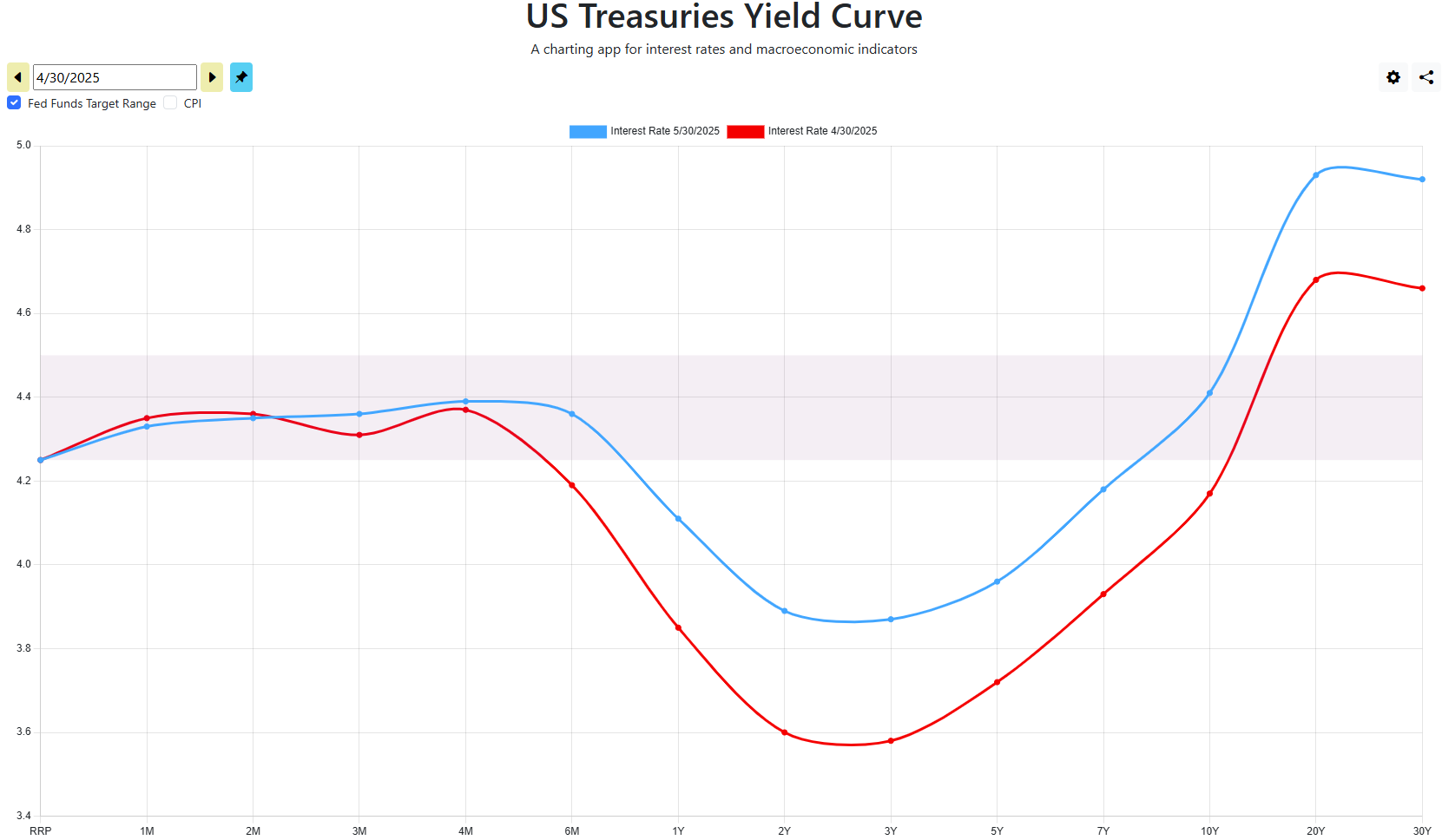
Equity markets were volatile in May. The S&P 500 rose 6.29% marking the best single month return since 2023. The Nasdaq rose 9.56%, and the Dow Jones Industrial Average returned 3.2%. The strength in markets was driven by easing inflation concerns, strong corporate earnings, and reduced uncertainty around tariff and trade negotiations. Headline inflation (CPI) rose by 0.1% month-over-month and 2.4% year-over-year, while core inflation increased slightly by 2.8%. The drivers of the slight increase were Shelter, Food, and Energy. The labor market exceeded expectations with 139,000 jobs added while unemployment remained stable at 4.2%. Employment growth was led by healthcare and hospitality, while Federal government jobs declined by 22,000. At the May Federal Open Market Committee (FOMC) meeting, the Federal Reserve held rates steady at 4.25%–4.50%, citing persistent inflation concerns and the need for more data. The yield curve maintained its U shape, with the short end unchanged, 2-year Treasury yield rising to 3.89% and the 10-year yield up slightly to 4.41%. While stagflation risks are still not imminent, the combination of slowing growth and persistent inflation warrants continued monitoring.
Impact on Real Estate Markets
The current economic environment presents several challenges for real estate. Elevated interest rates have increased borrowing costs, while construction costs remain high due to labor shortages and materials inflation. Additionally, tighter credit conditions have reduced transaction volumes. Retail properties are seeing mixed performance, with experiential retail rebounding but traditional malls are under pressure. Multifamily assets remain resilient, supported by strong rental demand, though rent growth has moderated. Office properties continue to face headwinds from hybrid work trends. Financing structures play a critical role—properties with floating-rate debt are under stress, while those with fixed-rate, short-duration financing are better positioned. One silver lining is the opportunity to acquire distressed assets at attractive valuations. In discussions with many active investors, they are seeing more opportunities to buy assets.
Headlines Fueling Uncertainty
US Credit Ratings
On May 16th the Credit rating was downgraded from Aaa to Aa1. This is important as the US Treasury is the primary tool of pricing risk around the world. As anticipated, rates remained stable after the announcement, although they rose slightly beforehand due to increased risk expectations. Why this might matter to real estate investors:
Treasuries are Global: Interest Rates Up Across the Board
The downgrade signals increased risk, prompting lenders to demand higher yields. This raises borrowing costs for the U.S. government, which trickles down to corporate bonds, personal loans, and mortgages.
Rising Mortgage Rates
Mortgage rates are closely tied to Treasury yields. As yields rise post-downgrade, so do mortgage rates, making home loans more expensive and potentially cooling housing demand.
Reduced Property Affordability
Higher borrowing costs can price out buyers, especially in high-cost markets, leading to slower home price growth or even price declines.
Pressure on REITs and Real Estate Stocks
Real Estate Investment Trusts (REITs) often rely on debt financing. Higher interest rates can squeeze margins and reduce dividend payouts.
Increased Cap Rates
Commercial real estate valuations may adjust as cap rates rise to reflect higher risk premiums, potentially lowering property values.
Privatization of Fannie and Freddie
The mortgage giants were established to provide stability to the secondary home loan market, offering liquidity to homebuyers. However, the 2008 financial crisis almost sank the two entities. The government bailed them out with taxpayer funds, and they have been in conservatorship ever since. Their return to liquidity has been a boon for shareholders, who have received over $300 billion in dividends over the years, far surpassing the government’s initial bailout investment.
It is early days in this announcement but here are some points to consider:
Reduced Government Risk Exposure
Privatization would shift mortgage market risk from taxpayers to private investors, potentially reducing the federal government's financial liability in the event of a housing crisis. However, depending on the structure, the government still might be forced to bail them out.
Increased Market Competition
A privatized model could encourage more competition and innovation in mortgage finance, potentially leading to better services and more diverse loan products.
Potential for Greater Efficiency
Freed from government oversight, Fannie and Freddie might operate more efficiently, streamline operations, and respond more quickly to market demands.
Investor Confidence and Capital Access
Privatization could attract private capital and boost investor confidence, especially if the firms are seen as profitable and well-managed.
Higher Mortgage Rates
Without the implicit government guarantee, investors may demand higher returns, leading to increased mortgage interest rates for consumers.
Reduced Access to Affordable Housing
Privatization could limit support for affordable housing initiatives, as private firms may prioritize profitability over social goals.
Lack of stability in Lending Practices
Fannie and Freddie standardize mortgage products and underwriting. Privatization could fragment these standards, causing volatility in housing finance and complicating mortgages.
Maintaining implicit government guarantees is essential, as their absence may lead to increased interest rates. Investors would demand higher returns to offset the heightened risk.
Potential Impact on the Kirkland Income Fund: If Fannie Mae and Freddie Mac become private entities, it is likely they would expand their lending portfolio to include more niche private debt. This shift could present opportunities for our fund, as they may become future sources of exit for our borrowers.
One Big Beautiful Bill
On May 23rd the House passed the bill, 215 vs. 214. It is off to the Senate and they are targeting to have the legislation completed and back to the President before July 4th. A few points of interest for real estate investors in this legislation are:
QBI deduction enhancements: The Section 199A deduction for qualified business income would be permanently increased to 23%, with eligibility extended to business development companies, a notable win for direct lending platforms like the Kirkland Income Fund.
Bonus depreciation and legacy planning: The bill reinstates 100% bonus depreciation through 2029 and raises the estate tax exemption to $15 million per individual.
Our Approach at Kirkland Income Fund
1. Conservative Underwriting as Protection
KIF maintains a weighted average loan-to-value (LTV) of 58.99%, focusing on 'as-is' valuations rather than speculative future values. This conservative approach provides a buffer against market volatility and protects investor capital.
2. Short Duration Limits Exposure
Our portfolio has a weighted average maturity of 5.14 months. With many loans now in the pipeline, we expect duration of the portfolio to increase over the next few months as new loans are originated in the fund.
3. Income-Focused Returns
KIF delivered a net monthly yield of 0.67% in May, translating to a trailing twelve-month compounded return of 9.76%. Our income-oriented strategy reduces sensitivity to market fluctuations and provides consistent cash flow to investors.
4. Loan Pipeline
The primary reason for the recent decline in monthly yields can be attributed to cash drag, caused by a slowdown in loan funding. Loan submissions began to recover in January and February this year, showing positive momentum, but March experienced a notable drop. This decline was likely driven by the uncertainty surrounding the current administration’s tariff policies, which created apprehension among real estate borrowers and buyers, discouraging them from taking on new loans. Because loans take 4 to 6 weeks to close with our stringent due diligence process, the March slowdown directly impacted fundings in both April and May, contributing to the reduced yield.
Adding to this was the discovery of significant issues during the due diligence process on several loans from Q1. These included problems such as large amounts of unpaid taxes and even criminal activity. A cliché but nevertheless true, desperate times makes desperate people do desperate things. Borrowers like this will gamble on hoping a lender does not discover these types of issues. This is precisely why we have a comprehensive due diligence process to identify any such undisclosed issues.
While the situation presented short-term challenges, the fundamentals of the market we focus on remain strong. Real estate investors and business owners in secondary and tertiary markets continue to require bridge financing, a niche that remains largely untapped by larger financial institutions. Q2 2025 is showing signs of normalization, with loan submissions back on track compared to last year. In June, we have already funded loans and have a few more loans scheduled to close before month end. Another deal nearing completion—a 26% LTV $1.5 million cash-out loan for a conference center hotel in the Midwest. The borrower, having purchased the property from a distressed seller in 2023, is now seeking financing to complete brand-required renovations. Short-term funding, even at a higher cost, offers a strategic advantage, as the borrower anticipates securing improved long-term financing once renovations bolster the property’s net operating income (NOI). This reflects the enduring value of KIF’s niche, and as Jeff Bezos aptly noted, “When you have something you know is true, even over the long term, you can afford to put a lot of energy into it.”
Looking Forward
While forecasting remains difficult, KIF is positioned to navigate both improving and deteriorating conditions. Our focus on principal preservation, conservative valuations, thorough underwriting, combined with rigorous process and procedure will continue to provide consistent income.
Educational Section: Understanding Bridge Loan Dynamics in Changing Markets
Bridge loans are short-term financing tools used to 'bridge' gaps in capital needs, often during property repositioning or lease-up. In volatile markets, bridge loans offer flexibility but also carry risks. For example, rising interest rates can increase debt service costs, especially for floating-rate structures. At KIF, we mitigate this by focusing on short durations and strong borrower covenants. Understanding these dynamics helps investors evaluate risk-adjusted returns more effectively.
Question from an Investor
Times of uncertainty create a source of great questions from investors. The latest question I wanted to share with everyone is, “Do you have any concerns that if we pivot into a "risk-on" sentiment in the future that demand will go down and redemptions will flood in?”
The objectives of the investor play a crucial role in determining their actions. If an investor is primarily using private debt for short-term purposes, such as a place to park money, there might be some redemptions from that class of investor. We strive to understand investor objectives and their portfolio construction goals. It is equally important for us to educate investors on why fixed income is a key component of a portfolio.
In my career as a money manager, even the most aggressive plans were not 100% “risk on.” With broad traditional fixed income instruments yielding 4 to 8% we are unlikely to see a shift to traditional fixed income. We could see some pressure on new investments as the uncertainty washes out from the markets, and there is data indicating a real chance of the Federal Reserve lowering short-term rates. Most investors in the fund have chosen to migrate some of the fixed income allocation permanently to private fixed income, recognizing that this asset class can capture 8 to 12% net, which is a sizable spread over traditional fixed income. Additionally, this asset class exhibits low correlation to both traditional and other private investments. We believe most of our investors already have risk assets and the money they have deployed to the Fund is part of a longer-term portfolio strategy rather than a short-term parking play.
