
April 2025 Newsletter
Introduction
Periods of uncertainty often create the best opportunities for disciplined investors, and April 2025 has undeniably proven to be such a time.
In this month's newsletter, we will examine what happened in the broader economy, how these developments affect real estate markets, and most importantly, how the Kirkland Income Fund is positioned to navigate these conditions.
The Economy: Mixed Signals and Market Volatility
The broader economy sent mixed signals in April. The month began with markets falling, only to rebound in the final week on optimism fueled by easing trade tensions and strong technology earnings. Despite this late rally, the S&P 500 closed down 0.76% for the month, while the Nasdaq Composite, buoyed by tech earnings, managed a 0.9% gain, breaking a two-month losing streak that was fueled by concerns about U.S. artificial intelligence engines facing competition from China.
On the positive side, inflation continues to moderate. The Consumer Price Index (CPI) rose just 0.2% in April, bringing the annual rate to 2.3% – the lowest since early 2021. This weaker inflation was led by a steep fall in energy prices, though food and shelter costs continue to rise. Core inflation (excluding food and energy) stood at 2.8%. The job market remains reasonably healthy, adding 177,000 positions in April while maintaining an unemployment rate of 4.2%. Job growth was led by healthcare, transportation, and financial services sectors, while federal employment continued to decline.
However, we are seeing potential warning signs. Commercial Mortgage-Backed Securities (CMBS) delinquencies have increased to 11% which is a concerning trend that we are closely monitoring. While there is not a perfect correlation between delinquencies in large lending markets and our niche micro-balance space, this can serve as a leading indicator of potential challenges ahead.
The Federal Reserve (The Fed) maintained the federal funds rate at 4.25%-4.50% for the third consecutive meeting. In its statement, the Federal Open Market Committee (FOMC) cited heightened economic uncertainties stemming from President Trump's recent tariff actions as a key reason for their cautious approach. Fed Chair Jerome Powell expressed particular concern that sustained tariffs could lead to higher inflation, slower growth, and increased unemployment. The committee remains data-dependent, awaiting further economic indicators before considering rate adjustments.
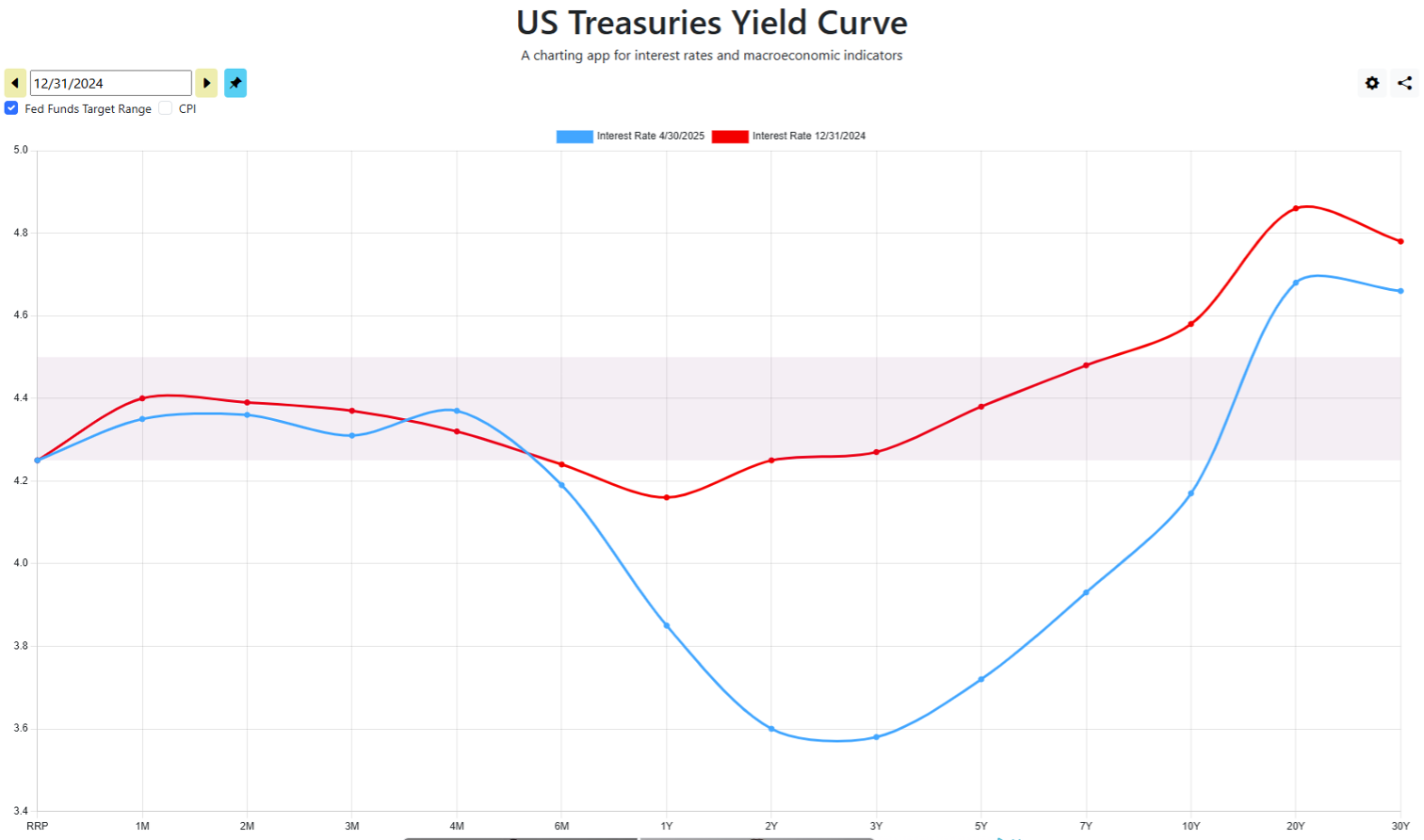
The chart below shows the shift of Treasury yields from the beginning of the year through the end of April. While short-term rates and long bonds have seen little change, the middle of the curve (2 to 10 years) has experienced significant movement. This pattern often indicates investor expectations for rate cuts sooner rather than later, though the FOMC has clearly signaled it wants more data before changing course.
Perhaps the most consequential development has been the escalation of U.S.-China trade tensions. President Trump's announcement of a 90-day pause on reciprocal tariffs (excluding China) briefly sent markets soaring with a 9.52% single-day surge in the S&P 500. This optimism faded quickly when China retaliated with 125% tariffs on U.S. imports, prompting the U.S. to counter with 145% tariffs on Chinese goods. Early May brought another pause in escalations, but the rapid back-and-forth has reignited market instability and uncertainty around economic impacts.
Some economists have begun discussing the possibility of "stagflation" — that rare and troublesome combination of high inflation, slow growth, and rising unemployment. This term has been frequently referenced recently, and we have mentioned it in previous newsletters. Stagflation occurs when high inflation combines with a recession involving high unemployment. What makes this occurrence rarer than other economic forces is that the factors that typically cause unemployment and recession are generally deflationary, not inflationary.
It is worth noting that true stagflation has only occurred once in modern economic history, during the 1970s. Regardless of the economic hardship periods seen in the U.S. economy since the 1800s, we are not currently seeing all the markers of stagflation, but the economic conditions warrant careful monitoring.
Impact on Real Estate Markets
These economic crosscurrents are creating specific challenges in real estate.
First, tariffs are driving construction costs higher — up 10-20% year-over-year according to industry estimates. This makes new developments increasingly difficult to justify financially.
Second, the uncertain rate environment has slowed transaction activity as buyers and sellers struggle to agree on appropriate cap rates and valuations.
Third, we are seeing a pronounced "flight to quality" across all investment categories, including real estate. Investors are gravitating toward assets with strong fundamentals, reliable income, and lower volatility.
These conditions affect different property types in different ways. Retail properties with stable, necessity-based tenants are showing resilience, while more discretionary retail struggles during economic uncertainty as consumer spending declines. Multi-family properties continue to benefit from the housing shortage, though Class C and D properties may face increased collection challenges and higher vacancy rates during downturns as they typically charge market rents.
Fix & flip models also tend to face headwinds in recessionary environments as home prices drop. Even a modest 5% decline in after-repair value can eliminate the entire profit margin on these projects. Similarly, high-end short-term vacation rentals often experience increased vacancies during economic contractions as families opt for more budget-friendly alternatives.
Particular concerns around tariffs and real estate include:
Higher construction costs impacting development feasibility.
Delays in renovation and development projects.
Reduced ROI for value-add real estate investors.
Softening demand in certain sectors, particularly industrial and retail.
One potential silver lining: the push to re-industrialize the US could benefit many secondary markets that offer lower-cost options for manufacturing and logistics operations.
Throughout various economic cycles, real estate generally performs well, but with important distinctions between property types and financing structures. Regardless of property class, investments financed with short-term debt and thin cash flows face greater challenges. Properties with longer-term, fixed-rate financing and strong cash flows tend to weather downturns better, as they provide owners and investors with the ability to ride out difficult market conditions.
Our Approach with the Kirkland Income Fund
At KCG, we have built our strategy specifically to navigate uncertain environments like today's.
Our focus on micro-balance commercial real estate bridge loans provides three advantages that are particularly valuable now:
1. Conservative Underwriting as Protection
Our average loan-to-value ratio remains below 60% (specifically 59.10%), providing a substantial equity cushion against market fluctuations. We don't need to predict the exact timing or magnitude of potential market corrections because our conservative approach builds in protection. When we underwrite a property, we are looking at today's "as-is" value, not speculative future valuations.
2. Short Duration Limits Exposure
With a weighted average maturity of just 5.86 months, our portfolio constantly refreshes, allowing us to adjust terms as market conditions evolve. Unlike long-term commercial mortgages that might be underwater for years during a downturn, our short duration means we are never far from having capital returned to deploy at potentially better terms.
3. Income-Focused Returns
Our returns come primarily from current income rather than appreciation, making them less vulnerable to market volatility. In April, we delivered a net monthly yield of 0.76%, continuing our track record of consistent, attractive returns. Since the fund's inception, we have consistently achieved positive monthly returns without any instances of negative performance. Over the trailing twelve months, this translates to a compounded net return of 9.95%.
Perhaps most importantly, we maintain discipline. In the face of uncertainty, it is tempting to chase yield or relax standards. We do neither. We have turned down numerous loans in recent months that didn't meet our rigorous criteria, even when discovered late in the underwriting process. While this sometimes creates a short-term drag on returns, it protects our investors' capital over the long run.
Looking Forward
No one can predict with certainty how trade tensions, inflation concerns, or rate policies will resolve in the coming months. What we can control is how we respond to whatever environment emerges.
If conditions deteriorate, we expect to see more attractive lending opportunities as traditional capital sources pull back. If markets stabilize or improve, our short duration allows us to quickly participate in that upside.
Either way, our primary focus remains unchanged: preserve principal first, generate attractive income second, and maintain the operational excellence that allows us to identify opportunities others miss.
When markets get noisy, staying true to a disciplined, proven process becomes more valuable than ever. We remain committed to this approach as we navigate these markets on behalf of our investors.
Education: Manager Selection in Alternative Investments
When evaluating any investment manager, particularly in alternative assets, the quality of the management team often makes the difference between exceptional and mediocre returns.
The chart below illustrates an important reality: while private investments have historically outperformed their public counterparts, the dispersion of returns is dramatically wider. The difference between top and bottom quartile managers can be 1,500+ basis points annually – far more significant than in traditional investments.
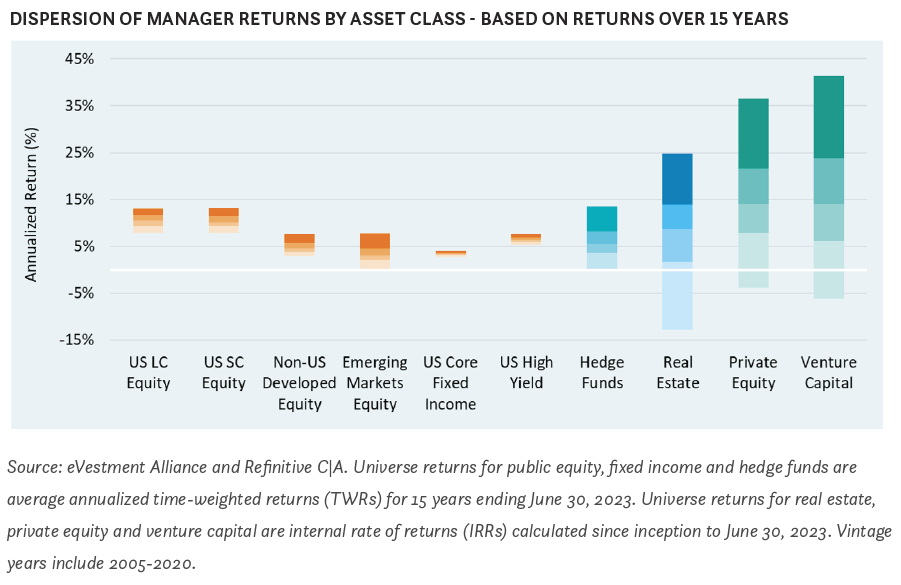
This dispersion makes thorough due diligence essential. Below is a comprehensive, though not exhaustive, list of key elements to consider when evaluating investment managers:
Track Record: Consistent historical success across different market cycles indicates a manager's skill and resilience. Look for performance through both favorable and challenging market environments.
Investment Philosophy & Strategy: A clear, disciplined framework for sourcing deals, conducting analysis, and managing investments. The strategy should be well-defined, repeatable, and have a demonstrable edge in the market.
Team & Culture: A cohesive, skilled team with low turnover fosters better decision-making and long-term success. Evaluate the depth of experience, clear roles, and succession planning.
Network & Deal Flow: Access to difficult-to-reach markets via established networks can consistently generate proprietary investment opportunities that yield enhanced returns. Superior sourcing is a critical competitive advantage.
Operational Capability leading to Value Creation: Managers who have dynamic processes and procedures to improve portfolio performance often outperform. This includes post-investment oversight and active management.
Alignment of Interests: Transparent fee structures, personal investment by professionals, and investor-friendly terms ensure managers' incentives align with limited partners. Managers should have significant "skin in the game."
Risk Management Expertise: Top fund managers excel at identifying, assessing, and mitigating risks while maintaining strong returns. Look for systematic approaches to risk management.
Adaptability to Market Conditions: The best managers can adjust strategy based on macroeconomic trends, regulatory changes, and investor sentiment without abandoning core principles.
Deep Industry Knowledge: Understanding investment-specific dynamics allows managers to make informed decisions and capitalize on emerging opportunities. Sector specialization often creates an information advantage.
Strong Decision-Making Under Pressure: The ability to make calculated decisions in volatile markets is crucial. Manager experience in difficult markets provides insight into how they will respond during future challenges.
Long-Term Vision & Patience: Superior managers avoid short-term speculation and chasing the latest "Hot Dot," instead focusing on sustainable and defensible strategies with proven long-term value.
Efficient Cost Management: The management organization should be structured to keep fund expenses low while maximizing returns to investors.
Continuous Learning & Innovation: Staying ahead of market trends, adopting new technologies, and refining investment strategies enhances performance and creates competitive advantages.
A rigorous due diligence process that monitors all these areas, combined with qualitative and quantitative evaluation factors, is essential for identifying managers with the edge to outperform over time.
In our experience, the best managers also combine deep operational knowledge of their specific niche with the discipline to say "no" far more often than they say "yes." They focus not only on outperforming in bull markets but also on protecting capital when others are struggling.
At KCG, we strive to embody these principles, bringing specialized experience in the micro-balance commercial real estate lending space while maintaining the conservative underwriting discipline that has served our investors well through varying market conditions.
