March 2025 Newsletter
Introduction
Welcome to this month's newsletter! We discuss our latest insights on the private debt market, updates on our fund's performance, and key economic trends that have impacted all investors. Discover how private debt continues to offer stability and high returns, even in these unpredictable times. We will also cover recent tariff impacts, real estate market challenges, and the evolving risks in private debt investments.
Private Debt Market Overview
Private debt has once again proven its value as an exceptional source of excess returns within fixed income. Its ability to maintain low correlations with traditional asset classes, coupled with low volatility, positions it as a cornerstone of stability, especially during these unpredictable times.
The private debt market continues to grow, offering unique opportunities for managers operating in inefficient spaces. Those with the expertise to mitigate risk and the networks to uncover opportunistic investments are well-placed to excel, even amid the uncertainty posed by inflation, tariffs, potential recessions, and supply chain disruptions.
Given the lack of clear valuations in both public and private markets, there is currently a “flight to quality”. Investors are showing an increased preference for stable, income-producing investments supported by tangible collateral. This shift highlights the enduring appeal of private debt as a defensive and high-yielding component of diversified portfolios. However, caution is still advised as volatility in private markets may lag behind the movements in public markets or sectors with higher capital flows.
Kirkland Income Fund Highlights and Updates
Our portfolio continues to demonstrate resilience and progress. We are pleased to see the fund’s return gradually rising to levels we know can be generated from our portfolio of loans. The pipeline continues to regain momentum following the slowdown experienced towards the end of 2024 and the beginning of 2025. We have also seen continued positive movement in non-performing loans:
Hampstead Loan: Final lease agreements are being negotiated, with a purchase option for the lessee. This outcome exemplifies our focus on structured solutions that maximize investor returns.
Pontiac Medical Building Loan: After overcoming complex challenges, we are finalizing a sale agreement with a medical group. Investors will recover 100% of their principal, accrued interest, and late fees—a testament to our commitment to delivering results.
Pittsburg PA Loan: This month the loan was refinanced and 100% paid off with the complete recapture of interest owed.
Loan Performance: No new non-performing loans have emerged, ensuring growing interest collections and value to investors. The portfolio also had three loans successfully exit via long-term refinancing. While deployment has slowed amid elevated uncertainty, our team is actively marketing to our network of loan brokers to source quality loans that align with our rigorous standards.
Economic and Market Updates
Labor Market Trends
U.S. unemployment has surged to 4.2%, marking its highest level in three years. The recent March layoffs serve as a clear indicator of the persistent economic challenges we are facing.
Rates and Inflation
In March, the Consumer Price Index (CPI) decreased slightly to 2.4% from February's 2.8%, indicating that short-term inflation is nearing the Federal Reserve's target. Core inflation, which excludes food and energy, remains at 2.8% for the trailing 12 months, a decrease from February's 3.1%. Despite this, inflation persists, and the looming threat of tariffs could drive the numbers higher, causing concern for many. The likelihood of a rate cut at the upcoming May FOMC meeting has risen, as the Federal Reserve may need to address these unexpected economic pressures.
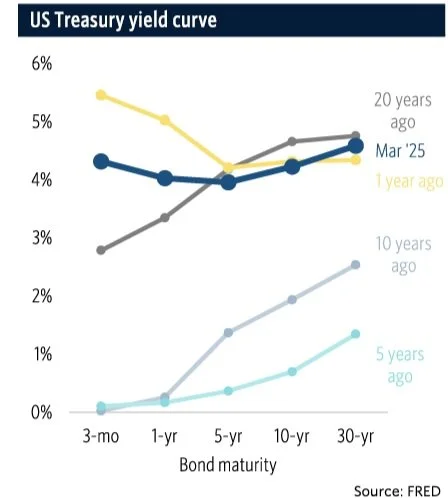
The chart below provides a good overview of how the yield curve has moved over the last 20 years. The curve is no longer inverted but is materially higher.
Market Movements
Tariff announcements have led to increased uncertainty, causing a sell-off in equities and a shift towards higher-grade debt and gold, with the latter experiencing a notable surge of 9.5% in March.
Tariffs
New tariffs implemented on April 5 include a baseline 10% rate on all imports, with higher rates on goods from China (initially 34% but has been raised to 125% in April), the EU (20%), and Vietnam (46%). These measures are projected to:
Add 1–1.5 percentage points to U.S. inflation and shave a similar amount off GDP growth.
Push the U.S. economy closer to recession, as global growth forecasts are downgraded by 0.5 points.
Disrupt supply chains and increase input costs, with significant implications for real estate and other sectors.
This is a very dynamic area with news changing each week. The Administration has announced it is in negotiations with 130 nations regarding the tariffs, but regardless of ending tariff rates, these pending tariffs have fueled uncertainty and opaqueness of the ending outcome. Given the current market conditions, we maintain a conservative approach towards our valuations, the loan-to-value (LTV) ratios we are comfortable underwriting, and the borrowers we choose to engage in business.
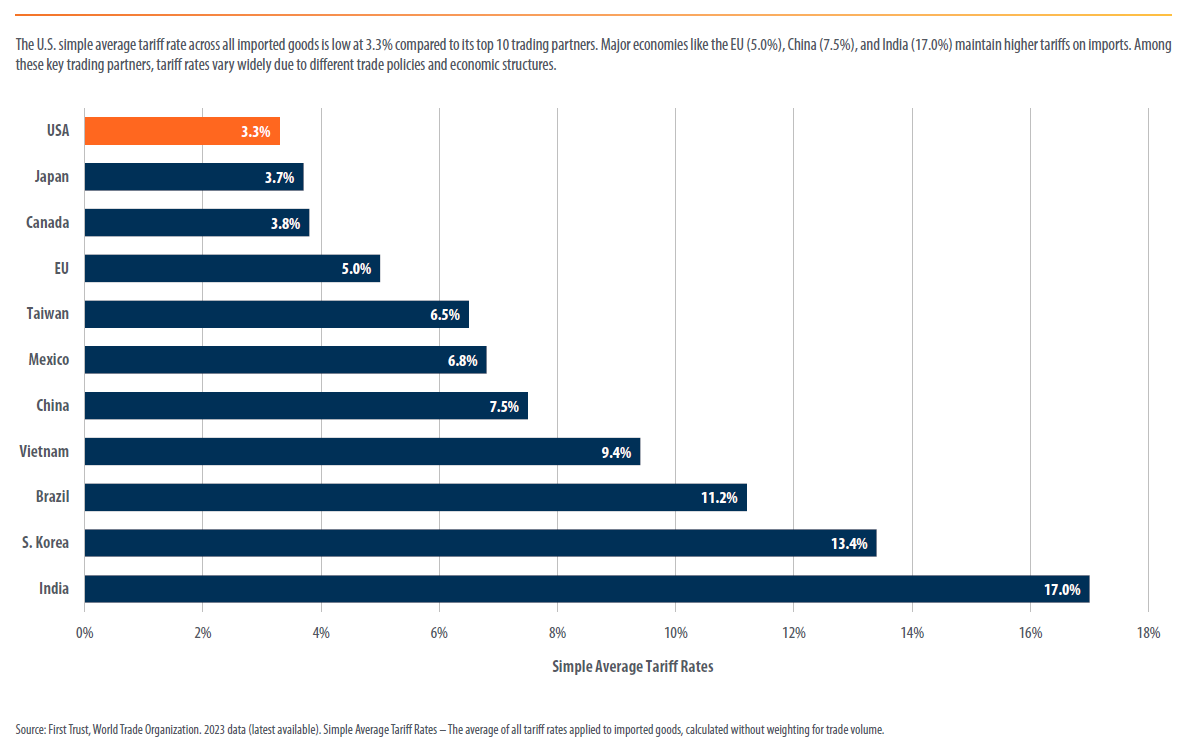
Regardless of one's political stance, there were intriguing observations regarding our current global tariff positions. As depicted in the chart provided by First Trust, the United States significantly maintains lower tariff rates compared to our key trading allies.
Real Estate Market Impacts
Inflation and Development Costs: Consumer inflation expectations have risen, putting continued pressure on real estate development. Rising material and labor costs present ongoing challenges for new projects. Our borrowers primarily invest in established properties, and the constraints on new developments are expected to further enhance the value and stability of their real estate investments.
Housing Affordability Crisis: Inventory continues to remain limited as current homeowners, who secured low interest rates between 2020 and 2021, are reluctant to put their properties on the market. Addressing the future housing demand necessitates implementing scalable solutions instead of focusing on isolated, small-scale projects. This ongoing trend is expected to create further opportunities for our borrowers. Valuations, supporting equity, and borrower quality based on both assets and experience are key risks we are hyper-focused on in these current markets.
Risks and Considerations in Private Debt
While private debt offers compelling benefits as many of you have seen through your own investments, it is crucial to be mindful of evolving risks:
Over-leverage: Complex structures and excessive leverage may hinder refinancing or loan exits. We are only working with borrowers that can operate on lower LTVs.
Economic Slowdowns: Reduced liquidity and activity can limit loan exits during downturns. Part of our underwriting process is to ensure that the existing income of the building, the borrower’s available cash, and sources of outside income can service the debt if the duration increases.
Market Crowding: Larger managers dominate fundraising, which reduces opportunities for niche managers to raise capital to capture high-performing investment opportunities. As an investor, you should look to diversify your exposure to private debt as well, given its many forms. If investors crowd in with all the big-name funds, they will capture a private debt market return. However, if a market shock or “gap event” occurs, it could leave investors stuck with an investment that turned out to be more correlated than initially believed. Historically, the Kirkland Income Fund has demonstrated a negative correlation even with other types of private debt.
Erosion of Terms: Competitive pressures may lead to weaker covenants and documentation standards. Make sure that the private debt investment you choose is not relaxing terms or completely disregarding them in order to get more loans completed.
Inconsistent Valuations: In a dynamic macro environment, the importance of robust and transparent valuation practices becomes paramount. We are committed to transparency and consistently maintain low LTV ratios for our portfolio based on "as-is" valuations.
Market complexity: There is not just one type of private debt. There are multiple forms of private debt spanning real estate, corporate, venture, consumer and many sub classes under each of these broad categories. As an investor, it is crucial to have a thorough grasp of the risks associated with the specific type of private debt in which you are investing.
Is Private Debt Really Outperforming?
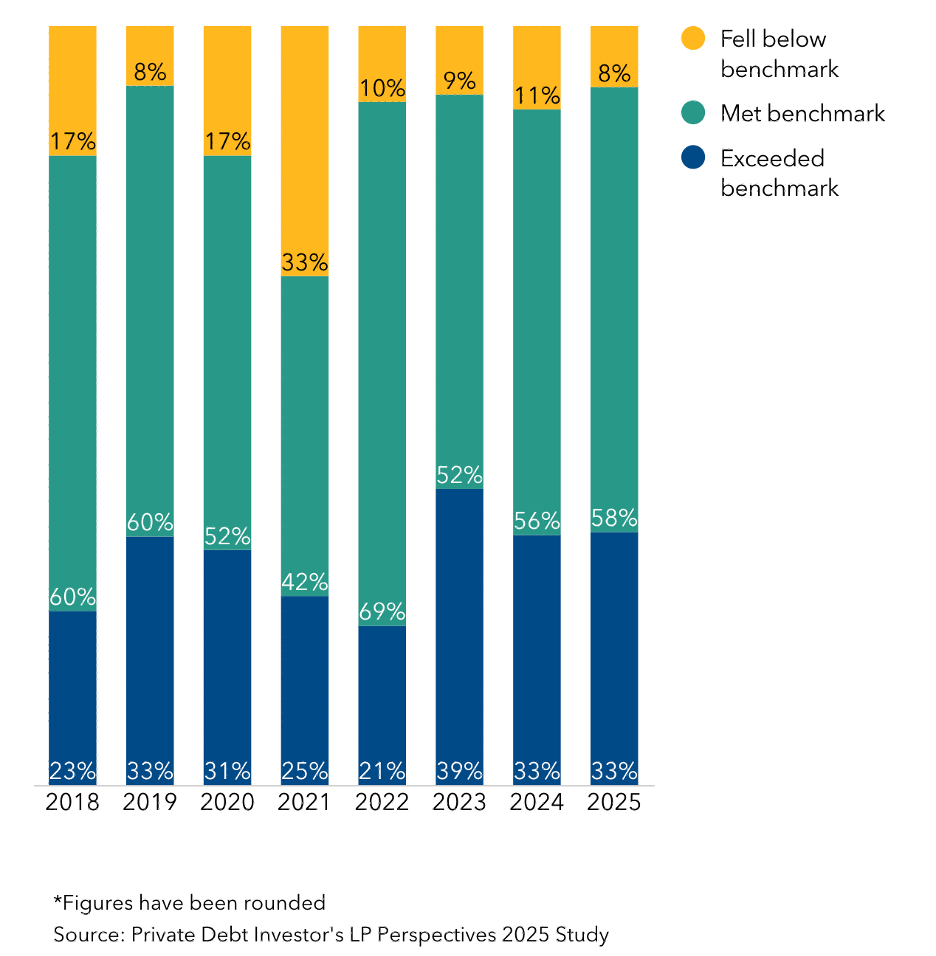
According to the 2025 Private Debt Investor LP Perspectives study, fewer than 40% of private debt funds outperformed their benchmarks. Amidst crowding and competition, larger fund performance is under pressure. Smaller funds targeting niche opportunities often demonstrate better performance. The crucial point to emphasize here is the importance of conducting thorough due diligence and selecting competent managers to help ensure the generation of excess returns and the diversification of an investment portfolio.
How has private debt performed against their benchmarks?*
SEC Regulatory Changes: Simplifying Access to Private Funds
On March 12, 2025, the SEC simplified Rule 506(c) verification processes for private fund sponsors. This change allows issuers to set minimum investment thresholds of $200,000 for individuals and $1 million for legal entities, along with streamlined self-certification. These updates are expected to enhance fundraising efficiency and open doors to broader investment opportunities for investors. However, for many investors, an initial investment of $200,000 might create concentration issues, which is a larger concern than obtaining proof of accredited verification from a third-party source. We believe this change will not have a material impact on most accredited investors.
Closing Thoughts
As we face the weekly shifting news and resulting market volatility, our dedication to providing value through rigorous management and strategic vision remains resolute. In these uncertain times, private debt stands out as a valuable instrument for diversifying portfolios and generating strong returns from fixed income allocations.
