
February 2025 Newsletter
Markets Update
In the current market environment, uncertainty is prevalent, causing many investors to gravitate towards the security of fixed income assets. Specifically, high-grade fixed income options are preferred, as demonstrated by the strong monthly performance of Investment Grade Corporate Bonds and Government Bonds.
Meanwhile, equity markets displayed some vulnerability, which is understandable given the prevailing circumstances:
Concerns regarding AI and questions from investors about its real potential future impact.
Continued uncertainty surrounding the current administration’s global policies.
Continued sticky inflation.
However, the broad real estate markets experienced a rally in February, supported by stronger-than-expected earnings from several REITs. The Federal Reserve's announcement to halt interest rate changes has led to increased investor confidence, at least in the short term, resulting in higher capital allocation to REIT investments.
Inflation and Rates
February's inflation rose by 0.2%, driven mainly by higher shelter costs, while energy prices fell across all categories. The 12-month inflation rate decreased to 2.8% from last month's 3.0%, and it is lower than February 2024's 3.2%. The chart below shows the CPI-All items’ rates. Is 2% the optimal target based on historical data?
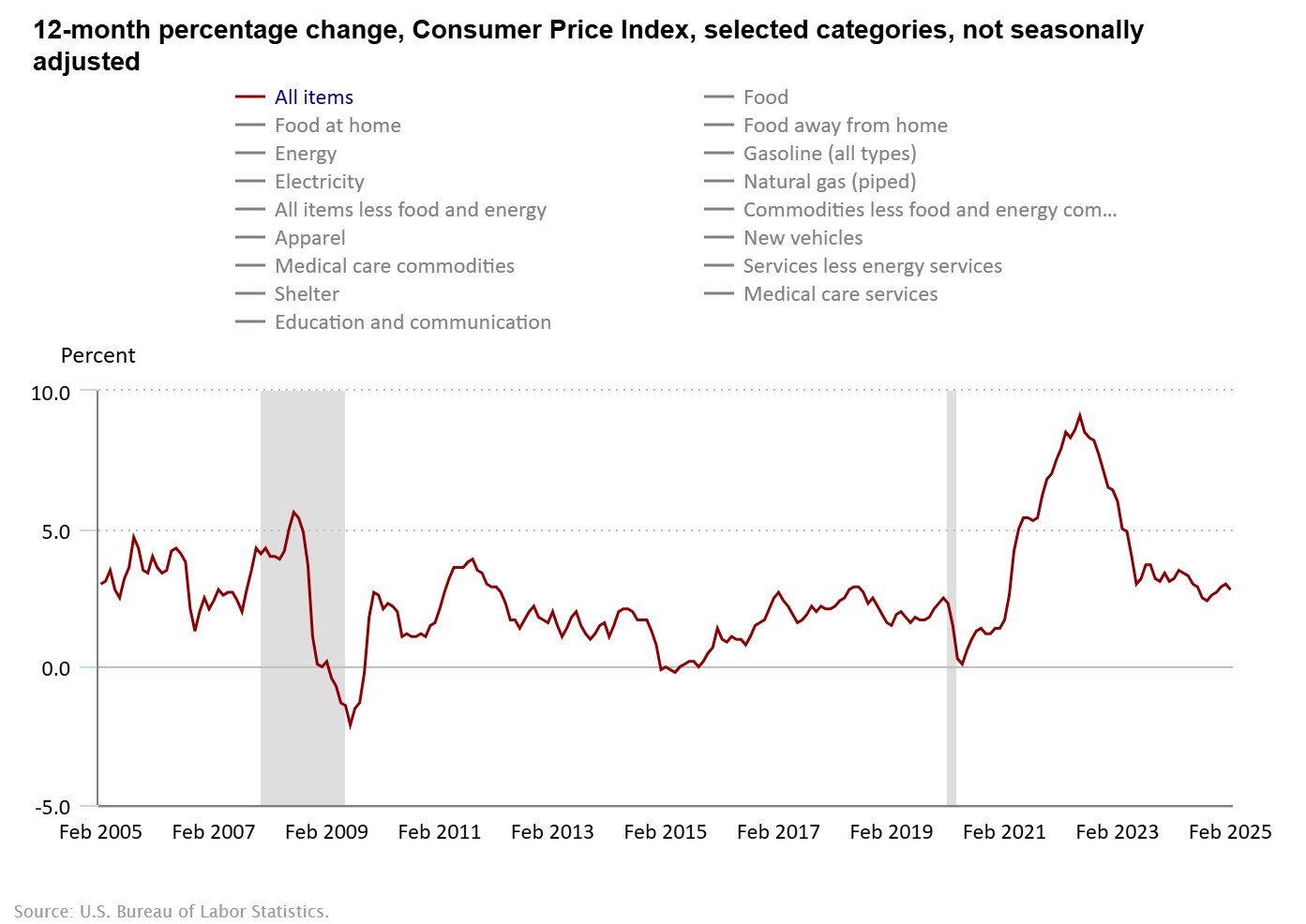
The Fed adopted a wait and see approach at the last Federal Open Market Committee (FOMC) meeting. With these inflation numbers, we imagine they will continue to hold. The next FOMC meeting is on the 19th of March.
Loan Pipeline
Our loan pipeline continues to show robust activity. The two loans mentioned in last month’s newsletter have been successfully funded, with a combined total exceeding $2 million. Additionally, loans currently in Term Sheet Underwriting or Due Diligence have reached nearly $8 million, marking a significant increase from the previous month. This uptick reflects growing confidence among borrowers, even with the current volatility from the current administration’s changes.
Executive Actions
Changing regulations
Department of Government Efficiency (DOGE) is in place to review and identify waste, fraud, and abuse across the government. The current administration has clearly indicated its intention to exert control over several government entities that have traditionally operated independently. The biggest and latest target is the SEC. At this time, it is uncertain how regulatory changes under the current administration could impact enforcement priorities and investor protection principles.
DOGE's current actions at the SEC include:
Investigating the SEC’s operations to identify inefficiencies and potential misconduct.
Examining the workforce composition to consider potential layoffs, particularly among probationary staff.
Reassessing enforcement and regulatory guidelines, including the best interest rule and anti-money laundering proposals.
Potential implications:
Reduced Workforce: Layoffs at the SEC might cause a talent drain, making it difficult to effectively oversee and regulate financial markets. This could cause delayed response times, diminished capacity to detect and address fraud early, ultimately harming investor confidence.
Shift in Enforcement Priorities: A pivot from technical violations to substantial harm violations may result in a more lenient approach towards minor infractions. While this could allow firms greater operational freedom, it may also reduce the deterrent effect that stringent enforcement has on potential offenders. History has also shown us it is difficult to detect a violation that could cause substantial harm.
Changes in Securities Regulations: Adjustments to key investor protection rules, like the best interest rule (SEC Regulation Best Interest (Reg BI) | FINRA.org), could impact how financial advisers serve their clients. Investors might face a landscape where protections are either diminished or enforced differently, necessitating greater diligence on the investors’ part. While we do not see major swings in existing rules, and we think investors should always take ownership of due diligence.
Investors must stay informed about these developments and adapt their strategies accordingly to mitigate potential risks and capitalize on new opportunities presented by the evolving regulatory environment.
Tariffs
This is the biggest macro factor that everyone is watching unfold. The Trump administration has stated their terms with regards to tariffs on Canada, Mexico, and China. Of course there have already been concessions on certain classes of imports. Now comes the question of how many more changes will unfold over the coming months.
Why are tariffs important to us in real estate? Tariffs will have an impact on many aspects of the market, at least in the short term until the supply chain readjusts.
Higher Costs and Disruptions: Increased cost of supplies means increased construction costs and supply chain disruptions. Most developments were not already penciling and had halted. Increased cost or delays will only prolong this issue. This is not the first time we have seen supply issues. In 2021, building supplies were not just more expensive; they were not even available. This is definitely going to make a difference, but it's uncertain whether these price hikes will cause the significant impact that concerns many, given our past experiences where we've encountered similar situations and managed to find a way. Regardless, lumber prices have gone up 11% just on the mention of tariffs.
Reduced Housing Affordability and Slower Market Activity: Simply put, higher costs mean higher prices and reduced affordability of new construction. There will be less construction and more uncertainty making home buyers and investors hesitant. If you find yourself in a housing market that is already experiencing a shortage, the current properties may show price resilience as well.
Inflation: Increased costs have created concerns about our economic future and inflation. This is a concern but interesting enough the 30-year mortgage rates have dropped. Rates started the year at 6.91%, reached a high of 7.04% on January 16th and as of the end of February rates are 6.76%. We will see if that will hold out given the rhetoric around inflation fears and if The Fed holds fast on rates.
We are observing policy changes and market trends, while maintaining conservative lending practices to ensure loan stability.
Small Cap CRE Update
Boxwood Means has finalized their 2024 Small Cap CRE assessments. The analysis incorporates data from CoStar, focusing on commercial properties under 50,000 square feet and multifamily units ranging from 5 to 50 units.
The Small Cap CRE sector saw an increase in sales for 2024. Sales levels are still a little below 2019 but above 2020 pandemic levels and the 2023 fall out from rising interest rates.
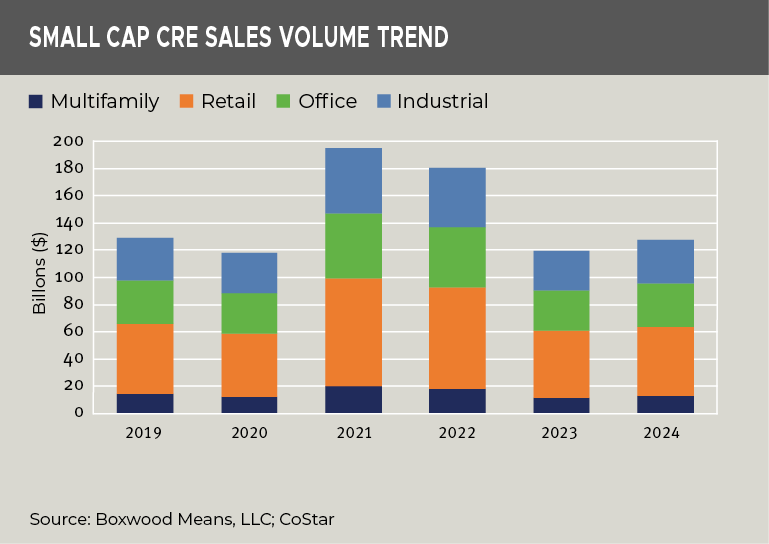
Multifamily saw a strong surge in activity as housing demand continued to surge and single-family homes affordability suffered from low inventory, increased mortgage rates, and rising home prices.
Industrial properties continued to be the only sector with net growth since 2019. Demand being driven by the spike in activity for small warehouse to fulfill last mile logistics.
Data shows Office seeing some stability led by suburban office that caters to small tenants with short term leases.
Retail is still strong. Niche retail strips, community centers, and open-air centers are flourishing as they provide easy access to everyday items. There is still a scarcity of available space for lease, with minimal new supply entering the market.
We are pleased to see consistency and stability in the small cap CRE place and continue to be excited about the opportunities in the micro-balance bridge loan market. This data supports what we see from our networks where real estate investors are finding opportunities, particularly in retail properties.
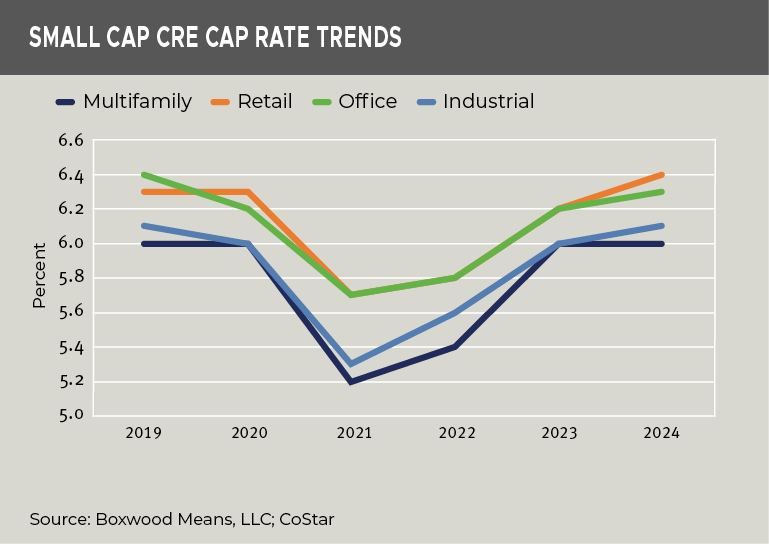
For Small Cap CRE, Cap Rates are coming up slightly and back to 2019 levels across all major sectors. What do recovering Cap Rates imply? It means with the move to higher rates for longer we are starting to see valuations across property types flatten or drop slightly. We estimate that as inflation remains stubborn and The Fed maintains its stance on interest rates, and assuming we avoid a recession, we can expect capitalization rates to level off at higher points. This could create additional opportunities for real estate investments in the Small Cap CRE sector.
Source: KKR GBR Analysis as of December 31, 2023.
Tis the Season for Taxes
Every year at this time the emails start flying in. When are K-1s going to be completed? What is a K-1? Why don’t you send out 1099 at the end of January? We thought it would be useful this year to have a short write-up to answer some of these questions. There is a more detailed article you can access here if you want more information.
Form 1099 is provided by businesses, financial institutions, and government agencies to independent contractors, freelancers, investors, and others who receive non-employment income. These forms are generally issued by January 31st, with some exceptions. Schedule K-1, on the other hand, is issued to partners, shareholders, beneficiaries, and pass-through entities, typically by the third month after the end of the entity's fiscal year.
Choosing between a K-1 or a 1099 depends on the specific circumstances. K-1 forms are used for pass-through entities and can provide tax advantages by avoiding double taxation, though they are more complex and require meticulous tracking of each partner's or shareholder's basis in the entity. Conversely, 1099 forms are simpler and cover a broader range of non-employment income, but they lack the pass-through tax benefits. Investors should consider their unique situations and consult with tax professionals to obtain guidance on items such as the need to file an extension if you receive K-1s.
