January 2025 Newsletter
Markets Update
Public equity markets just had back-to-back 20%+ years, and those returns were driven by a concentrated set of names all in or heavily related to the technology sector. Equity markets are at high valuations and clearly in a very sensitive position. The market’s reaction to the release of China’s DeepSeek had an expected impact on the technology sector. On that announcement Nvidia alone fell 17% losing roughly $589 billion in market value. That is the largest single day loss of any company in history. Most AI and technology indices and ETFs fell 13% or more on that day. Total loss of market cap was estimated to be roughly $1 trillion globally.
Recent findings concerning DeepSeek revealed that, despite employing some innovative methods, many of its claims were fraudulent and it posed less of a threat than initially anticipated. As a result, U.S. AI-related stocks have demonstrated resilience and have recovered. Given the high stakes in the AI competition between the United States and China, it is likely that we will see more misleading or partially truthful claims in the future.
With persistent inflation and stable rates, equity valuations and fixed income principal values will continue to face pressure. Despite these challenges and some headwinds, markets overall achieved positive returns across many asset classes.
New Administration
I should title this newsletter, “The Year of increased Negative Kurtosis”. For you non-stats folks, Kurtosis is the measure of the thickness of the tails of a distribution. In other words, just as we thought it might get a little boring the new administration has taken multiple stances that have increased the probability of low probability events.
Let’s walk through some of them and some of the pros and cons.
Tax cuts and deregulation are regarded as potential positive catalysts. Tax cuts enable the reinvestment of more capital. Deregulation is anticipated to stimulate more activity in mergers and acquisitions, development, and financing.
Tariffs and strict immigration are both viewed as events that could adversely affect markets. 25% tariffs on Mexico and Canada would likely raise the cost of numerous goods. Additionally, mass deportations could result in labor shortages, particularly affecting real estate developers, as studies indicate that 15% to 23% of construction workers are illegal immigrants. The primary concern with these actions from the new administration is their potential to drive inflation. If inflation remains above the Federal Reserve's target, we may see no reductions in interest rates and possibly an increase. For those who doubt the possibility of a rate hike, consider my initial comment; this could be a period where events previously deemed unlikely become more probable than anticipated.
Federal Deficit
Currently, the deficit stands at $1.83 trillion. The new administration has implemented a policy utilizing DOGE to identify and eliminate fraudulent or wasteful spending and is negotiating a new budget that emphasizes fiscal responsibility. However, achieving meaningful deficit reduction, especially in conjunction with the proposed tax cuts, will be an enormous challenge. This area continues to be of significant concern.
Other Administration Events
Scott Bessent is the new head of the US Department of the Treasury. There is concern about whether the current administration will influence the Federal Reserve's decisions through Bessent. Although this could happen in the future, recent statements from Federal Reserve Chairman Powell indicate he does not intend to lower rates despite the President advocating for rate cuts during his address in Davos. January inflation numbers were higher than expected, which supports Powell's decision to maintain current rates.
Inflation and Rates
Inflation fears are still top of mind and mortgage rates will be higher for longer.
As expected, the Fed did not change interest rates. Trump of course called out Powell and the Fed for “failing to stop the problem they created with inflation.” We don’t know about you but last time we checked the Fed made the biggest increase in rates in the shortest period of time in history to battle inflation. We also have a strong economy and appear to be avoiding a recession. Inflation might not be at the 2% target rate, but it is also the lowest it has been since 2020. We still feel that the full impact of 2022 has yet to play out and halting the ease of rates might let that come to fruition. The chart below shows the history of inflation. While we are in a better position than in recent years, factors like food and shelter still contribute to persistent inflation.
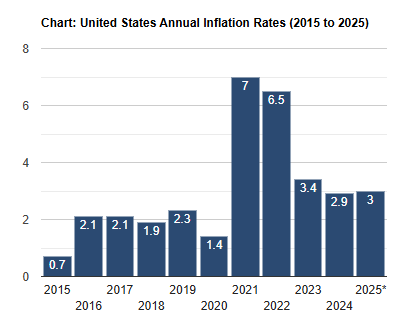
The Consumer Price Index (CPI) for January increased by 0.5%, resulting in a 3% rise over the trailing 12 months. The estimated CPI for the forthcoming 12-month period is projected at 2.9%. Furthermore, the Federal Reserve is signaling that there will be fewer interest rate cuts over the next few years.
The Story of Private Investments is Still Strong
According to KKR, the alternative investment industry was valued at $15 trillion in 2022 and is projected to grow to $24 trillion by 2028. While this represents significant growth, it constitutes less than 2.4% of global financial assets, highlighting substantial potential for further expansion. Several factors are driving this growth, including a considerable funding gap in various investment sectors that traditional financing sources cannot meet. As a result, private capital in various forms has stepped in and will need to continue to do so to provide the necessary financial resources for both niche spaces and larger projects, such as infrastructure. Analysis from KKR indicates that $3.7 trillion is required annually through 2035 globally to sustain anticipated GDP growth. Current government resources are insufficient to cover these expenses.
Both Institutional and retail Investors are becoming more educated and aware of private investment and increasing exposure to capture enhanced returns, unique sources of return, and portfolio diversification as they target higher risk adjusted returns. You can see in the chart below that over the last 10 years private investments have been providing higher average returns than their traditional counterparts.
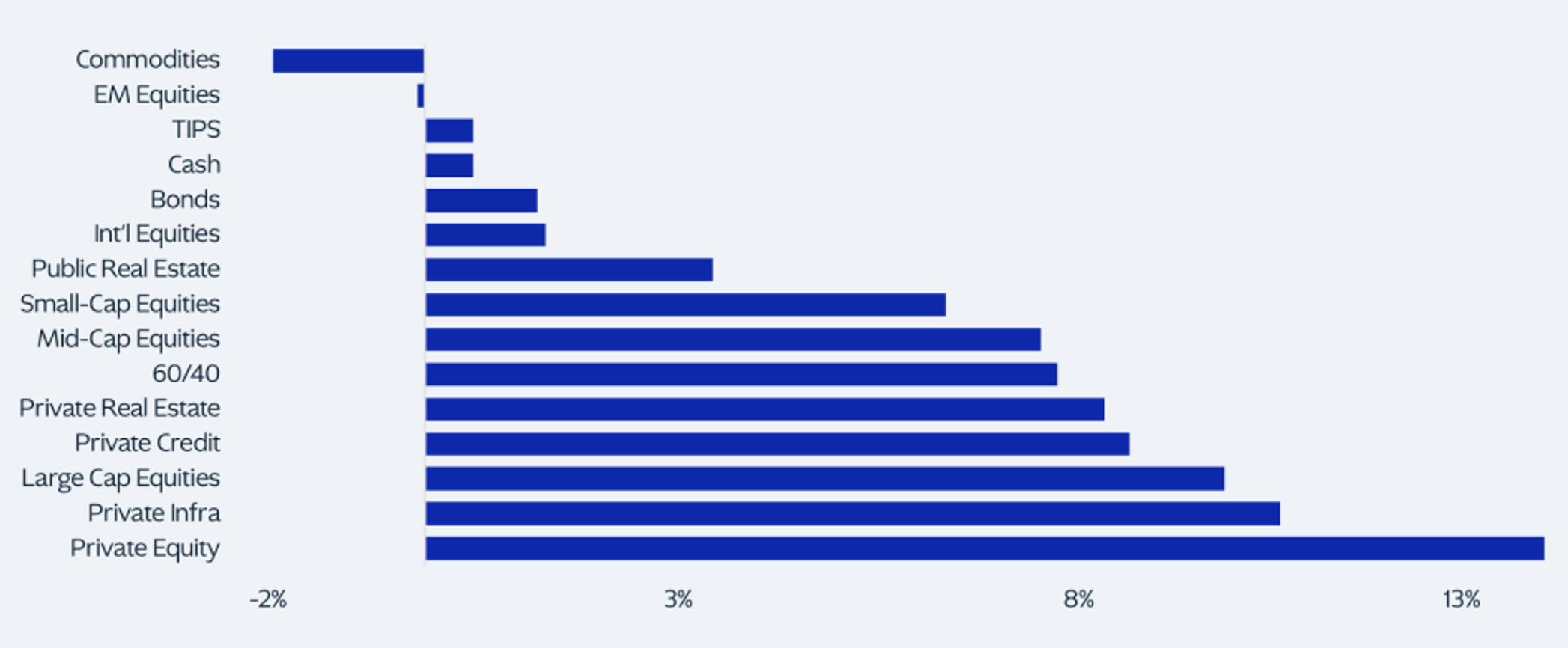
Source: Cambridge Associates, Bloomberg
It is a matter of education and due diligence, but as illustrated in the chart below from KKR, there remains significant potential for individuals to increase allocations. But do not be in a hurry, be patient and size investments appropriately.

Source: KKR GBR Analysis as of December 31, 2023.
Kirkland Income Fund Portfolio
We have received several questions from investors about the rise in retail commercial real estate (CRE) over the past year. We discussed this in our quarterly webinar, but here are some additional metrics.
CoStar recently reported that the national retail vacancy rate for 2024 is at its lowest, at 4.1%, with only 0.4% of inventory currently being developed. According to CoStar, these figures have been consistently decreasing since 2017, indicating a scarcity of supply. The strongest categories in retail are food and beverage, grocery, discount, and experiential retail.
Furthermore, CoStar stated that rents for retail have increased by 4.3% due to high demand and limited supply availability. However, growth is expected to decelerate to 2.2% annually as consumers moderate their spending in response to prolonged higher inflation.
While the ability to secure prime retail locations remains very competitive, retailers should be conservative as there are many cyclical economic factors that are still playing out. Recognizing this, we are maintaining a conservative analysis process for our retail property type related loans.
Pipeline and Loan Deployment
Since the inception of the Kirkland Income Fund (KIF), we have consistently highlighted the challenge of managing the balance between the loans in the pipeline and the cash available for deployment. This teeter-totter effect has been a critical aspect of our operations, requiring careful monitoring and management.
Market Conditions and Loan Submissions
The market conditions and political uncertainty in the last half of 2024 significantly impacted our loan submissions. From September to December 2024, we received 70 new loan submissions, a stark contrast to the 167 submissions during the same period in 2023. Up until November 2024, this level of activity was fairly balanced with the cash available for deployment. However, with a significant increase in incoming new investment funds starting in November, we initiated an outreach campaign to our network of loan brokers. December remained relatively quiet, which is understandable given the holiday season and the lag in inbound loan activity to loan brokers. It takes time for borrowers to make purchase decisions or decide on refinancing based on current market conditions, reach out to a loan broker, and then have the loan broker submit the loan to us.
Outreach Campaign and Loan Activity
We continued our outreach campaign, and January saw an uptick in inquiries from loan brokers. While these inquiries did not necessarily result in immediate loan submissions, they often involved reacquainting brokers with our niche program. Several loans that had quotes issued months ago are now reactivated. Loans now in Term Sheet Underwriting or Due Diligence have reached over $6.6 million in total value.
Examples of loans in our pipeline, both in the last stages of due diligence:
Big Spring, TX: 60% LTV, $1.3M construction takeout loan for a fully renovated multifamily property now in the lease-up phase; borrower has 25 years of real estate experience.
Tybee Island, GA: 68% LTV, $748k loan to take out seller financing on a multifamily property with short-term and long-term leases and fund partial renovations, which will bring the value to near $2M.
We expect this upward trend to continue with renewed confidence in CRE reported by third-party sources and our own conversations with borrowers and loan brokers.
Commitment to Due Diligence
While aware of cash drag on KIF returns, we remain committed to thorough due diligence for every loan. Recently, we denied a loan for a property in Savannah, GA after discovering red flags during our review. The property was bought on a land contract by a couple with a different last name than the primary borrower, who was added to a new entity with the couple for a cash-out refinance. The couple's credit report showed multiple foreclosures since 2008, with the latest in May 2024 on their primary residence. This information wasn't disclosed upfront, as they used a straw borrower to hide their poor credit and foreclosure issues. Despite the property's condition being satisfactory, we are equally focused on borrowers with a high likelihood of timely repayment.
Future Outlook
We expect loans in the pipeline to significantly boost monthly returns in the coming months. Increased confidence in CRE and our continued outreach efforts will benefit the growing portfolio.
New Lending Advisor
Since inception, Brock leveraged his experience to build a strong network of loan brokers and has been the primary point of contact. As KIF has grown so has the number of loans so in the beginning of Q4 last year, we started searching for a qualified candidate to fill the role of Lending Advisor. This role, as we have designed it, is different from most of the lending industry.
Most lenders have Account Executives (AEs) who work with loan brokers or borrowers and earn commissions based on funded loans. This creates a conflict of interest. We chose someone from the loan processing side, known for detail-oriented work and effective collaboration with brokers and borrowers, to be our Lending Advisor. They will receive a base salary, and an annual bonus based on profitability, loan performance, and individual performance, aligning their incentives with investors' interests rather than the volume of loans processed.
For this role, we received over 2,000 applications. The front-end assessment testing narrowed this down to about 25 candidates, of which 5 were selected to start the text chat interview process. Two candidates passed the live interview stage, and following the BRG psychometric assessment, it was determined which candidate was the best fit. Laura accepted our offer, and she will start in mid-March. Even with the addition of the new Lending Advisor, Brock and I will continue to review all loans at multiple points during the loan process and maintain final approval on all loans.
Dive Deeper
If you would like more information about our lending or hiring process, please schedule a time to speak with Brock.
