
October 2024 Newsletter
Kirkland Income Fund Update
October was a slow month for funding loans. As we will discuss below there were uncertainties keeping investors and borrowers on pause. Regardless, the fund moved forward in producing another positive month of returns. A loan in Georgia was paid off and we are seeing more borrowers able to move forward again into long term financing while paying off our loans. October does have many loans in the pipeline working through underwriting. As we hit November, we are excited to fund the loans that make it through our rigorous due diligence.
Markets:
With more headwinds than tailwinds and continued uncertainty on multiple fronts, broad investment markets were off in October.
Headwinds
The U.S. real estate market is experiencing notable shifts. Thirty-year mortgage rates remain high at 6% to 7%, constraining home sales, but the supply of newly built homes is rising. According to data from US News & World report, 86% of homeowners are paying less than 6% on their current mortgage so we are unlikely to see an increase in availability from current owners looking to sell.
The market is still facing challenges in the office space. Defaults continue to unfold, with the most recent one coming from Opal Holdings defaulting on a 40 million dollar office park loan.
In October, US Credit card debt reached a record $1.14 trillion, with delinquency rates continuing to climb. (Source: USA Today)
Several global challenges are poised to affect the US economy. Ongoing conflicts in Ukraine and the Middle East are still creating potential risks to US economic performance.
Uncertainty around the foreign policy of the new administration being inflationary.
Cost of ownership. The total cost of homeownership has risen significantly, with variable costs such as property taxes, HOA fees, maintenance, and insurance premiums becoming more prominent. (Source: US News)
Tailwinds
Although this news is not from October, we have seen an interest rate cut at the November Federal Reserve FOMC meeting by 25 basis points. This development aligns with the expectations of the investment community, although its immediate effects will be negligible.
Unemployment: In October, the unemployment rate remained steady at 4.1%, which was unchanged but lower than anticipated.
Inflation: CPI rose 0.2%, putting the 12-month number at 2.6%. This is in line with expectations and does not hinder the consensus that there could be another 25 bps ease in December. Although good in the short term, with inflation ticking higher and tariffs pending, there are inflation fears for 2025, which could cause a pause in further easing.
US Election Outcome and impact of Trump on bridge lending:
In light of the recent election results and President-elect Donald Trump's upcoming second term, we want to address potential impacts on our fund. While the situation remains fluid, we anticipate several key developments that may affect our investment strategy and market conditions:
Interest Rate Environment
We expect the interest rate landscape to remain higher for longer in the coming years:
Mortgage rates are likely to remain elevated, with projections ranging from 5.5% to 6.5% for 30-year fixed mortgages during Trump's second term.
This trend may extend to bridge loans, potentially increasing our lending rates.
Higher Mortgage rates
Several factors could influence demand for bridge financing:
Higher mortgage rates may discourage owners from selling as they can’t obtain the value they want from a sale, potentially reducing overall real estate transaction volume.
This could also create opportunities for bridge loans as buyers seek alternative financing options. In a high-rate environment, the speed and flexibility of bridge loans become more valuable. Buyers can use bridge financing to quickly close deals, then refinance later when rates potentially decrease or when they've improved the property's value.
Regulatory Outlook
The regulatory environment is expected to shift:
Trump's administration could possibly proceed with the relaxation of financial regulations, which might lead to a scenario where banks find it easier to extend loans.
This might lead to a more competitive landscape for many sectors in private debt. We do not foresee a spike in competition in our micro niche. Although having more participants should boost market liquidity and enhance our borrowers' opportunities to exit our loans.
Our Strategy
In response to these potential changes, our fund is:
Maintaining a diversified portfolio to mitigate risks associated with any impact to a particular property type, or geographical area.
Closely monitoring policy developments to identify new opportunities and manage potential challenges. There are no immediate policies from the new administration that impact private lending, but we stay vigilant to ensure we can capture opportunities and mitigate challenges.
Focusing on high-quality borrowers and properties to ensure the stability of our returns. In short, the best way to navigate uncertain investment waters is to enter into “well-diligenced” loans with solid borrowers who have experience and assets.
While uncertainties remain, we believe our niche investment space, experienced team, adaptive process and thorough underwriting positions us well to navigate the evolving landscape. We remain committed to delivering strong risk-adjusted returns for our investors for many years.
Kirkland Income Fund Investor Question of the Month:
We received a question regarding the note at the bottom of our investment statements, which reads:
“Mortgage loans and notes, especially private or non-performing loans, are hard to value. In addition, periodic income (interest and fees) accrued on such investments may not be realizable ultimately. As a result, client fund’s records may not accurately reflect the valuation and may be materially misstated.”
This is a standard disclaimer statement required by many Fund Administrators including, our third-party administrator, on all their investment statements. Here's what it means:
Alternative assets like private debt are not priced daily: Unlike public stocks, the value of private debt investments isn't updated daily. This means that the value of these investments can vary and may not always reflect the most current market conditions.
Non-performing loans can be correlated with property values: When a loan becomes non-performing (meaning the borrower is not making payments), it can sometimes coincide with a decrease in the property's value due to market conditions or lack of maintenance by the borrowers.
Accrual accounting can recognize interest that isn't collected: Under accrual accounting, interest income can be recorded even if it hasn't been received yet. This means that the financial statements might show interest income that hasn't actually been collected.
To mitigate these issues in our portfolio, we:
Use conservative estimates for property values and keep the amount we lend low compared to the property's worth, so there's a significant safety buffer.
If a borrower stops paying, we aim to have only one to two months of missed interest, which is less than what we expect to recover from selling the property.
If the borrower starts paying again, we make sure to recover both the original loan amount and any missed interest.
We calculate extra charges for late payments but only count them in our returns once we actually receive the money.
We hold the primary claim on the property and have full rights to it, including the ability to pursue the borrower's personal assets if needed.
We take many steps to ensure we can recover principal and accrued and unpaid interest. If by chance that amount is not recovered, we may not need to take a write-off of value as we have the ability to reclaim that value directly from the borrower's personal assets and income.
We are committed to maintaining the highest standards of accuracy and transparency in our valuations, ensuring your investments are well-protected.
What makes a great investor?
I have previously discussed the idea of exceptional managers and investors in my previous newsletters. However, I came across an external perspective that resonated with me, emphasizing the importance of being a “good student”, or as she aptly puts it, an intellectually curious individual at all times. At Kirkland Capital Group, not only the founders but also the employees are encouraged to continuously learn, and we have developed an internal program of continued education for all.
CAIA Chronicles: Authored by Christie Townsend
The question of what makes a good investor has been posed countless times, yet it continues to spark discussion among seasoned professionals and aspiring investors alike. Even investment greats like Howard Marks and Warren Buffet, among others, have weighed in. However, one concept that consistently rises to the forefront of the discussion is the importance of becoming a good student of investing, aka a student of the markets.
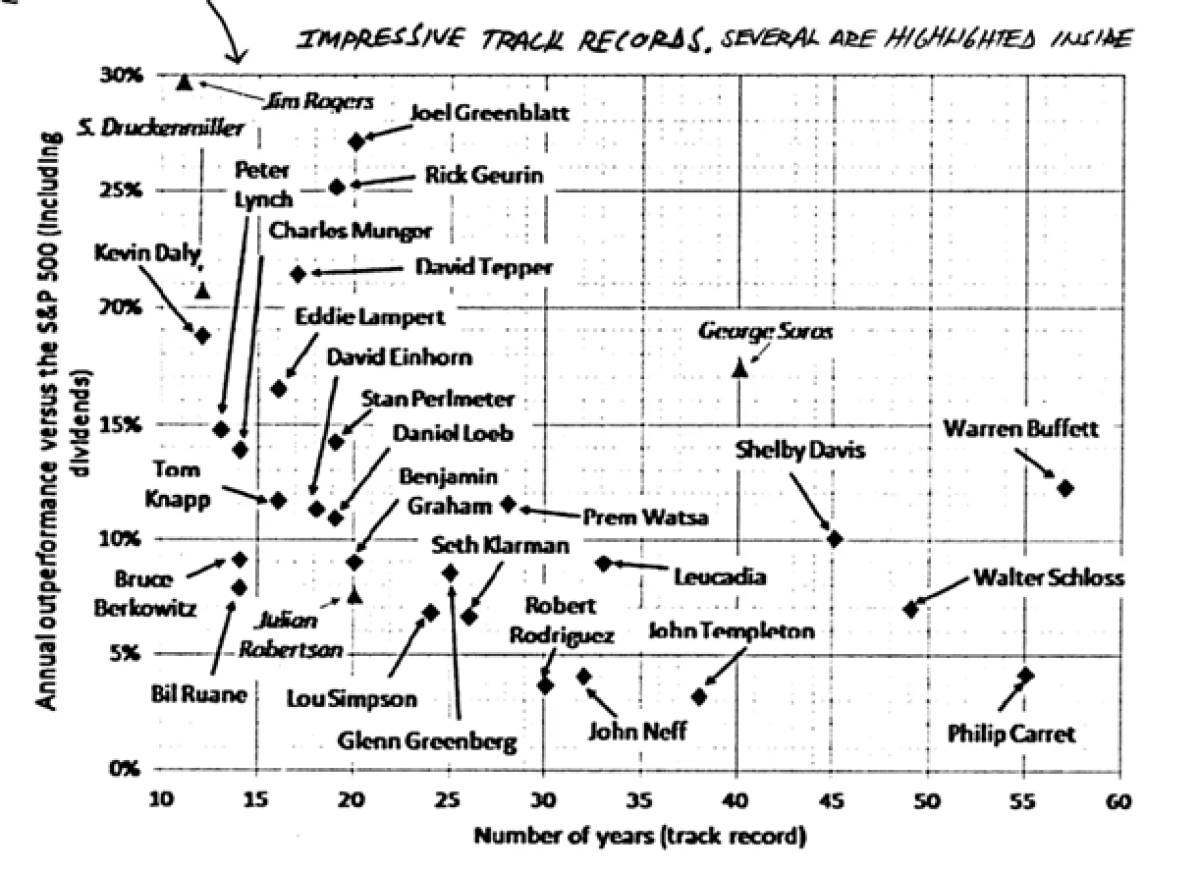
While this insight seems straightforward, it begs the question: What does it truly mean to be a good student?? Is it just getting good grades? While outcomes are important, marks are not the only determinate of “great”, and yet when it comes to evaluating investments in particular, we often judge practitioners based solely on their track record vs. an arbitrary equity benchmark (Figure 1).
Figure 1: Impressive Investment Track Records: Annual Outperformance vs. S&P 500
Source: CLSA.
These comparison exercises are fun and sometimes informative, but too often focus on the outcomes of great (or just lucky!) investors, not on what characteristics are indicative of investor greatness.
In my quest to find a modern solution to this age-old question, I turned to perplexity.ai and asked a simple question: What makes a good student? The results were interesting. As skeptical as I am about AI tools, I must admit, the list I got back was insightful, so I used it to help me create a more robust checklist of what makes a good student of investing.
AI Informed List of Characteristics: “Good Student of Investing”
Education / Continuous Learning Focused
(Due) Diligence
Self-Discipline / Patience
Adaptability / Humility
Confidence / Risk Management
Integrity
This list captures the core competencies like education, integrity, and risk management required on your journey to mastering aspects of investing; however, it also misses the one crucial trait that is required for good students to become great investors: intellectual curiosity.
“If you don’t keep learning, other people will pass you by. Temperament alone won’t do it—you need a lot of curiosity for a long, long time.”
The truth is, intellectual curiosity is a trait that is often taken for granted when we discuss our craft, even as the investors we admire largely attribute their success to it. It is the driving desire to learn about investing, portfolio construction, alternative investments, and other investment opportunities, along with the willingness to ask increasingly deeper questions. Intellectually curious investors take pleasure in understanding the minutiae of how markets work, learning why people behave in certain ways, evaluating the fundamental rationale behind decisions, and regularly challenging their underlying data and assumptions. Intellectual curiosity helps investors learn faster and develop new and creative solutions to recurrent investment puzzles.
Given its importance, there are a number of unique ways to foster and/or strengthen your intellectual curiosity muscle:
Enlist Your Network. Everyone knows the importance of connecting with investors you admire, but it’s equally valuable to engage with interesting and thoughtful leaders in adjacent and/or industries that are meaningful to your portfolio. Additionally, reaching out to those with diverse interests outside of yours can provide fresh perspectives and insights. But perhaps more importantly, find people who you respect but can disagree with you; it will help sharpen your investment ideas and theses. Engage operators to deepen your due diligence processes. Learn from the mistakes of others.
Revisit your beliefs regularly. Review your investment processes and procedures periodically in order to ensure they are adequate and appropriately tied into your program for achieving investment goals. Solicit feedback and dine à la carte from the best practices of others with similar goals.
Expansive Reading/Knowledge Intake. There really is no substitute for high quality educational sources, and while it’s important to read investment specific news, history, and research, reading and listening to podcasts outside of investments will often inform some of your best decisions. As such, a list of interesting research and resources has been included below to pique your curiosity!
“To be a great investor and to be successful in most things, intellectual curiosity helps a lot…always reading, even if it’s not directly relevant to the job today.”
When you have any questions about the newsletter or the Kirkland Income Fund, please do not hesitate to reply or book a call with me.
