November 2024 Newsletter
Kirkland Income Fund Update
During this Holiday Season, the Fund was bustling with activity as usual. One of the largest loans in the portfolio rolled off on the 15th. This loan had a bit of history and fell into default status but thanks to the team's diligence in collaborating with the borrowers, the loan was able to be rescued from default status. Through the combined efforts of the loan broker, borrower, and our KCG team, the property was successfully refinanced and the Fund was paid off. This not only recovered the principal but also secured the outstanding default interest and late fees that had previously gone unpaid. This capital was promptly re-deployed into three fresh loans that were also originated in November. The loans consisted of two light industrial properties and one mixed-use property. The properties are located in Pennsylvania, Arizona, and Michigan, respectively. The dollar-weighted coupon rate of the loans is 15.07%, with an LTV of 58.49% based on an "As-Is" valuation. These loans bring incremental benefits to the portfolio, enhancing both gross coupon and risk exposure (LTV).
As we near the end of the year post-election, there has been a noticeable uptick in investor engagement, a positive trend as we continue to maintain a robust loan pipeline to sustain us through December and into the upcoming year of 2025.
We are making steady progress on NPLs. The sale of the property in Winchester KY will be finalized in December. The Pontiac medical building, closely monitored by KCG, has shown ongoing improvement and there is now a possibility of having a pharmacy as a tenant in the building. Stay tuned for further updates in 2025 regarding the progress and potential opportunities for the fund related to this property.
Comparing KIF
We value investors who present questions and comparisons for us to evaluate. Lately, we have been drawing comparisons to larger funds, and even public instruments like BDCs. A recent research report by the CAIA highlighted the benefits of blending private and public investments to create a diversified portfolio with robust risk-adjusted returns and flexible liquidity parameters. However, this topic will have to be explored at a later date.
Upon examining numerous investment opportunities that have been presented to us for comparison, it becomes crucial to understand the investment structures, levels of leverage employed, types of loans, and the current distressed markets that may offer one-off opportunities that are not repeatable. Many of these funds or public instruments are involved in riskier lending practices or seizing short-term profit potentials that exist today but may not be sustainable in the future. Many investments can exhibit higher volatility based on the type of investment and the use of leverage. Our portfolio has shown an annualized volatility of approximately 0.42% since its inception. Certain investments may also entail heightened operational risks to maintain their current performance levels. These risks are not inherently negative and could potentially align well with your private fixed income portfolio, provided that you have a clear understanding of the risks involved.
The Kirkland Income Fund aims to maintain consistency in our loan portfolio by avoiding ventures into high-risk pools that may backfire due to timing issues or heightened default risks. Additionally, we prioritize minimizing operational and counterparty risks linked to excessive use of leverage to generate returns. We are focusing instead on generating a solid return without compromising on stability.
Be mindful of what you own. Large investment firms that operate BDCs, interval funds, or other hybrid liquid formats containing illiquid investments is a combination that has been tried in the past, failed, and is likely to fail again. Simply packaging illiquid investments into a fund labeled as liquid does not change the nature of the investments.
Losses in CRE: Shifting times
MSCI compiled historical data on commercial real estate that looks at the losses being reported. It's worth noting that this data pertains to large CRE investments and doesn't directly apply to our specific niche in the micro-balance market space. However, it is encouraging to see that significant losses recorded in late 2021, 2022, and 2023 are being resolved without any new losses being reported, as far as we are aware.
The next point of interest highlighted in this analysis pertains to the exposure to different property types. As illustrated in the chart below, certain major categories within commercial real estate, such as office, had already been facing challenges well before 2020. Apartments, historically considered a sound investment, have encountered recent issues that are largely time dependent. The majority of concerns surrounding apartments seem to stem from investments made post-Q3 of 2021 but is now showing a flattening trend. There may be some hope on the horizon for investors who find themselves trapped in these properties. On the other hand, industrial properties stand out as a sector that has managed to navigate the turbulent times, consistently maintaining positive unrealized gains throughout these challenging four years.

Source: MSCI
Continued Aggregation of Capital
BlackRock is finalizing yet another acquisition in private credit, indicating a growing consolidation of funds in major investment firms. This trend of continued aggregation of capital is concerning to me as an investor. However, it also presents a chance for smaller investors to surpass larger ones by dedicating time to learning and conducting thorough research to identify those niche managers that will outperform the larger pools of capital.
One key aspect to grasp about Wall Street is that their activities typically revolve around two main strategies. They either acquire investments and dismantle them to sell the individual parts for a higher value than the whole, or they assemble various components in order to create a product that can be sold for a greater sum than the individual parts.
Once all available assets have been acquired and the majority of investments are concentrated in a select few, that's the point at which concerns should arise for those involved in the investment. Major shocks can impact investment, and there may not be sufficient liquidity, or it may lead to settling for less profitable transactions or fees may gradually rise due to their increased size and control. History has shown that this scenario seldom benefits smaller investors, as evidenced by past occurrences (such as the pump and dump schemes, inflated dot com valuations, and securitized mortgage products, etc.)
Regulations of Crypto
Not a usual subject in our newsletter but I think it is important to note as we contemplate the future of regulations across many sectors that crypto could potentially have a wide-reaching impact on many investments. It’s not surprising that the SEC will experience sweeping changes under the new administration. Under Gensler, the SEC had brought suits against Binance, Coinbase, and Kraken. The SEC wanted exchanges to adopt the same or similar rules that regulate investors transacting in other securities. This sort of litigation takes years, and now with a changing of the guard, it might not reach the finish line.
Trump has stated that there will be fewer government hurdles on crypto. Which is interesting as that was not his rhetoric in his first term, where he stated crypto value is “based on thin air.” Regardless, this will create some interesting opportunities in crypto that as stated above will certainly bleed into many other industries with real estate being one of them. Keep your eyes open for opportunities but also approach with caution and perform proper due diligence before diving in as there will likely be less oversight on crypto operators going forward.
One of the steps being considered by the administration involves restricting the autonomy of both the SEC and the Federal Reserve. This idea is concerning to me, as it appears to consolidate exposures and control under a single umbrella.
Markets and Economics:
Inflation and rates: Not just on a domestic level, but also on a global scale. Monetary policy is actively engaged in the battle and seems to have achieved some success. The graph provided below illustrates the current inflation rates and the peak inflation levels observed in several countries.
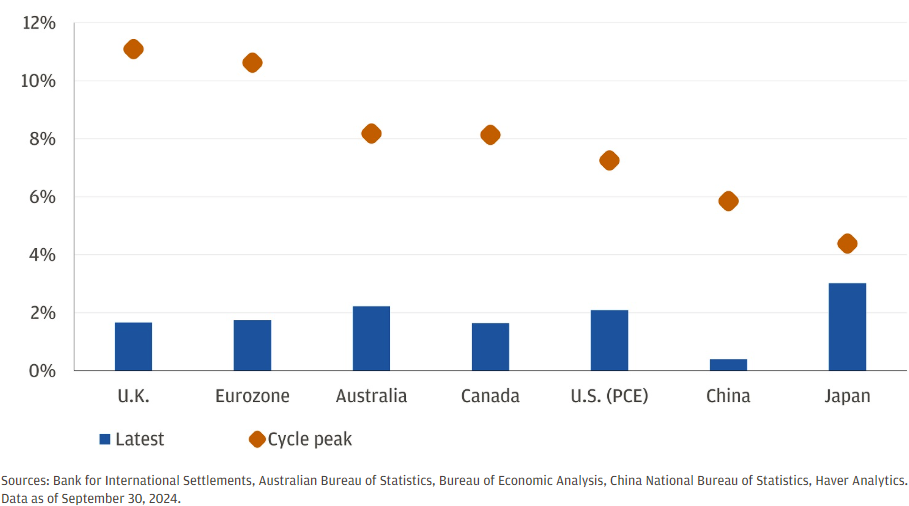
For the time being, inflation seems to be under control, but there are various factors at play that could potentially trigger its return. The United States' primary concern lies in the actions of the new administration, particularly regarding tariffs. The challenge remains in striking a balance between sustaining growth while keeping inflation at bay.
In November, the Consumer Price Index rose by 0.3%, marking a 2.7% increase over the past twelve months. This monthly uptick was primarily driven by higher costs of food and shelter. These figures are not aligning with the Federal Reserve's targets, casting doubt on the likelihood of further easing measures or, at the very least, at a pace that would have any significant impact.
The unemployment rate stood at 4.2%, showing a slight increase of 0.1% compared to the previous month, which was in line with the anticipated trend.
Markets: With the elections now over and the anticipation of a new administration that is expected to be highly pro-growth and pro-deregulation, we have witnessed a surge of enthusiasm in the markets during November. The year as a whole has been remarkable, with the S&P 500 showing a remarkable increase of over 25%, following a gain of 24% the previous year. Despite facing various challenges, companies have managed to deliver robust earnings. The majority of Wall Street foresees that earnings will continue to be strong, especially with the prospect of lower rates.
Three sectors that are expected to attract ongoing attention and experience growth are artificial intelligence, energy, and security, particularly in the realm of cybersecurity.
It’s not just the equity markets but Crypto is also experiencing good times:
Bitcoin up in November +37.29%
Ethereum up in November+47.21%
What implications does this hold for us at Kirkland Capital Group? Positive trends typically spread into various sectors, and we anticipate a shift towards increased lending activity. As we've previously mentioned, we don't see other lenders as rivals but rather as an expanded pool of options that would offer long-term financing solutions for our borrowers.
When you have any questions about the newsletter or the Kirkland Income Fund, please do not hesitate to reply or book a call with me.
