
October 2023 Newsletter
Month of October Index Returns vs KIF:

Portfolio Update:
The Fund saw a robust return in October, fueled by rising default interest rates and the addition of new loans to the portfolio. Our Q3 update hinted at potential increase in fluctuation of monthly returns due to defaults and the resolution of foreclosed loans in the portfolio.
October set a record for us in terms of loan requests since we started. No change in the funnel where a significant number are declined, another large set reject our requirements or the interest rate, and a minority have moved into the due diligence phase. As predicted, some requests are for purchases, yet the bulk remains refinance requests.
New Tracking Index for the Portfolio: Morningstar Leveraged Loans Index
We've added a new index to the list we monitor in our reports.
What's this new index? It's the MSTR Leveraged Loans Index. This fixed income index includes roughly 1,400 bank loans and senior secured loans. Most of these loans have a floating rate. The index gathers information from both public and private sources.
For a loan to be part of the index, it must be a senior secured loan. It also needs to have a minimum term of one year and be in US dollars. The initial spread should be LIBOR/SOFR + 125, and the issue size should be $50 million or more.
The index rebalances every week. This helps it keep up with changes in this large and ever-changing market.
Why did we show it? The Kirkland Income Fund does not exactly align with the composition of the index. However, private lenders provide some of the index's data, making it a useful industry reference for the private debt universe. A reputable operator, Morningstar, also created and tracks this index. It may not be a perfect fit, but it's worth considering for investors exploring various private debt strategies.
Markets
This year, investors have faced a series of challenges, metaphorically climbing a "wall of worry". Ongoing and new events keep stirring up uncertainty in various parts of the world and financial markets.
Let's examine these events that impact us as investors in the Kirkland Income Fund and may also affect other assets you own.
Fed Actions
The Federal Reserve (Fed) left the Fed Fund's rate unchanged. This met the broad consensus. The Fed also stated it is going to continue to reduce its balance sheet. Reducing the balance sheet (Quantitative Tightening) means they will not reinvest, or limit reinvestment of principal repaid as investments mature. They can also sell investments before they mature. The Federal Reserve began cutting back on Treasury Debt and Mortgage-backed securities in the middle of 2022. They purchased these assets to support a faltering economy—a process known as Quantitative Easing. Selling or reducing these assets suggests market strength. It also shows a desire to decrease government influence in creating economic stimulus. The use of Quantitative Tightening has been rare, so its exact effect or how strong that effect might be is unknown.
Core inflation has dropped over the past year and now stands at 3.7%. Experts expect this trend to persist into 2024. The Federal Reserve suggests that economic elements such as spending and hiring are starting to stagnate. This stagnation could further reduce inflation. People who are monitoring inflation warning signs are focusing on the costs of shelter and energy. Many believe these could be the future forces behind persistent inflation.
Whispers of an earlier than expected rate cut have already started. I still think we need to see a pattern over several periods before the Fed takes this action. It likely won't happen in the first quarter.
Further Fixed Income Opportunities
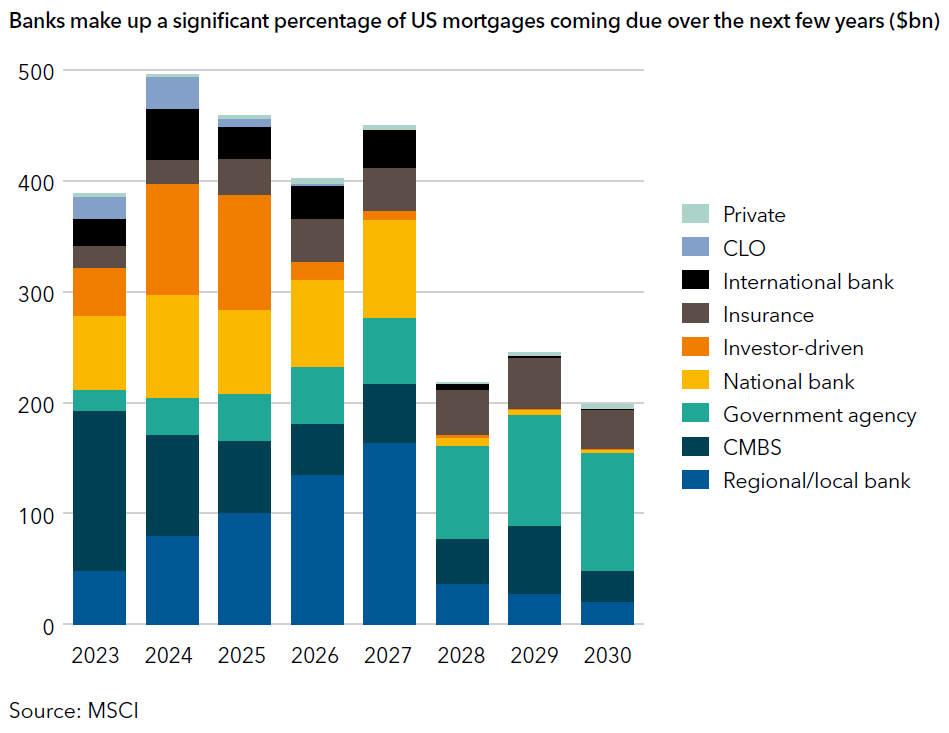
Traditional and alternative fixed income opportunities are expected to last longer. Banks continue to cut back on lending, which increases opportunities for private debt. The chart below illustrates the growing problem that regional and local banks will face in the upcoming years due to maturing mortgages. This potential issue with balance sheets may also reduce future appetite for lending.
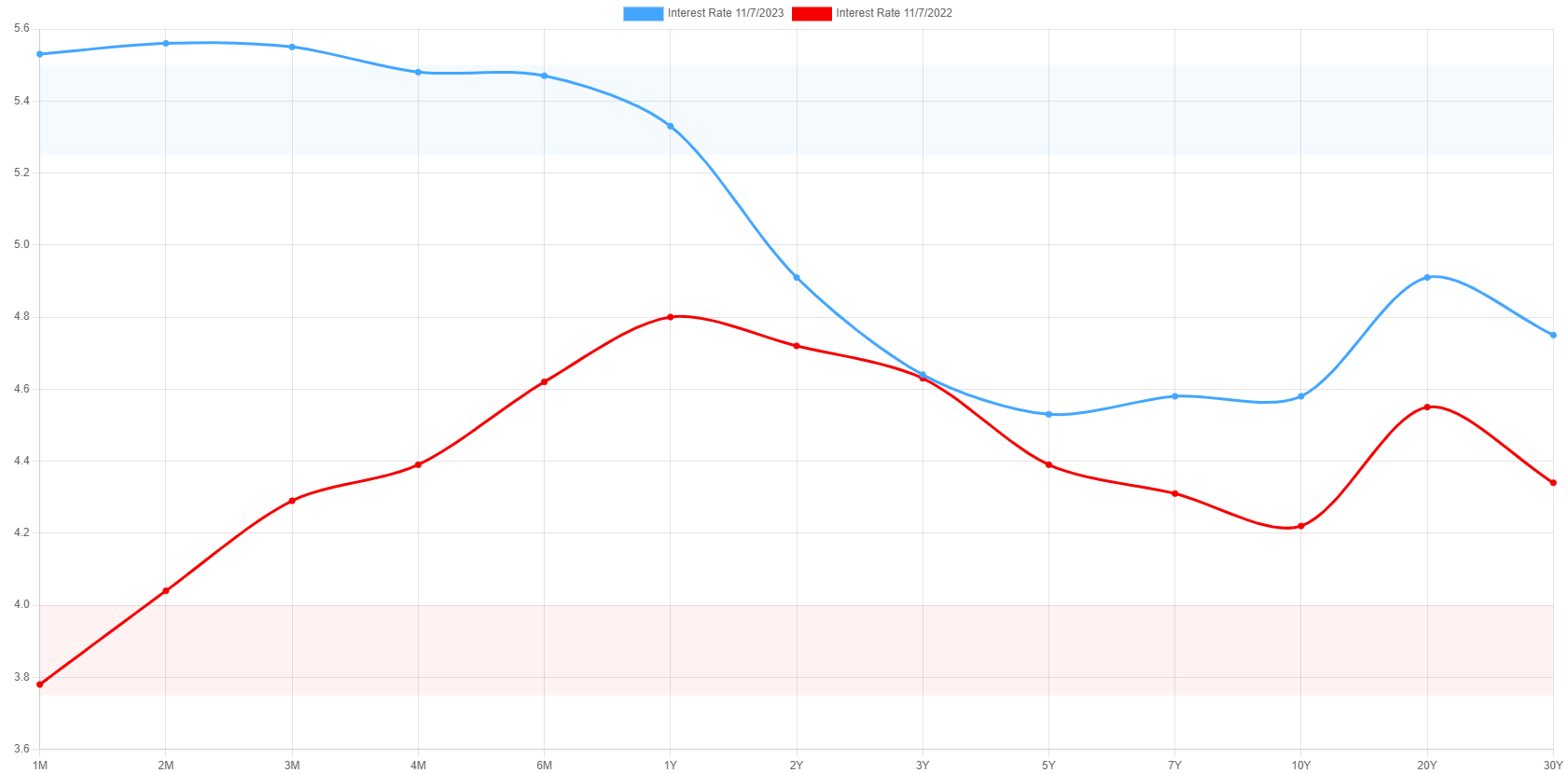
Yield curve continues to shift. This fluctuation causes many investors to hesitate to make long-term debt and equity investments. It's understandable, especially if there's a chance rates could increase or remain high for an extended period. Nobody wants to commit to these rates long-term or bear the burden of higher financing costs for an equity project. In traditional markets, it's challenging to justify venturing out on the curve when you can earn about 5% with virtually no duration. So, is it still better to stick to the short end?
The chart below presents the current treasury yield curve for Nov 7th, 2023, and Nov 7th, 2022. This picture best illustrates the significant change and the current rates' position on the short end.
Global Risks
We are still facing uncertainty from two ongoing wars, China's and Europe's financial weakness, and a dysfunctional US government that must deal with a 1.7 trillion-dollar deficit.We are still facing uncertainty from now two wars, China’s and Europe’s financial weakness, and a dysfunctional US government that must deal with a 1.7 trillion-dollar deficit.
Interestingly enough, in a report I was reading, there have been 21 US Government shutdowns historically. None of them really caused major market moves. Still, it's concerning that we have lots of uncertainty in the world and our government can't figure out how to operate.Interesting enough in a report I was reading there have been 21 US Government shutdowns historically. None of them really caused major market moves. Still concerning we have lots of uncertainty in the world and our government can’t figure out how to operate.
Wars are always a horrible event for alleveryone. The overall financial reaction to the events in the Middle East were subdued. In early October, there was certainly an immediate reaction, then a quick market recovery. If there is further escalation, we will most likely see ongoing hardships that could create future uncertainty and dislocation in trade and commodity markets.In early October there was certainly an immediate reaction then a quick market recovery. If there is further escalation, we will most likely see ongoing hardships that could create future uncertainty and dislocation in trade and commodity markets.
How will these events affect commodities, imports, exports, and price stability in the future? No one really knows, but you can be certain it will not be a smooth ride for all. Our loans do not have direct exposure to these events, but these events can certainly affect a variety of investments indirectly. We will continue to tightenadjust underwriting guidelines to ensure our goal of principal preservation.How will these events effect commodities, imports, exports, and price stability in the future? No one really knows but you can be certain it will not be a smooth ride for all. Our loans do not have a direct exposure to these events, but these events can certainly affect a variety of investments indirectly. We will continue to tighten underwriting guidelines to ensure our goal of principal preservation.
We haveThere are many issues to monitor. However, we should note the strength of the US economy has been strong. The Federal Reserve aims to slow itthe eceonomy down. But, when wethey do, we areit will be slowing from a strong position. This should ideally lead to a milder recession.Lots of issues for all of us to monitor but one thing to be noted is the US economy has been strong. We will slow and that is the Federal Reserve’s goal but we will be slowing from a strong position giving us hopefully a milder recession.
When you have questions, I would love to find a time to answer them.
