
September 2023 Newsletter
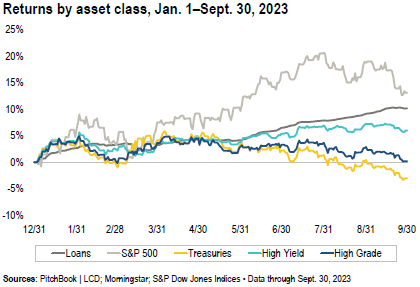
If you're curious about the current returns in the fixed income area, look at this chart. It's from Pitchbook/Morningstar and it compares returns to the S&P 500. In this chart, "Loans" refers to private loans.
Correlations
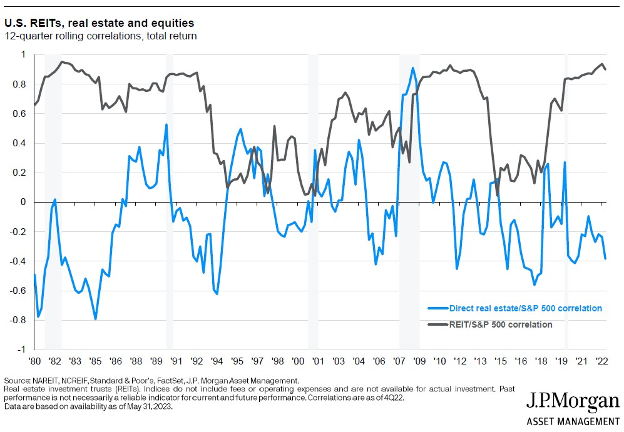
I've previously discussed the importance of considering investment correlations when shaping your portfolio. Private debt has always been a valuable addition to a portfolio due to its low risk and low correlation with many other investments. If you're a Public REIT investor, look at the chart below from JP Morgan. It shows the correlations of private equity in real estate and the S&P500 versus public real estate instruments. The performance illustrates this correlation. If you need to refresh your memory on correlations, check out our article, Correlation and the Impact on an Investment Portfolio
Interest rates, Fed, and future impacts to private lending
The Federal Reserve maintained the same interest rates at their September policy meeting. Powell also mentioned their ongoing focus on inflation. He indicated their readiness to increase rates once more this year if necessary.
Is the Fed's 2% core inflation target attainable? It's challenging due to numerous influencing factors. The only glimmer of possibility lies in the fact that their target inflation measure excludes food and energy costs. These costs are significantly impacting consumers and are likely to worsen.
It appears that rates will remain high. We've been asserting this all year. This point holds significance as the pressure on equity-related projects hasn't eased and may intensify. Numerous equity investors and managers I've spoken to are eagerly awaiting rate reductions in the second half of 2024. However, if this occurs, it may not reach the levels many desire.
For the Kirkland Income Fund this means a tailwind for a longer period. As rates do drop off, it will be at a gradual pace that should allow us to continue to capture higher rates for investors.
However, challenging times lie ahead for private debt, including real estate. We're closely monitoring valuations and rejecting loans with doubtful exit potential. Our lending approach to properties and borrowers has always been conservative. We fund less than 8% of the loans that formally apply. If loan scenarios brought to us by phone and email are included, then the percentage of accepted loans drops to 2%.
A few ways we focus on risk in our lending approach:
As-is valuations; provides a strong equity cushion to the principal of the loan.
Secondary and tertiary markets that have not experienced as large an increase in value as primary markets.
Properties that generate income or will do so by the end of our loan and can secure an exit out of our bridge loan.
No raw land or construction.
Diversification by state and by property type.
Limits on loan sizes to diversify properly and to focus on loan opportunities in our specific markets.
Owners of real estate continue to face rising costs. We are constantly revising our underwriting to account for these events. Take insurance as an example. The costs in markets like Florida and Texas have surged significantly. When dealing with refinances that already have an insurance policy, we include the costs of renewing the policy in our financial analysis. We don't just consider the current premium.
In essence, we began with a conservative approach. We continue to uphold this approach to ensure consistency, even during market fluctuations. We chose this path because our unique sector allows for a conservative approach while still offering substantial returns to investors.
The next year and a half will challenge the underwriting practices of many lenders, both private and conventional. This is because property valuations might stay down or even drop below current levels. For multifamily and traditional office in primary markets or previously “hot” markets, the collateral's value is already less than the loan amount. We can anticipate bank consolidations or mergers to help balance the financials of numerous regional banks. Conventional lending will persist. For instance, we've settled 14 loans this year. However, it will continue to face difficulties in comparison. There's ample capital ready for deployment, but it's uncertain when it will re-enter the market.
““Just because default rates are going up does not mean that private debt investors should worry about the asset class as a whole,” says Schwimmer “…the minute you have a financial covenant default, that is when you take the opportunity to sit down with the borrower and start fixing it. What hurts performance is losses, not defaults, so private debt investors can still feel pretty positive.””
The economy is robust but slowing down. More business owners and renters may find it hard to pay loan interest and rents which could lead to higher default rates and possibly foreclosures. Lenders need strong legal backing and a sufficient equity buffer in their portfolios to safeguard their principal. Currently, we have two loans in foreclosure. These loans have a dollar-weighted Loan to Value (LTV) ratio of 52%. Ideally, we want no foreclosures in our portfolio. However, borrowers often face difficulties unrelated to the property. With this low LTV, we believe we will recover the principal value of the loans.
As investors, review your investment portfolio. Question if the manager possesses the necessary systems, support, process, and experience. They should be able to handle the portfolio during challenging times.
We feel thrilled about what's to come. Micro-balance loans for commercial real estate still provide excellent risk adjusted returns. We believe the momentum we've built over the years will continue.
Do you have the allocation to private debt suitable for your portfolio? If not and you have questions, we would love to find a time to answer your outstanding questions.
