
November 2025 Newsletter
In November, there was a clearer view on two key aspects: policy decisions and the availability of data. The Federal Reserve (“The Fed”) made another 25 basis points cut to its policy rate on December 10, showing a continued focus on employment in its risk management approach, while also recognizing that inflation remains higher than the target. Meanwhile, the recent government shutdown has raised concerns about the reliability of official economic data. This situation has once again left investors uncertain as they try to make sense of the economic figures from November.
In this month’s update, we’ll cover: the macro backdrop (inflation, labor, rates, curve), how these conditions are flowing into real estate, and what this means for the Kirkland Income Fund. We’ll also pull out the “crystal ball” and look at where various property types see growth and contraction
Economic Overview
November’s macro landscape was defined by three key developments:
The Fed’s third consecutive rate cut, signaling a continued push toward easing monetary conditions.
The end of the government’s 43‑day data blackout, which left markets navigating without official statistics for weeks.
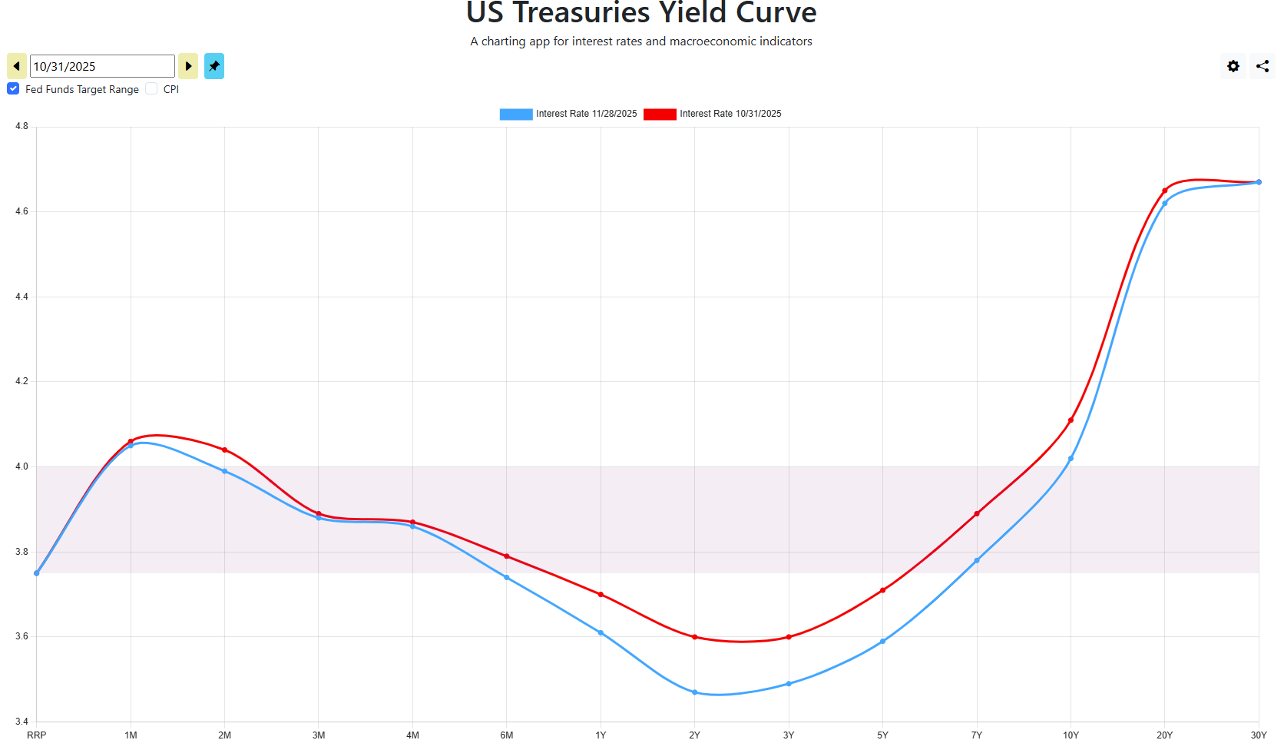
A continued steepening of the yield curve between the 2-year and 10-year, reflecting shifting expectations for growth and inflation.
Together, these factors are reshaping credit spreads, influencing refinance activity, and altering loan exit strategies.
Key points:
Policy Rate & Operations: The Federal Open Market Committee (FOMC) lowered the Fed funds target range to 3.50%–3.75% (9–3 vote) and signaled a cautious easing bias amid signs of labor market cooling.
Inflation: With October’s Consumer Price Index (CPI) canceled, the November CPI, effectively covers two months of price changes. Numbers came out on Dec 18th with CPI at 2.7%. Shelter, energy, and food were up slightly. This is down from the 12-month number ending in September at 3.0%.
Labor Signals: Weekly unemployment claims rose modestly through mid-November, while insured unemployment climbed to ~2.0 million, the highest level since late 2021.
Yield curve: The spread between the 10-year and 2-year widened, creating a steeper positive slope—an indicator of growing optimism for economic recovery. The short end remains inverted, reflecting recent monetary policy and funding stress.
Retail & Spending: November retail sales rose ~4.5% year-over-year, excluding autos and gasoline, according to Retail Insight Network. This growth underscores continued consumer resilience, a key driver supporting broader economic stability.
What does this all mean for Kirkland Income Fund investors?
Rate Cuts & Yield Curve: The Fed’s rate cut lowers short-term benchmarks such as Secured Overnight Financing Rate (SOFR), but it does not directly reduce long-term mortgage rates, which track closer to the 10-year Treasury. A steeper yield curve generally benefits short-duration lenders, especially those whose pricing is not tightly correlated with public market rates. The Kirkland Income Fund’s rates are driven by local supply and demand dynamics in smaller markets, with highly customized debt structures tailored to borrower and property needs. This approach helps maintain pricing power and attractive yields, even as broader rate movements create volatility.
Lower Rates & Property Values: Falling rates tend to increase the value of underlying commercial properties, making it easier to secure exit financing through local community banks and credit unions.
Inflation Data Uncertainty: When inflation data is inconsistent, investors must err on the side of caution, while conservative underwriting becomes essential to ensure loans maintain strong equity collateral. With inflation still at 2.7%% YoY, future Fed tightening is unlikely but remains a risk as policymakers aim for their 2% target.
Labor Market Softening: A “softening without breaking” labor market aligns with our focus on stable, asset-backed borrowers. However, we may still see requests for extensions or loan modifications if property-level stress emerges—particularly around rent collection or expense management.
Real Estate Market Impact
Real estate fundamentals remain mixed:
Multifamily: Demand has cooled but shows signs of stabilization.
Office: Structural challenges persist despite incremental improvements.
Retail: Displays selective firmness, with performance varying by location and tenant mix.
Financing conditions have improved slightly with recent rate cuts, but underwriting standards remain tight, reinforcing the need for strong collateral and conservative deal structures.
Data & examples:
Multifamily: November rents fell again, according to Multi-Housing News: National advertised rate down $8 to $1,740, +0.2% YoY—weakest growth since early 2021, Absorption rates remain at multi-year lows, with Sun Belt oversupply weighing heavily on performance. Borrowers increasingly request modest extensions.
Market‑level stabilization: Moody’s Analytics CRE notes national vacancy holding near 6.5% and cap rates around 5.7% (Q3). Deal flow is improving in select metros, signaling early signs of recovery.
Office: Vacancy remains elevated at ~18.6% nationally (Oct/Nov) despite slight YoY improvement. Certain metros—Seattle and Austin—still hover near 27%, per CommercialSearch and CommercialCafé data.
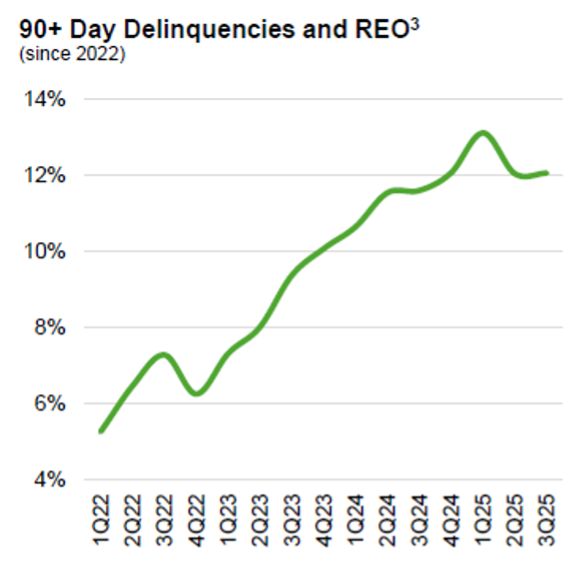
Delinquencies: CMBS delinquencies eased 20 bps to 7.26%, though levels remain historically high this year. Data that is closer to the Kirkland Income Fund’s data set from Green Street Research notes loans with 90+ day delinquencies hovering above 12%. The data shows resolution has been slow but steady throughout 2025, consistent with trends observed in the Kirkland Income Fund’s portfolio as well.
What This Means for Kirkland Income Fund: Continued Conservative Underwriting as Protection
2025 has been a challenging year for commercial private debt, with economic pressures adding stress to borrowers and driving higher delinquency risk. For the better part of the year, loan demand was strong, but the majority of these loans did not pass our strict underwriting standards.
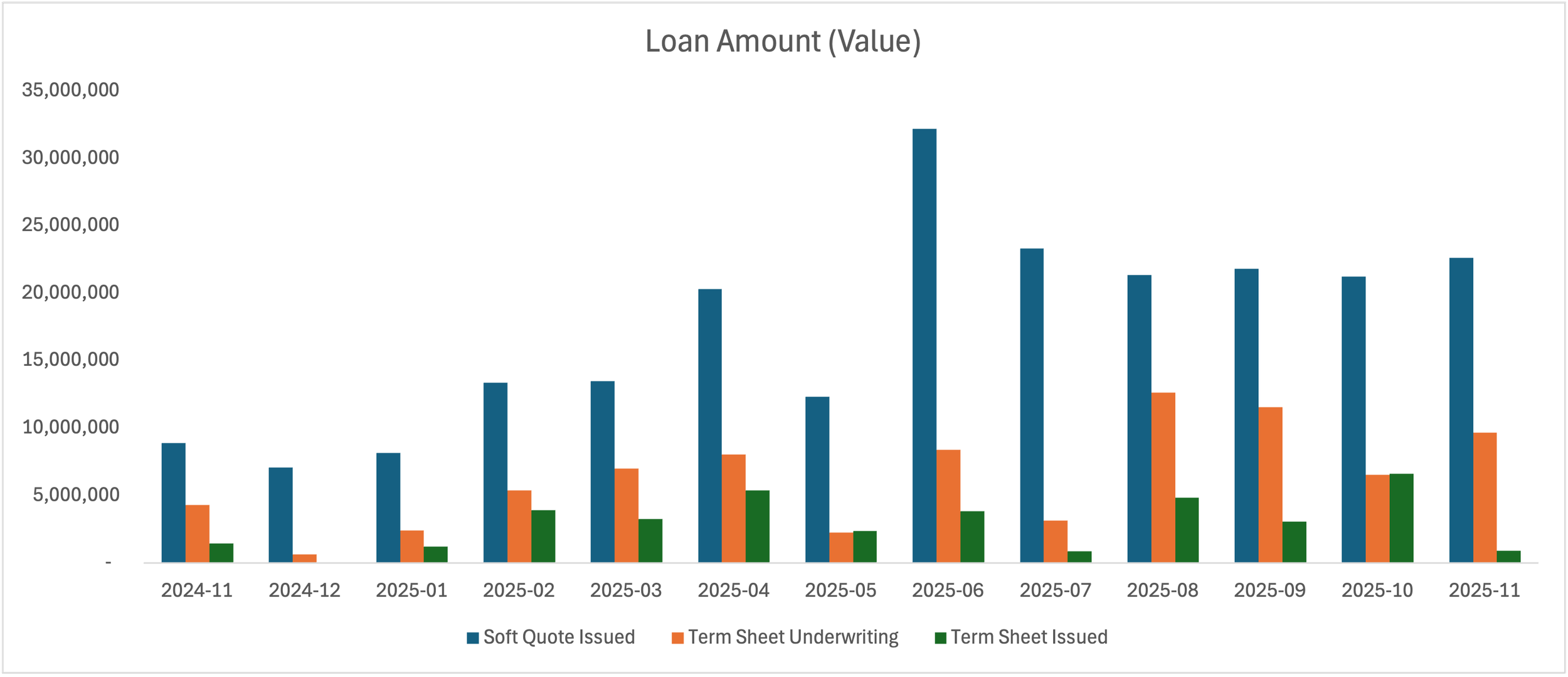
November continued the positive momentum: we saw an increase in quality loan demand and sustained production following the outsized number of term sheets issued in October. This reinforces our disciplined approach—prioritizing conservative underwriting and strong collateral to protect investor capital.
We’ve included our loan flow chart below to illustrate these changes as we head to the end of the year.
We continue to deploy cash at an accelerating pace as year-end approaches, coinciding with increased deal activity across commercial real estate. According to CBRE, investment volumes are rising, with alternative lenders originating 37% of loans, banks at 31%, and life companies at 16%. This reinforces our long-standing belief: private debt remains a dominant and growing force in lending, regardless of loan size—a trend that positions Kirkland Income Fund for sustained success.
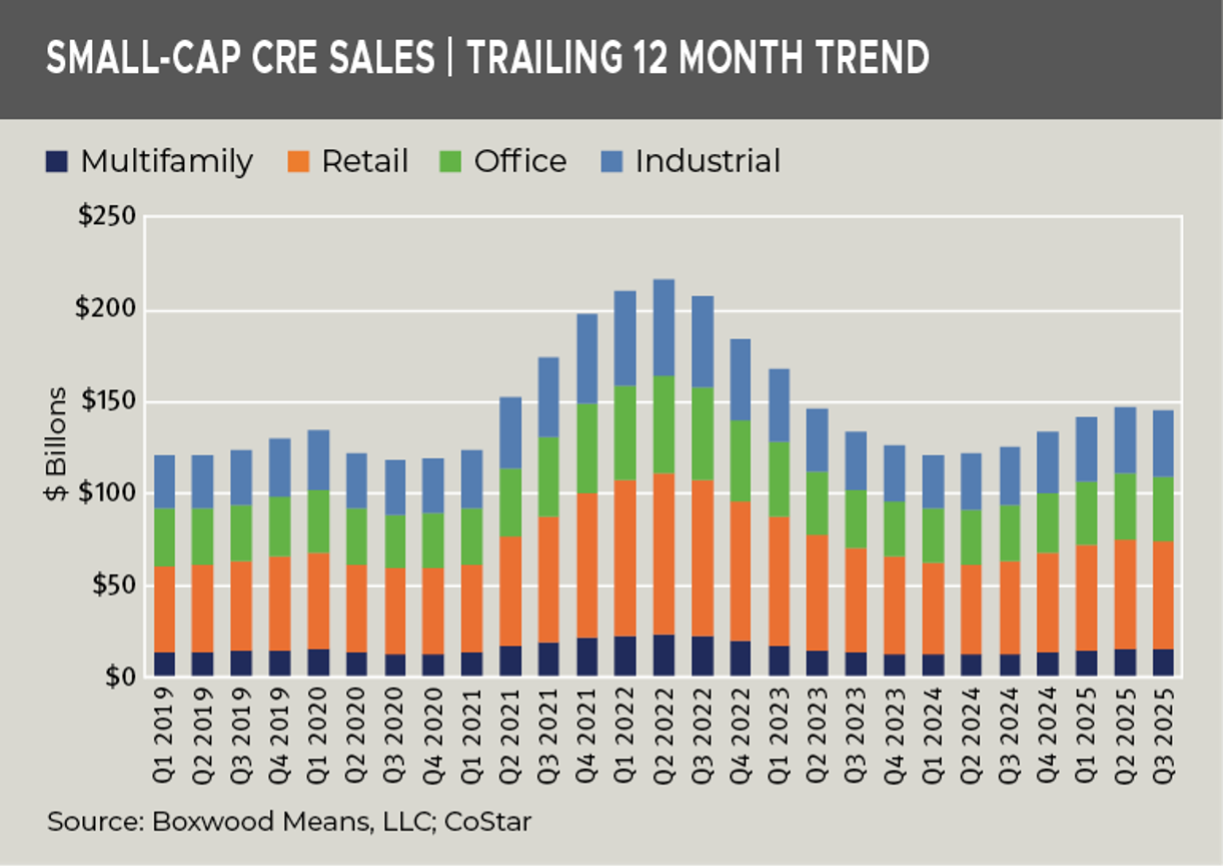
Research from Boxwood Means shows that Small-Cap CRE, which closely aligns with our lending niche, has recovered more than half of its volume since the 2022 peak (see chart below). This signals a healthier small-cap market and improved exit and refinancing opportunities ahead.
As we move into 2026, we anticipate the cycle shifting from correction to slow recovery, creating a favorable environment for disciplined lenders focused on risk-adjusted returns.
We also remain committed to conservative underwriting standards, continuing to decline loans that fail Debt Service Coverage Ratio (DSCR) requirements, lease-up feasibility tests, or lack stable borrower characteristics. This discipline ensures that every loan in our portfolio is backed by strong fundamentals and collateral support.
At the same time, we are encouraged by the increase in loan demand as economic conditions bring more qualified borrowers to the table—creating opportunities for selective growth without compromising risk management.
Looking Ahead
As we close out the year, many will attempt to forecast what lies ahead. At Kirkland Capital Group, we view forecasting as a tool—not a guarantee. It is an art of probabilities, and outcomes can shift quickly.
Our focus remains on adaptability and preparedness—identifying threats and opportunities before they materialize. In the investment world, success depends on having the right process, procedures, and team in place to navigate short-term obstacles. We are proud to say we have all three firmly established at Kirkland Capital Group.
Green Street has complied a vast amount of data to show us a forecast of Revenue growth by sector:

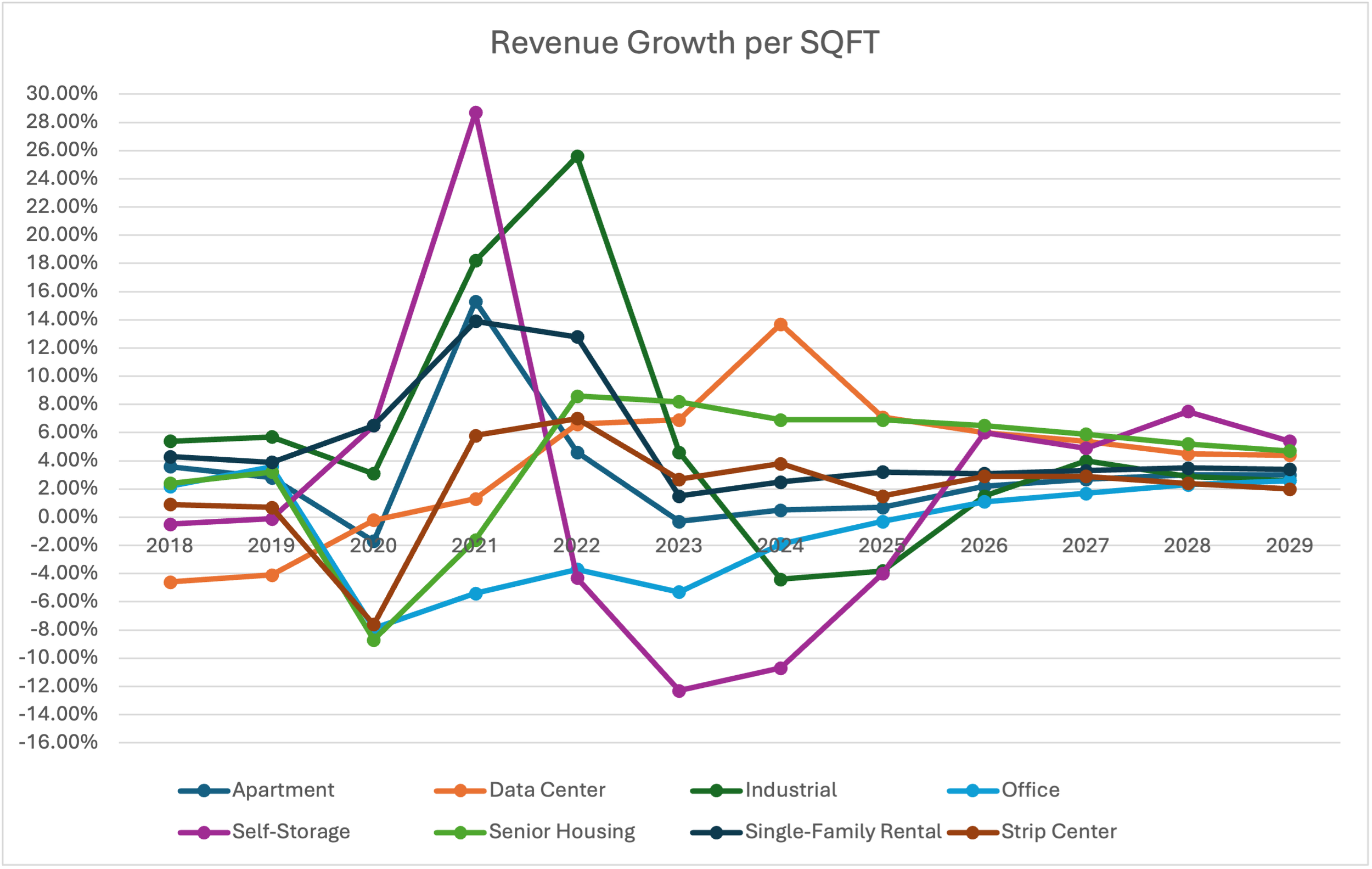
Key Takeaways:
2020–2025: Volatile Cycle Across CRE. Most sectors experienced significant swings during this period, with one major exception—Industrial, which saw explosive growth driven by e-commerce and warehouse demand during the pandemic.
2023 & 2025: Broad Contraction. Many CRE segments posted negative or muted growth as higher rates and tighter liquidity weighed on fundamentals.
Self-Storage: The Most Volatile Performer. Overbuilding led to sharp declines, but the sector is now showing signs of recovery.
Office: Persistent Headwinds. While conditions appear to be stabilizing, expectations for future growth remain limited.
Looking Ahead: Forecasts point to a more predictable environment across most CRE sectors—an ideal backdrop for lenders like Kirkland Capital Group, where disciplined underwriting and collateral strength thrive.
Outlook:
We anticipate continued policy caution from the FOMC, with further easing likely—though less aggressive than in 2025. This measured approach should lead to selective and gradual improvements in financing conditions, rather than a broad-based shift.
Real estate fundamentals will remain highly dependent on property type and geography, reinforcing the importance of diversification. Kirkland Capital Group will continue to operate a diversified portfolio, positioning the fund to capture opportunities while mitigating localized risks.
Next Steps for Investors:
Review our latest performance page to see how Kirkland Income Fund continues to deliver consistent results.
Schedule a 30-minute call if you’d like to discuss this newsletter or explore details of the Kirkland Income Fund.
