
December 2025 Newsletter
December marked the close of a year defined by transition. After two years of volatility, the market is finally showing signs of stability. Inflation cooled below 3%, the Federal Reserve (“the Fed” shifted decisively from tightening to easing, and property values began to firm after a prolonged correction. These developments are reshaping financing conditions and creating opportunities for disciplined lenders like the Kirkland Income Fund.
In this month’s update, we’ll take a walk down memory lane and look back at some themes of 2025, explore the macro backdrop—rates, inflation, labor, and public markets—how these trends are flowing into commercial real estate and private debt, and what they mean for Kirkland Income Fund for 2026.
2025 in review: Uncertainty, Policy Pivots, and a Focus on Quality
Financial markets spent most of 2025 balancing mixed macro signals with evolving policy and geopolitical risks. Early in the year, inflation tracked in a 2.3%–3.0% range while unemployment held near 4.2%, but by late summer, labor data softened and uncertainty rose.
The Fed held rates steady through midyear amid tariff related inflation concerns and then pivoted with 25 bps cuts in September and October as employment weakened and a record 43 day federal government shutdown disrupted official releases.
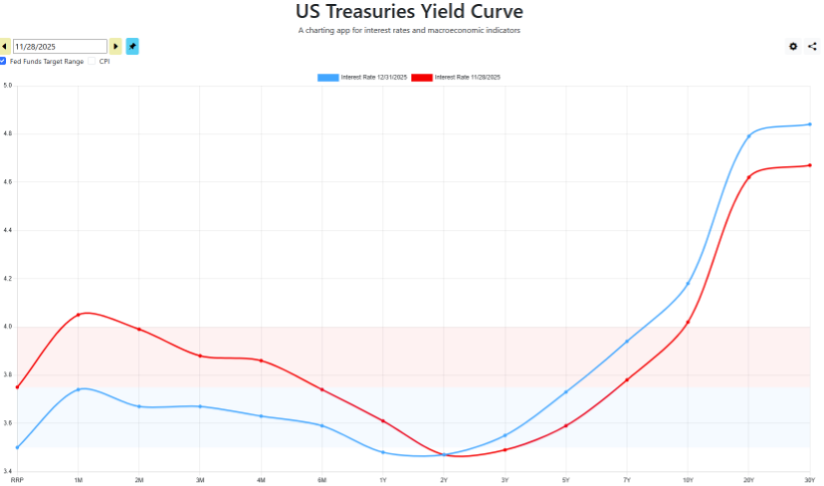
Yield curve moves reflected this shift: short rates eased while longer maturities stayed elevated, keeping curves kinked and caution high. These dynamics fostered a flight to quality across portfolios and supported income focused strategies over high beta risk (greater volatility with higher risk and potential return).
Real Estate: Bifurcation by Sector and Geography
Commercial real estate bifurcated as fundamentals diverged across segments.
Retail remained resilient—especially grocery anchored, discount, health, and experiential formats—on scarce new supply and durable demand, even as tariffs and e-commerce pressured margins.
Multifamily generally proved sturdy, but oversupply in select Sun Belt metros lifted vacancies and pressured Class A assets while workforce housing held up better.
Hospitality underperformed on margin compression and uneven demand recovery, and office continued to struggle under hybrid work dynamics despite pockets of strength in newer, higher quality buildings.
Industrial demand stayed solid, concentrated in modern facilities with older stock seeing negative absorption. In small‑cap CRE, sales activity improved from pandemic lows and cap rates drifted back toward 2019 levels, supporting steady opportunities for nimble lenders.
Policy and Regulation: Headwinds and Structural Tailwinds
Policy dominated 2025. On the tax side, the “One Big Beautiful Bill” (OBBB) enacted in July made the REIT Section 199A/QBI deduction permanent, restored 100% bonus depreciation, and expanded OZ incentives—tailwinds for after tax income strategies and KIF’s SubREIT architecture.
Basel III “Endgame” also nudged banks toward tighter capital, supporting private credit’s growing role.
The SEC’s 506(c) verification guidance streamlined accredited verification with minimum investment thresholds and self-certification under “reasonable steps.”
On digital assets, the GENIUS Act and CLARITY Act advanced a clearer federal framework for stablecoins and tokenization—opening pathways for compliant real-world assets (RWA) financing and faster settlement rails that may eventually benefit CRE debt markets.
Separately, the 401(k) Executive Order sought to widen access to alternatives for retirement investors, while renewed privatization talk for Fannie and Freddie raised strategic questions for mortgage finance and potential exit pathways.
KIF Positioning: Conservative Underwriting, Short Duration, Capital Preservation
Against this backdrop, KIF stuck to its edge: conservative, “as is” valuations and sub-60% LTVs, paired with short duration lending that refreshes quickly and limits exposure to adverse moves.
The team consistently rejected loans with weak borrower profiles or red flags—even late in diligence we found many issues (e.g., unpaid taxes, undisclosed legal issues, fraudulent bank accounts). A continuing theme of 2025 was to prioritize principal protection over near-term yield.
Cash drag from tight approvals and slower quality deal flow modestly dampened monthly returns, but deal flow and quality improved into Q3–Q4 as borrowers re‑engaged while underwriting standards remained intact. Process strength was enhanced with the addition of the Managing Counsel position to oversee loan servicing and default management, accelerating resolutions and tightening controls.
Throughout the year, the fund emphasized consistent income and low volatility and correlation and consistently outperformed the MSTR Levered Loan Index and many other traditional debt indices despite the deliberately cautious stance and low risk profile. The chart below shows the relationship between return and risk across a variety of different investments for the full year 2025. The Kirkland Income Fund can be seen outperforming many other investment options while taking drastically less risk.
Risk Management in Practice
KIF’s risk first approach stayed visible: turning down inflated pro formas and thin equity packages, favoring stronger NOI potential, higher supporting assets and shorter terms where appropriate, and maintaining borrower covenants designed to weather longer holds if markets slowed. Where non-performers arose, proactive workouts—backed by strengthened servicing and legal oversight—kept resolutions on track without write-offs.

Not All Were Left Unscathed
It’s important to acknowledge that 2025 was not without casualties in the private credit and alternative investment space. Many funds faced liquidity pressures and resorted to gating investor withdrawals or halting monthly distributions—moves that shook investor confidence and underscored the importance of transparency and risk management.
Some platforms, such as Yieldstreet, were caught in controversies involving misrepresentation of risk, leading to allegations of fraud and regulatory scrutiny. These events serve as a stark reminder that not all strategies are created equal. In times of stress, the difference between disciplined underwriting and aggressive yield-chasing becomes painfully clear.
The Bottom Line for 2025
In a year defined by policy volatility, softening labor, and rate path uncertainty, KIF’s discipline—low loan-to-value (LTV), short duration, and rigorous due diligence—preserved capital and delivered steady income while avoiding style drift to chase yield.
Sector dispersion validated the focus on collateral quality and borrower strength, and structural reforms (OBBB, Basel, SEC guidance, digital asset clarity) broadly favor well governed private credit platforms positioned to lend into inefficient niches. With loan pipelines improving into late Q3/Q4, we exit 2025 with the same playbook that has worked across cycles: principal first, income second, and continuous operational refinement.
December Economic Overview
Policy Rate & Monetary Easing: The Fed delivered its third consecutive 25 basis point cut, lowering the federal funds target range to 3.50%–3.75%. This marks a clear pivot toward easing after two years of aggressive tightening. The Fed’s tone suggests a cautious but sustained path of rate reductions in 2026 although estimated to be less than 2025. The Fed aims to support growth while keeping inflation anchored. We will have to monitor the Fed even closer as it is fractured. More and more governors are split on votes. This means they don’t have a clear view on the economy.
The Fed market activity: The Fed will resume buying treasuries, in particular, short-term treasuries. The Fed stated it will maintain the short term funding markets via these market operations. Putting liquidity into the market ensures rates stay at 3.5% to 3.75%, allowing banks to consistently borrow from the Fed window. An interesting point is that these additional moves by the Fed imply the market is not stable enough on its own to maintain these borrowing rates. This uncertainty can be seen in the yield curve chart below short end is cheaper but there is still sentiment of risk in the future as longer term rates edged up.
Inflation Cooling: Headline Consumer Price Index (CPI) rose 2.7% year-over-year in December 2025, led by food and shelter, while core CPI (excluding food and energy) increased 2.6%—both below expectations and down from earlier highs. These results signal that inflationary pressures are easing, supporting the outlook for continued monetary policy easing and progress toward the Fed’s 2% target.
Labor Market Signals: Unemployment was down slightly (20 bps) in December at 4.4%. November marked the highest rate since 2021, reflecting a cooling but resilient labor market.
Public Market Equity Performance:
Equities were largely flat in December after a strong November rally:
S&P 500 TR Index: +0.06% for December; +17.88% for the year.
NASDAQ Composite: +0.53% for December; +20.4% for the year.
Dow Jones Industrial Average: +1.01% in December; +12.7% for the year.
Real Estate Market
The commercial real estate market entered December with clearer signs of stabilization:
Property Values: Green Street’s Commercial Property Price Index rose 0.8% month-over-month and 2.4% year-over-year, marking the first annual gain since 2022. MSCI’s RCA Index echoed this trend with a 1.6% year-over-year increase, confirming that values have likely found a floor.
Industrial: +5.1% YoY; fundamentals remain strong with vacancies near 4%.
Retail (necessity-based): +2.4% YoY; grocery-anchored centers continue to outperform.
Multifamily: Slightly negative (-1.4% YoY) but stabilizing after oversupply pressures earlier in the year.
Office: Still distressed; downtown values down ~1.9% YoY, suburban up ~2.7%, highlighting bifurcation within the sector.
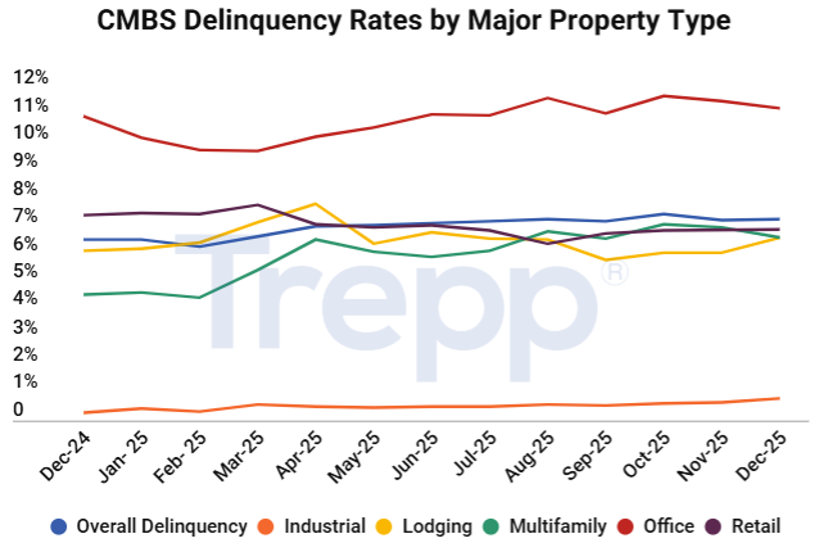
Credit Conditions: Commercial Mortgage-Backed Securities (CMBS) delinquency rates ended up slightly on the year at 7.3% overall, with office delinquency down 37 bps but still at 11.3%. Special Servicing rates according to TREPP data were still high for Q4 2025. Overall rate was 10.86%. With Retail and Office still showing the greatest need for some forbearance. Retail rate as of November 2025 was 11.57% and Office at 17.16% in special servicing.
What Does This Mean for Kirkland Income Fund?
December’s developments strengthen the outlook for our strategy:
Improved Exit Visibility: Lower rates and stabilizing property values make refinancing and asset sales more achievable for borrowers, reducing risk on short-term bridge loans. This also increases the options of resolving currently non-performing loans.
Origination Pipeline Growth: With banks being cautious, demand for private financing remains strong. We expect increased deal flow in 2026, particularly for workforce housing, industrial, and necessity retail assets—sectors that have demonstrated resilience and upside potential in secondary and tertiary markets.
Portfolio Resilience: Our continued focus on diversifying across sectors, maintaining conservative valuations, and ensuring low LTVs, while upholding processes, procedures, and building a team that will continue to perform rigorous analysis to lower volatility, limit downside risk, and continue to protect investor capital.
Initial Thoughts for 2026
If rate cuts continue and policy clarity improves, expect quality borrowers to lean further into fixed rate, short-term bridge solutions, particularly in workforce housing, necessity retail, and modern industrial. We’ll keep cash discipline tight, expand servicing agility under our internal counsel, and explore compliant tokenization pilots where they reduce friction and enhance investor liquidity without compromising underwriting. Above all, we remain conviction to our guiding principles: underwriting “As is,” staying sub-60% LTV on average, and keeping duration short so the portfolio can adapt quickly as the cycle evolves.
Our mission from day one remains unchanged—deliver attractive, risk-adjusted returns while safeguarding investor capital.
Next Steps for Investors:
Review our latest performance page to see how Kirkland Income Fund continues to deliver consistent results.
Schedule a 30-minute call if you’d like to discuss this newsletter or explore details of the Kirkland Income Fund.
