
January 2026 Newsletter
January opened with an economy continuing its slow transition toward normalization. Inflation decelerated meaningfully, the Federal Reserve (“the Fed”) paused after last year’s cuts, and the yield curve finally moved out of its long-running inversion to a more normal shape. At the same time, job growth surprised to the upside—even as backward revisions reminded us that headline strength can still obscure underlying fragility. The Consumer Price Index (CPI) is easing, but shelter and services remain sticky; growth is holding up, but hiring is increasingly narrow and sector‑dependent.
In this month’s update, we unpack these crosscurrents—slowing inflation, shifting labor dynamics, the Fed’s policy posture, and a newly normalized curve—and examine how they are flowing into commercial real estate and private debt markets. We’ll connect the macro backdrop to what it means for underwriting quality, refinancing risk, property level fundamentals, and where lenders like the Kirkland Income Fund are positioned as 2026 takes shape.
Economic Overview: We don’t forecast risk; we work to calibrate risk.
Inflation
Inflation moderated more than expected in January. Headline CPI was 2.4% Year‑over‑Year (YoY), down from 2.7% in December, reflecting continued cooling in broad price pressures. Core CPI—which excludes food and energy—rose 0.3% Month‑over‑Month (MoM) and 2.5% YoY, indicating that underlying inflation is easing but not yet fully resolved.
Energy prices declined a meaningful 1.5% MoM, providing an additional drag on headline inflation. Shelter, however, increased 0.2% MoM and remains the single largest contributor to monthly CPI gains, running at roughly 3.0% YoY. This sticky shelter component continues to slow the overall disinflation process even as other categories soften.
Employment
January’s labor data delivered a nuanced signal. Payroll growth remained positive and unemployment fell to 4.3%, down slightly from 4.4%, even as the federal government reduced headcount. Treasury Secretary Scott Bessent has argued this is a constructive development: falling unemployment alongside government job losses suggests a healthier, more market driven labor dynamic, with private sector employers absorbing labor and driving job creation rather than public sector expansion.
That interpretation has merit—but it is not definitive. Private sector job growth remains concentrated in a narrow set of industries, while sectors such as financial services continue to contract, limiting how broadly employment gains translate into household formation and income growth. Government job reductions can also create short term local drag in regions with higher public sector exposure. Compounding this, sizable revisions to prior employment data underscore lingering uncertainty around labor market momentum. The takeaway is a labor market that is stabilizing, not accelerating—supportive of growth, but still uneven and highly dependent on sector and geography.
Federal Open Market Committee (FOMC) Action
On January 28, 2026, the FOMC maintained the federal funds target range at 3.5% to 3.75%, noting solid economic activity, low job gains, stabilization in unemployment, and inflation that remains “somewhat elevated.” As the Fed signaled at the end of 2025, policymakers are less inclined to cut rates and remain firmly data‑dependent. The arrival of a new Fed Chair introduces an additional source of potential volatility as the year unfolds.
Kevin Warsh’s nomination as the next Federal Reserve Chair has sparked significant speculation. President Trump has publicly emphasized Warsh’s willingness to cut rates aggressively, calling him “one of the GREAT Fed Chairmen” and a supporter of lower borrowing costs. However, analysis from CNBC, the Darden School of Business, and Mortgage Professional America indicates that expectations for rapid or outsized rate cuts are likely overstated. Warsh has historically been hawkish on inflation and only recently aligned with arguments for lower rates. Moreover, he is just one vote among twelve, and the Fed’s dual mandate—price stability and maximum employment—limits how aggressively any chair can move.
Interest Rates and the Yield Curve
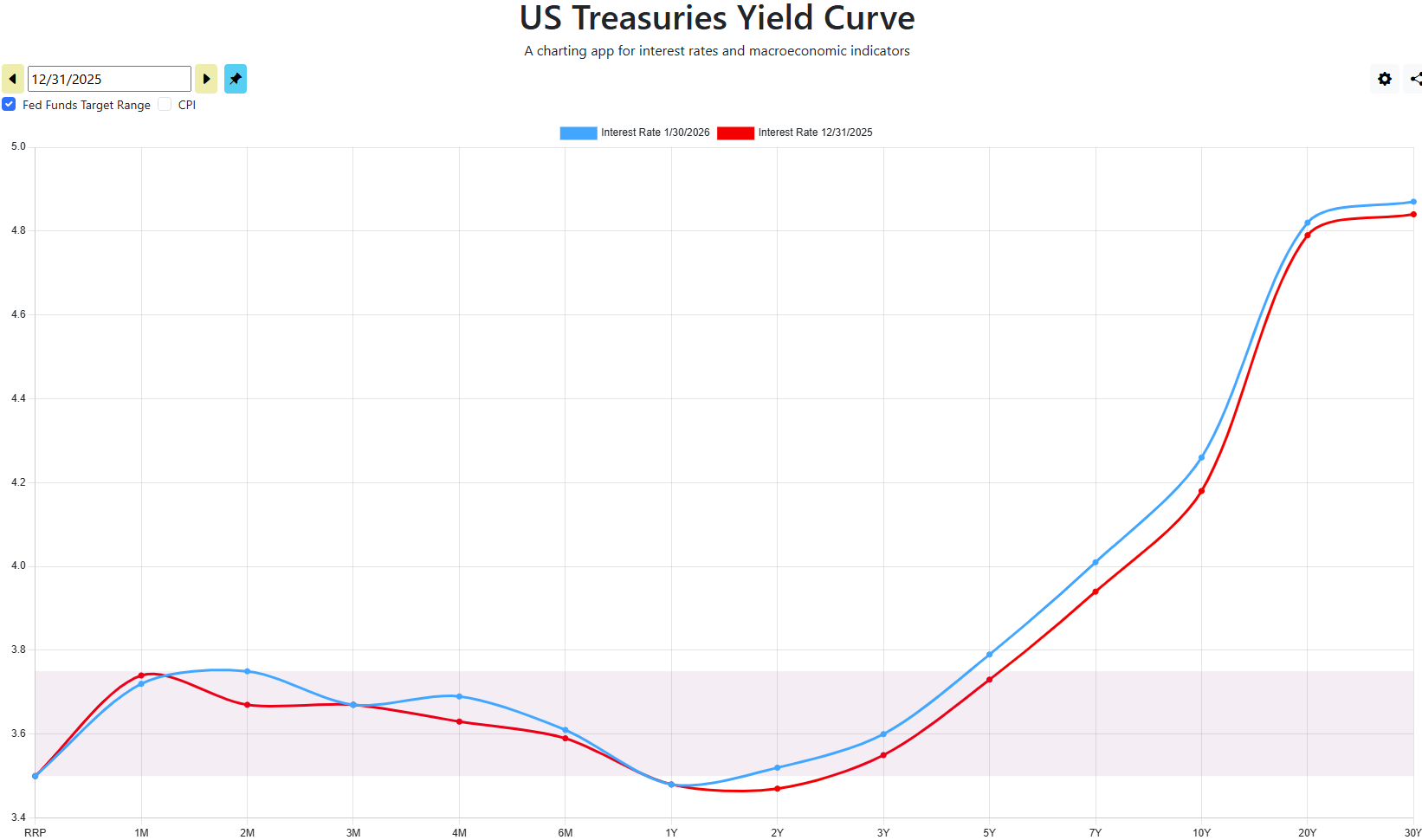
After more than two years of inversion—one of the longest yield‑curve inversions on record—the 10‑year minus 2‑year Treasury spread has finally turned positive, averaging roughly +60 to +70 bps throughout January and early February 2026, according to FRED data. This normalization is meaningful, but it does not signal that the cycle is over or that risk has cleared.
Historically, the economy has often weakened after the yield curve turns positive, not before. This shift typically marks the end of policy restlessness, not the elimination of late‑cycle vulnerabilities. Today’s backdrop reflects that pattern: inflation is falling but remains above long‑term targets, labor markets have cooled but are far from broken, and fiscal deficits remain large. The curve’s move back into positive territory is therefore notable—yet it should be interpreted as a transition point rather than an all‑clear signal
| Indicator | Latest (Jan 2026) | Prior / Context | Why it Matters for Real Estate Credit |
|---|---|---|---|
| CPI (YoY) | 2.4% | 2.7% in Dec | Lower inflation reduces upward pressure on cap rates and operating costs. |
| Core CPI (YoY) | 2.5% | 2.5% in Jan (core trend) | Services inflation matters for payroll-heavy properties (hospitality, retail). |
| Unemployment | 4.3% | 4.4% in Dec; 4.0% a year earlier | Slightly higher YoY suggests slower household formation versus peak growth years. |
| Fed Funds Target Range | 3.50%–3.75% | Pause after 2025 cuts | Borrowers get clarity; refi risk shifts from rate shock to underwriting discipline. |
| 10Y–2Y Spread | Positive (~+0.62%) | End of inversion | Curve normalization supports cautiously improving bank behavior and longer-term financing assumptions. |
Source Data (BLS.gov, Federalreserve.gov, Fred.org)These data reinforce our belief that in 2026, private credit underwriting will be the difference between volatility and durability. We are treating this year as one in which underwriting quality matters more than macro direction. Cooling inflation and a Fed pause are constructive developments, but they do not eliminate refinancing risk or property-level execution risk.
For investors the practical move is to favor strategies with:
documented collateral value,
shorter duration, and
cash yield that does not depend on cap-rate compression.
Real Estate Market Impact
If January’s macro takeaway was “cooler inflation, stable rates, and a normalizing curve,” the real estate translation is more specific: the market is slowly moving from denial to price discovery.
Multifamily: Occupancy-first, rent growth second.
Multiple industry outlooks entering 2026 expect soft demand in the first half, driven by tepid job growth and reduced household formation, with operators prioritizing occupancy and using concessions—especially in markets still working through a large wave of new supply. CBRE’s 2026 outlook frames this as a period where renewal strength helps, but rent growth remains low, and high-supply Sun Belt and Mountain markets may not see positive asking rent growth until late 2026.
Retail: More resilient than many expected—but bifurcated.
Sector research entering 2026 broadly describes a transition year: stabilized fundamentals in stronger centers and continued pressure where tenant mix is weak. Newmark’s 2026 sector view emphasizes an uneven recovery and widening divide between high-quality and low-quality properties.
What matters for credit is not whether “retail is back.” It is whether the property’s cash flow is granular and defensible: tenant diversification, lease rollover profile, and stable or growing income levels geographically. Cooler inflation helps consumers at the margin, but if job creation is narrow and wage gains are not large retail will struggle. This sector is even more defined by local factors.
Hospitality: Improving, but operations remain unforgiving.
Higher‑end hotel properties are showing resilience, while lower chain‑scale segments continue to face pressure. A reset in pricing is drawing capital back into the sector, but performance remains uneven. Data from Crexi (a commercial real estate marketplace) indicates that Revenue per Available Room (RevPAR) and Average Daily Rate (ADR) are running below projections through 2025 and into 2026.
Rising capitalization rates, along with a large volume of upcoming Commercial Mortgage‑Backed Securities (CMBS) maturities and elevated hotel delinquencies, add further stress to the market. In this environment, operators with disciplined processes will be rewarded—while those without operational rigor will continue to struggle.
Private debt markets are growing in this segment as hotel borrowers increasingly ask lenders for custom structures that accommodate operating volatility—interest-only periods, capex holdbacks, or performance covenants that reflect seasonality.
What This Means for the Kirkland Income Fund (KIF)
Kirkland Income Fund is built for environments like this—where the “macro headline” matters less than idiosyncratic factors: borrower strength, valuation, leverage, duration, yield, and exit.
Conservative Underwriting as Protection (LTV + as-is value)
KIF’s first line of defense is conservative leverage and collateral reality. Our underwriting is designed to anchor decisions to as-is value, not speculative future valuations—because in a repricing market, appraisal optimism is not a strategy.
By keeping leverage modest relative to collateral value, we seek to create a buffer against valuation swings and refinancing friction.
Short Duration Limits Exposure
Duration is the second defense. In a market where the Fed is paused and the curve is normalizing, the risk is not only “rates up” or “rates down.” The risk is terms change—lender appetite, liquidity, covenants, and refinance windows.
Shorter duration loans allow the portfolio to reprice and re-underwrite as conditions evolve—rather than being locked into long-term fixed structures that can become mismatched to market reality. This is one reason long-duration mortgage books tend to feel more pressure in downturns: they cannot adapt quickly when valuations reset or lender standards tighten.
Income-Focused Returns
In a real estate repricing cycle, investors often rediscover a simple truth: income that is paid is different from returns that are implied. We are 100% first lien fixed income. Our objective is to emphasize income. We do not have a structure that relies on cap-rate compression to be successful or on unrealized gains.
A steady cash-yield focus can reduce sensitivity to short-term valuation volatility because the return is not dependent on selling into a perfect market. That does not eliminate risk—credit always carries risk—but it shifts the portfolio’s center of gravity toward realized income rather than market mood.
Disciplined Approach
One of the easiest mistakes in a transitional market is to loosen standards to “keep capital deployed.” We view discipline as a compounding advantage: it can feel like short-term drag, but it is often long-term protection.
In 2025, we reviewed hundreds of loan opportunities where the sponsor narrative depended on near-term rent re-acceleration despite local supply pressure. As a lender in those cases, we could either require materially stronger collateral coverage and verified exit paths or decline the transaction when the numbers did not meet our standards. With all the uncertainty last year, we chose to decline these loans.
It is important to reiterate that we always put investor principal preservation first, even if it makes it difficult for the manager. That kind of restraint is not exciting and tough on our team, but it is how credit portfolios stay durable when the cycle is still finding its footing. Even as we see more quality loans, we stick strongly to this guiding investment principle.
Regulatory & Legislative Updates
A practical regulatory development to note: FinCEN’s Residential Real Estate Rule is scheduled to begin March 1, 2026. It requires certain professionals involved in closings and settlements to submit reports regarding certain non-financed transfers of residential real estate to legal entities or trusts, aimed at increasing transparency and deterring illicit activity in housing transactions.
Implications for KIF and investors:
This rule is not directed at private lenders per se and is focused on residential properties so no immediate impact to KIF. In practice, anything that increases transparency and reporting in real estate transfers tends to increase the value of clean documentation and institutional-grade processes. Over time, that environment generally favors lenders and operators who already run “bank-like” compliance habits.
Artificial Intelligence and Investing
You might expect this section to focus on how artificial intelligence (AI) can help investors—but the more urgent story is the impact AI is having on certain investments right now. Business Development Companies (BDCs) have faced mounting challenges since late 2025, driven in part by software‑sector bankruptcies such as Edmentum, which have contributed to broader distress in the space. BlackRock’s TCP Capital Corp reported a 19% drop in Net Asset Value, and the Blue Owl private BDC has received redemption requests totaling roughly 17% of its assets—clear signs of instability.
AI is making software development dramatically more accessible, lowering barriers to entry and accelerating competition among software firms. This heightened competition raises the risk of disruption, margin compression, and ultimately defaults. Combined with an already volatile market environment, this dynamic is especially concerning for BDCs, which have approximately 20% of their portfolios allocated to software companies. The surge in AI‑driven development could push default rates to new highs, with meaningful implications for both software companies and their lenders.
Given these risks, investors may want to reassess their exposure to BDCs with heavy software concentrations and consider alternative private‑credit strategies. Large investment firms may appear safer, but even they often hold diversified portfolios with hidden risks and intertwined exposures—making it essential to understand where and how capital is being deployed.
Looking Ahead
We are entering a phase where the cycle’s question is changing. The market spent two years asking, “How high will rates go?” Now it is asking, “Who can refinance—and who can’t—under tighter, more realistic underwriting?”
This shift in questioning does not require the skill of divination just preparedness: conservative leverage, short duration, documented value, and disciplined credit selection. Economics are looking stronger and more stable but it is not a guarantee of easy credit. The environment is improving, but it still demands a healthy dose of respect and caution.
Question for Investors: If refinancing windows open only for well-underwritten assets, are your portfolio investments positioned to benefit from selectivity—or exposed to it?
Questions from Investors (One question we are hearing)
Investor question: “If inflation is down and the Fed is paused, why don’t real estate values bounce right back?”
Real estate values do not move on CPI alone—they move on the cost of capital and the credibility of income. January’s CPI print is encouraging (2.4% YoY), but the Fed is still holding policy rates at 3.50%–3.75%, and lenders are underwriting to today’s standards, not last cycle’s optimism.
Meanwhile, income growth is uneven: multifamily rent growth is muted in supply-heavy markets, and hospitality operations remain margin-sensitive. Values recover sustainably when buyers can underwrite stable Net Operating Income (NOI) and finance it with confidence. Cooling inflation helps—yet it is only one ingredient in the valuation equation.
Next Steps for Investors
Review our latest performance page to see how Kirkland Income Fund continues to deliver consistent results.
Schedule a 30-minute call if you’d like to discuss this newsletter or explore details of the Kirkland Income Fund.
