
February 2026 Newsletter
February reinforced a pattern we have been emphasizing: inflation looks stable in the official data, even as real sources of uncertainty continue to build beneath the surface. Headline and core consumer price index (CPI) held steady, suggesting the disinflation trend remains intact, but that stability masks meaningful shifts elsewhere. The labor market softened more than expected, and late‑month geopolitical events especially in energy, introduced new volatility that is not fully reflected in headline figures.
These crosscurrents matter. Conditions are no longer moving uniformly in one direction; they are diverging, and divergence is where credit markets demand the most discipline. Inflation no longer delivers constant surprises, yet markets are increasingly sensitive to geopolitical shocks, energy swings, and shifts in growth momentum. That combination turns the focus away from predicting macro-outcomes and toward managing timing risk, refinance risk, and execution risk at the property level. We also saw notable pressure emerge within large private debt platforms—an important trend we break down later in this update.
In this month’s update, we break down what February’s mix of stable inflation, weakening employment, and renewed energy volatility means for private real estate credit—and how these dynamics are shaping borrower behavior, underwriting priorities, and the opportunity set for disciplined lenders.
Economic Overview
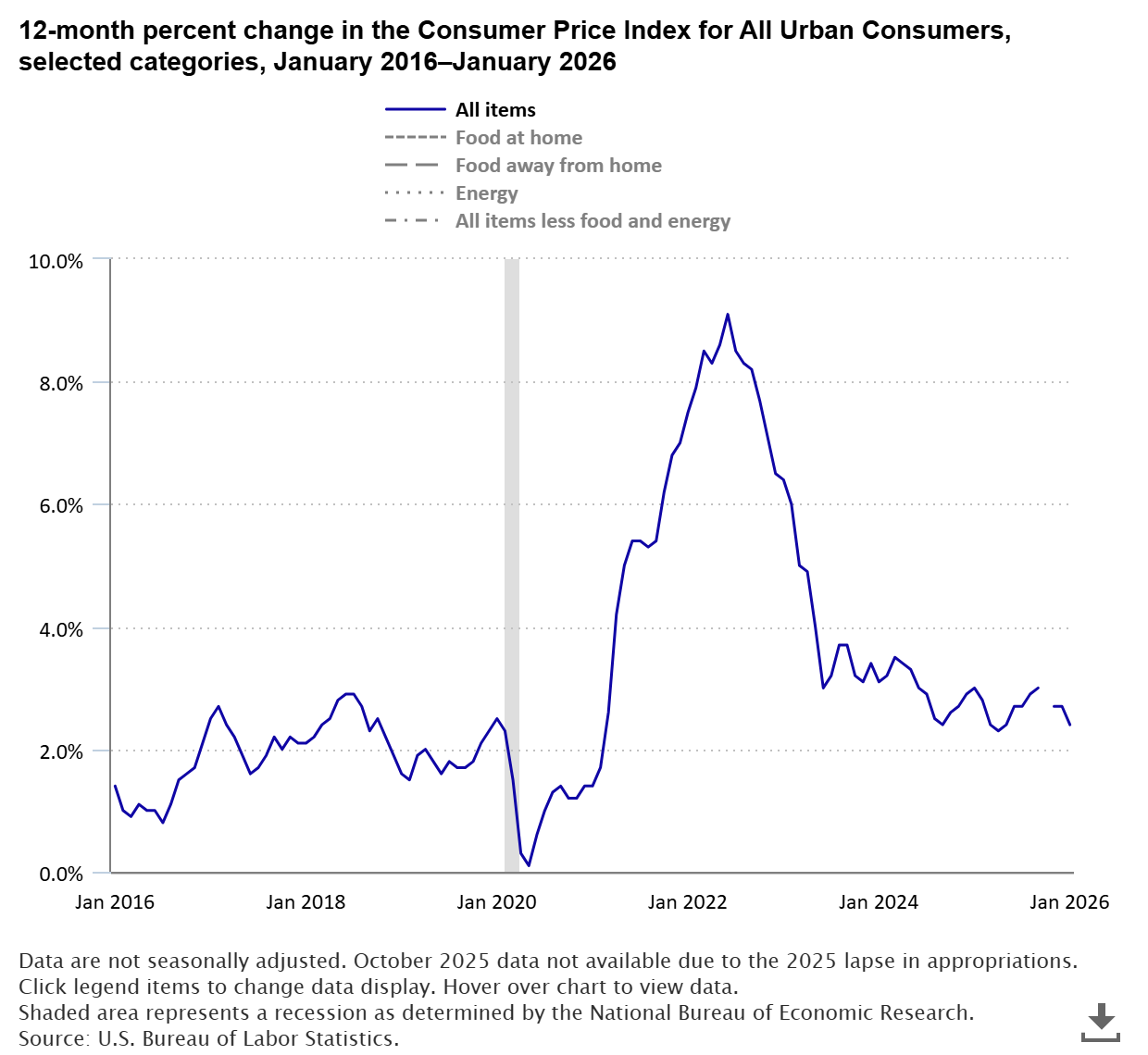
Inflation data for February showed stability rather than acceleration. Headline CPI held at 2.4% and core inflation at 2.5%, largely unchanged from January, with shelter inflation continuing to cool. As seen in the chart below, inflation is showing a down pattern and from a policy standpoint, this reinforces the Federal Reserve’s recent decision to hold rates steady and remain patient.
The labor market weakened meaningfully. Non‑farm payrolls declined by 92,000, and unemployment rose to 4.4%, signaling softer hiring momentum beneath the surface. For real estate, this matters because slower job growth affects household formation, retail spending, and travel demand—the cash‑flow engines of many property types.
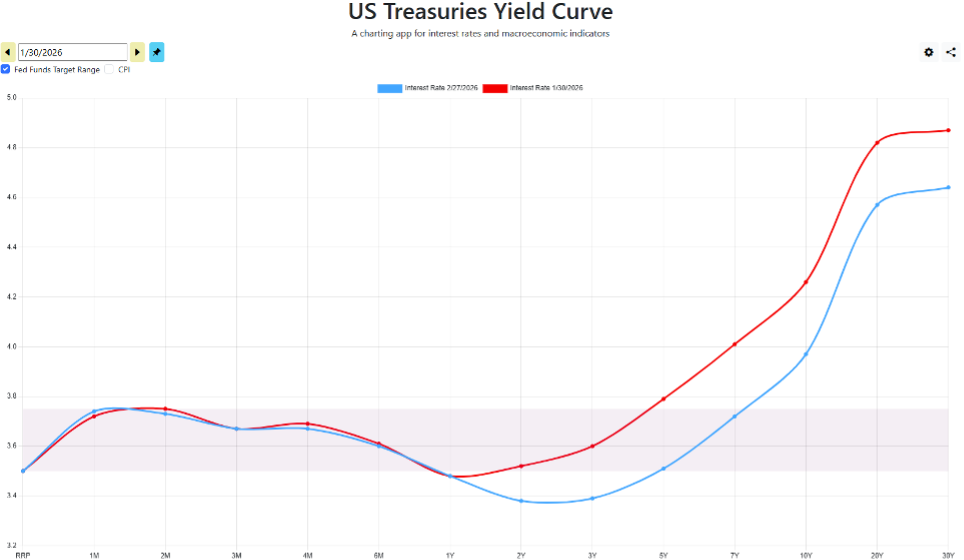
Meanwhile, the interest‑rate backdrop shifted in a subtle but important way. The Treasury yield curve saw the long end soften slightly but it is still not inverted. This positioning still implies markets have moved from “late tightening” toward a period where growth risks carry more weight than inflation risks. The 10-year vs 2-year spread tightened slightly from +0.74% to +0.59%. As can be seen in the chart below, yields fell across the spectrum of 2-year to 30-year. Generally, this move would imply slower long-term growth and lower inflation expectations.
What This Means for Investors
Two realities can coexist.
First, inflation is no longer the dominant upward surprise it was in prior years, and the data increasingly reflects that normalization.
Second, markets are becoming more sensitive to shocks. Geopolitical tensions, energy volatility, and softening employment can all alter the forward path quickly.
For private real estate credit, this environment marks a shift away from pricing risk and toward timing risk:
Refinancing windows.
Lease‑up assumptions.
Operating‑cost persistence.
Exit flexibility.
These factors matter more now than broad macro direction. In periods where signals diverge, portfolios built on conservative underwriting and short-duration exposure tend to remain adaptable while others are forced to react.
Stability in inflation is not a reason to relax standards — it is a reason to stay disciplined.
Real Estate Market Impact
We’re seeing February’s macro divergence translate directly into real estate behavior: borrowers are shifting from maximizing upside to protecting liquidity and optionality. With softer labor data, uneven growth signals, and renewed energy volatility, more owners are asking a single, pressing question:
“Can I refinance this asset on acceptable terms before maturity—or do I need to extend, sell, or inject capital?
Multifamily: Occupancy Over Aggressive Rent Growth
Affordability constraints continue to support rental demand relative to homeownership, but rent growth remains uneven as new supply works through the system. Operators are prioritizing occupancy and renewal retention rather than pushing rents.
This keeps properties stable—but it shifts the burden to execution quality and cost control, not market momentum.
Retail: Durable vs. Discretionary Continues to Split
Necessity‑based centers remain resilient, while assets facing near‑term lease rollover are experiencing closer scrutiny. Tenants are becoming more selective, which means even small dips in traffic or local employment can influence renewal decisions.
This bifurcation increases the importance of tenant diversification and rollover timing, not broad sector narratives.
Hospitality: Most Cyclical, Most Exposed
Hospitality continues to show the widest range of outcomes. Properties with strong operators and stable demand drivers are performing, while weaker assets are feeling the effects of softening labor conditions and operating leverage.
This sector remains the most sensitive to macro volatility and operational discipline.
Capital: Still Available, But Far More Selective
Across property types, one theme is consistent: capital has not disappeared—but it has become more discerning.
Borrowers increasingly value certainty of execution over theoretical pricing advantages. Lenders who can deliver clarity, speed, and disciplined underwriting are gaining influence in this environment.
What This Means for the Kirkland Income Fund (KIF)
Discipline remains central to deployment. We keep turning down loans with low sponsor equity, unrealistic exit timelines, or unreasonable underwriting assumptions.
The opportunity set, however, continues to expand. We are seeing a large increase in quality lending opportunities, and the pipeline keeps growing. The fund is again in the position where loan demand exceeds capital on hand. This is a preferable position, but to capture future opportunities, we will need to raise additional capital.
Maturities remain a tailwind. For March alone, $1.2 million is already scheduled to return, with multiple opportunities ready for immediate deployment. Non‑performing loans continue to show progress as well: the Tallulah, Louisiana loan has resumed monthly interest payments and is implementing a plan to cure back interest owed. We continue to work through remaining non‑performing loans and look forward to transition more of this capital back into performing positions throughout the year.
Current Events
Middle East: A Geopolitical Shock with Real Estate Implications
In our past newsletters, we have mentioned that economics do not currently appear to be the primary driver of future volatility and that the catalyst would come from global events. February certainly saw its fair share of global events. The biggest event was the escalation of military action in Iran. On February 28th, the US and Israel launched strikes against Iran, causing elevated risk globally and specifically in the energy sector. Oil prices surged 8%, and gold rose roughly 9%. The largest areas of concern for real estate are operating costs, especially since construction is energy intensive. Investors are most likely to pause, but real estate remains strategically attractive. As investors reengage, they are likely to be more risk-averse as the impact of this event unfolds.
Large Private Debt Funds Under Pressure
More problems continue to surface with the large private debt funds. Blue Owl Capital’s business development companies (BDCs) have agreed to sell $1.4 billion in direct-lending investments across three vehicles—OBDC II, OTIC, and OBDC—primarily to four North American public pension and insurance investors at prices near par value. This transaction allows OBDC II to return about 30% of its net asset value (NAV) to shareholders and marks a permanent shift from quarterly redemption programs to structured return-of-capital distributions. The move comes amid increased redemption requests, with OBDC II responding by halting share redemptions and focusing on regular capital distributions, funded through various means including asset sales and earnings.
This event reflects a broader challenge facing large private debt managers, such as Blue Owl and BlackRock. Many of these fund providers offer vehicles with periodic liquidity features, such as quarterly redemptions, which can lead to misalignment between investors’ expectations for liquidity and the underlying illiquid nature of private debt assets. As market conditions become more volatile and redemption pressures rise, funds often struggle to balance providing liquidity to investors while maintaining portfolio stability. The need to sell assets—sometimes at less-than-optimal times or terms—can impact portfolio performance and long-term returns.
The Blue Owl transaction demonstrates a trend among larger fund providers to re-evaluate their fund structures, shifting away from open-ended or redemption-based models towards mechanisms like scheduled capital distributions. This approach aims to better match the illiquidity of private credit investments with the liquidity provided to investors, reducing the risk of forced sales and improving long-term alignment. However, it also underscores ongoing tensions between investor demand for flexibility and the operational realities of managing large, illiquid portfolios, an issue that continues to challenge the private debt industry as it grows and attracts a broader investor base.
Investor Takeaway: Private Debt Works — If You Understand the Trade‑Offs
Investors in private debt need to understand the great value private debt can bring to their portfolio:
increased diversification,
enhanced risk-return profile,
and excess returns beyond traditional instruments.
These benefits must come with the understanding that they are inherently longer-term, illiquid investments.
Many fund managers are creating BDCs and interval funds with structured liquidity that is a mismatch to the underlying investments. Do your due diligence and do not fall into the trap of thinking these investments are safer since they are registered or backed by a big name.
For years, I have worked to inform investors that private debt is an amazing tool to add to their fixed income portfolio. It’s not a short‑term opportunity to chase, but a long‑term investment allocation decision that requires patience and discipline.
Looking Ahead
We are not making forecasts for the next policy move or the next macro print. Instead, our focus remains on preparedness. The yield curve’s current positioning, the softening in labor, and the re‑emergence of geopolitical volatility all point to an environment where timing, structure, and discipline matter more than direction.
Bank Lending Behavior Can Shift
Banks often become more willing lenders when curve economics improve (borrow short, lend long). That can add competition for some deal types and reduce spreads—especially on “vanilla” credits. This is not a concern for niche markets such as micro-balance CRE bridge loans. What it could create is increased exit capacity with banks more willing to lend in an environment with larger spreads.
Rate Movements Will Matter Unevenly
If long-term rates rise while short-term rates fall, borrowers with floating-rate exposure may feel meaningful relief, while fixed-rate borrowers may not benefit in the same way. This re-steepening environment, being locked into long-duration assets can be a risk, not a comfort. Neither of these are a concern for us as we consistently focus on short duration loans of twelve to eighteen months.
Inflation Stability Shifts Attention Toward Growth and Credit Quality
If inflation continues to stabilize, attention will increasingly turn toward growth and credit quality. If new shocks reintroduce inflation volatility, access to capital and refinancing discipline will matter even more.
Our approach remains the same: design the portfolio for flexibility, diversification, and disciplined execution, so we can adjust quickly no matter which path the cycle chooses.
Questions from Investors (One question we are hearing)
This month, we had many conversations with potential investors looking to deploy capital. Here’s a great question we received, which we feel is important for everyone to understand.
Investor question: "If the fund were to face a significant downturn or encounter unexpected challenges, would the impact be limited to reduced or paused distributions, or is there a real risk of investors losing capital?"
In a stressed market environment, the most likely impact investors would experience is a reduction or temporary pause in distributions rather than an immediate loss of principal. The Kirkland Income Fund is structured with capital preservation as its primary objective, which means its design is intended to withstand market volatility before investor capital is impaired.
That said, this is not a risk‑free investment, and it is important to understand that capital loss is possible in a severe downturn. All loans made by the fund are in first‑lien positions, are underwritten with personal guarantees from borrowers, and are sized conservatively based on current “as‑is” property values rather than projected future values. In addition, the fund is diversified across property types, geographic regions, loan sizes, and borrowers, which helps reduce the impact of challenges in any single investment.
For an actual loss of investor capital to occur, multiple adverse events would typically need to happen at the same time. For example, a borrower would have to default and be unable or unwilling to cure the issue, the underlying property type would need to experience a significant value decline below the loan amount, and a foreclosure or workout would likely be required, extending timelines and increasing costs.
Even then, capital loss would generally be isolated to a specific loan rather than the entire portfolio and would only occur if the ultimate recovery through sale or refinance failed to fully cover principal after legal fees, taxes, and carrying expenses. Historically, during periods of market stress, the more common outcomes for private debt have been extended loan durations, occasional interest deferrals, and lower or temporarily paused distributions, while principal has ultimately been recovered.
Next Steps for Investors
Review our latest performance page to see how Kirkland Income Fund continues to deliver consistent results.
Schedule a 30-minute call if you’d like to discuss this newsletter or explore details of the Kirkland Income Fund.
