May 2024 Newsletter
Kirkland Income Fund Update
The Fund's 2023 Financial and Operational Audit is done. Investors can find the Audit on the Portal for their review. If you have any trouble accessing it, please contact us.
The fund had another good month, and our loan demand remains high. I hope you all had a chance to look at our loan reports and watch our Q1 webinar. As anticipated, Non-Performing Loans (NPLs) are being resolved gradually. Dealing with these default loans is a normal part of business and takes time. Majority of the portfolio is still doing well. We closed four new loans and had one loan exit in May and there were no new NPLs.
We hired a new staff member, Gopal Dangar (KCG Team Page), please join me in giving him a warm welcome. He is part of the Finance Ops team working on accounting, fund administration, fund management, and performance. He has his Chartered Accounting degree and has experience working for a variety of different companies. We are excited for him to enhance our middle and back-office expertise and efficiency in systems and models.
Market Updates:
Economy, Inflation & Rates:
The economy is slowly feeling more pressure from the Federal Reserve’s (The Fed) moves. The yield curve has been inverted for 22 months. Recessionary pressures are still in the system. Many are wondering how we are not in a recession and are historical economic signals wrong this time. Historical signals are not wrong, and it is not completely “different” this time. The effects are just taking longer to materialize. Inflation has begun to decrease and is displaying indications of stabilizing, albeit at a gradual pace. Many economists are confident inflation will be put under control.
Consumers were carrying the economy, but they are weakening. What is now carrying the economy? Investment is now a growing factor buoying the economy. Most of this investment is seen in direct foreign investment and domestic investment in foreign operations being brought into the United States. For example, the manufacturing of chip production domestically such as the new Taiwan Semiconductor plant in Arizona.
May CPI was 3.3%. This was lower than the expected 3.4%. Better than expected but inflation is maintaining its stickiness above the Federal Reserve target of 2%. Some camps were predicting an ease in late summer and perhaps another in December. The Federal Reserve dampened those thoughts in their recent meeting where they stated rates will stay unchanged with higher probability of no changes this year or just one rate decrease. Not sure I would be making big investment decisions on the belief we are going to be seeing rate reductions from The Fed. Regardless of outcome the Kirkland Income Fund benefits. We like that win-win scenario.
Banks: On May 29th the FDIC issued their bank report. There is a collective exposure of $517 billion in unrealized losses, which are primarily housed at 63 banks. These 63 banks make up roughly 1.4% of total banks. Although this metric is troubling when looked at as a percentage of total industry, these banks are a very small part of the entire bank playing field. The FDIC in their notes also stated this is not an immediate concern. Why is this even news then? When added together with sticky inflation, higher rates for longer, uncertain elections, and geo-political instability, all these forces combined could create a scenario where banks are unable to maintain sufficient liquidity and unable to generate profits.
Elections: This year’s elections can be wrapped up by TTT (Tariffs, Taxes, Turmoil). Given the history of our elections it might be more like TNT.
Tariffs – Increasing Tariffs on China is a big battle front for both candidates. The image of Domestic first. This could continue to spur domestic investment.
Taxes – Lots of uncertainty and important to note this is not just a presidential election but an election period for the House and Senate. It is believed that the Senate will end up Republican, so regardless of presidential election outcomes, it is unlikely we will see higher taxes making it past the Senate.
Turmoil – China & Taiwan, Middle East, Russia & Ukraine, and further expansionist objectives. Very different outlooks from the candidates but regardless this will keep some level of uncertainty in the markets alive.
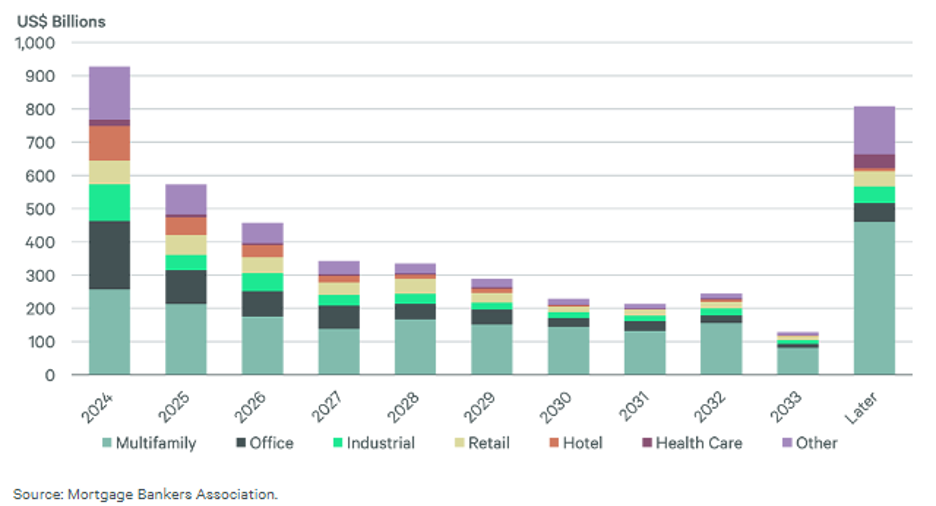
Debt Cliffs and Default: Top of everyone’s mind in both equity and debt real estate investments has been defaults, special servicing, capital calls, bank failures, debt cliffs. There is lots of data out there and one thing I want to highlight is there are many indices tracking these events and not all of them are the same. When you see a benchmark number take the time to understand what makes up that data. If you don’t, it is easy to be misled.
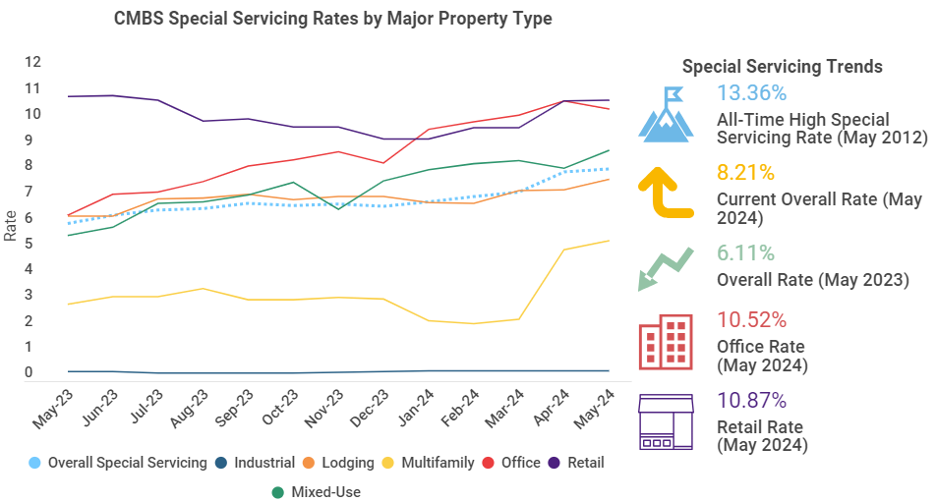
As large commercial real estate continues to struggle, we saw default rates/special servicing rates continue to increase last month. The TREPP CMBS Special Servicing Rate had the largest single monthly jump in the last four years. The rate jumped 80 basis points to 8.11%. This is the first time since 2021 that the rate has topped 8%. Four property types made up 98% of the 8.11%: Office, retail, multifamily, and “Other”. Office has always been the largest contributor of late but multifamily was the largest contributor this month to increased servicing rates.
Fund Managers:
Many investors of late have been asking me, what makes a good investment/fund manager? Entire books have been written about this subject so l will attempt to answer this question here by hitting some of the top points and by no means is this list exhaustive.
Efficient process and operations. Every aspect of a good manager overlaps this category as this is the most important and can only be built from experience. This is a complex web that assures the efficiency of the investment process and the generation of consistent returns and the avoidance of risks through many different market cycles. The KCG team brings multi-decade of experience, in underwriting, real estate, risk management, portfolio management, and technology systems. This is one of the points that we pride ourselves on. Brock has an extensive background in development and integrations of process, which has led the company to a vast pool of Standard Operating Procedures (SOPs) allowing all members of the company to be able to follow, understand, and implement almost every function across all aspects of the company.
Hiring the right people. It is costly and time consuming to define a position, identify potential candidates and then interview and test these candidates. This is so important that an entire industry backed by technology has been created to help facilitate the process. These folks are the stewards of your investment and in time they might be the people that carry on the next era of investments for a manager. The average time it takes to complete the hiring process at KCG is four months. This seems like a long time, but we feel that time allows us to assess multiple factors to better understand the candidate and the candidate to understand the company, management and the team. We hire slow as we know we will obtain talented people that understand the opportunity and potential career path for them at KCG.
Team and management of people. In a fund there is no group that does not overlap with another group in the normal course of action. Building a culture of transparency and trust is key. That does not mean everyone in the company is reviewing how everyone else is doing. What it does mean is providing everyone visibility on how the company is doing, what certain department priorities are, where the company is headed, and the vision of management. Everyone’s job intersects with others constantly and it is important the team knows where they are headed and the plan to get there and what their part is and how their efforts impact the efforts of others. We have developed a transparent organization where all members understand the impact and importance of their efforts and they also have input in ways to make the company better and increase the odds of successfully meeting our goals.
Risk management. There are many quantitative tools and risk factors to monitor to help understand a portfolio of investment assets. As investors, you must take risks to make a return.. A Manager should recognize the risk they want to take to earn an excess return consistently. Our underwriting process digs into a plethora of very specific risks at the property, structure, and borrower level. At a portfolio level we also monitor a second layer of risk factors, property type, geographical location, borrower concentration, and valuations. We, at Kirkland Capital Group, have no drift in our investment style. We invest only in first lien, full recourse micro-balance bridge loans in commercial real estate. We understand the risks we are taking, and it is a similar profile with every trade. With a clear focus and a defined process, it is easier to make dynamic shifts to control risk in fluid markets. Many other managers will invest across a spectrum of investments. Yes, that might diversify sources of return but also adds a number of additional risks for the manager to now be responsible for and understand as these ever-changing markets continue to move.
Even with focus and understanding of risk there is still risk in the portfolio and no manager gets them 100% right. What is important is the impact and the management of any challenged trades has a minimal and easily defined impact to the fund.
Operational risk management. Of course, this is intertwined with process and procedure. Operational controls are a huge component in today’s investment management business. According to papers from CAIA and empirical evidence of working in the space, 50%-66% of private fund failures are from operational errors or lack of knowledge. Dual controls of cash, limitations to access of sensitive information, cyber security, understanding of regulations, third party oversite via a Fund Administrator, and annual operational and financial audit. KCG has always been keen on operational controls to ensure transparency and safety of investors' investments in the Fund. No money can be moved in KCG without dual authorization. The third party fund administrator is responsible for fund accounting, fee calculations, and tracking all transactions for the fund. With that said, we have our own accounting team that shadows all calculations to ensure the third party accounting groups are accurate. At the end of the day, the fund is our responsibility and not that of a third party service provider. (See our article on how we ensure transparent and accurate monthly investor statements). Auditors are engaged annually to receive information from the Fund Admin and the manager to verify all positions, transactions, and operations. We are proud to provide this level of scrutiny and transparency to our fund to ensure operational safety of investor’s capital.
To summarize, the better managers should have deep understanding of the risk-return relationship. What risk do they need to take to earn the return they are seeking? What is the strategy and objective of the fund? Believe in that strategy and be focused regardless of market shifts. This understanding of risk and focus should help limit losses and create resiliency over time. Risk management should be at every level of the organization not just in the trades. Consistent and explainable understanding of underwriting, trade execution, monitoring, exit, treasury management, accounting, cost controls, ROI analysis of projects and systems, and service provider reviews, and more are all important for a strong manager.
When you have any questions about the newsletter or the Kirkland Income Fund, please do not hesitate to reach out or book a call with me.
