April 2024 Newsletter
Kirkland Income Fund Update
I hope you were able to watch the quarterly webinar. If not, Brock and I discussed several events related to the current environment creating loan stresses. Apart from that, a majority of the portfolio is business as usual.
We have seen a number of loans roll off this year, which is good news. We have also been recycling those funds and additional investments from investors to fund several new loans, while we continue to have a strong pipeline.
As we have mentioned in the past, we have always been conservative in our due diligence process, and we have become even more conservative over time. Interestingly, this increased caution has not forced us to reduce our lending interest rates, nor has it affected our pipeline.
This year will still have challenges, but we remain enthusiastic about the potential in private debt and especially in our niche area of micro-balance bridge loans for commercial properties.
Trials for Fund Managers
It's been a tough year for many funds. Some have shut down, stopped distributions, or missed return goals. I hope you're not facing any of these situations.
It's time to review your investments and understand their structures and challenges. Ongoing monitoring is a key part of due diligence.
The Federal Reserve announced recently that rates won't change. This was expected, but some think there will be no easing this year. This will continue to cause problems for funds that had weak underwriting and/or high levels of financing.
Understand the fund’s structure. You may think that a fund that offers you a fixed return or has a high preferred return structure is attractive. You may assume that this reduces some risk for you.
It does not.
In this environment, some funds will fall short of the minimum payout level they promised to investors. This has been a problem historically in many public and private investments that have high-yield payout structures.
When the market declines and there are challenges, the fund realizes it cannot sustain the high distributions they achieved in easier times. We discussed this in our article about the importance of consistent and stable returns.
Another scenario is a fund that offers a preferred return and only charges incentive fees above that preferred return level.
Sounds great, right?
This structure can also create problems when markets go down. If the fund's returns drop below the preferred return level, a high-water mark is created, and the fund cannot collect incentive fees until it reaches that level again. Some funds may choose to recover over time from the shortfall of the preferred return.
However, many funds will close that fund and open a new one that has no high-water mark. This way they can quickly once again earn incentive fees from their activities. This is not ideal, as investors are stuck in a fund that is not the main priority of the manager, and without any extra fees incentivizing the manger’s efforts, it may take a long time to liquidate that fund.
This is not a hypothetical situation, I just found out about a fund last week that did this to their investors.
Be sure to also inquire about redemptions. Increased redemptions due to a lack of performance can operationally stress a fund to the point it will close. Do not be late in that queue.
Impact of rising and falling rates on private debt
High capital costs continue to put pressure on equity investments. This generally lowers the expected returns, but it does not imply failure.
Lenders have benefited from higher rates, but they have also seen their credit spreads shrink as private rates have not increased as much as the Fed Fund’s Rate in 2022. This gap between private and federal rates is caused by many factors that affect the supply and demand of different lending pools.
For instance, demand for property has remained strong in certain segments, keeping the prices high for those. However, high property prices mean that the financing rate must be low enough for the investment to make financial sense for a long-term lender.
We believe that if rates fall, funds that operate in less crowded areas should recover some of the margin spread that they lost in 2022. It is worth noting that Kirkland Income Fund operates in a less crowded area, so we expect to see less fluctuation in lending rates as the Federal Reserve starts to cut rates.
Usual Suspects
Inflation causing rates to be higher for longer. Real GDP growth slowed but consumer spending was strong, job market is still strong, and labor participation rate is up. Federal reserve did not lower rates but holding steady to let the past moves continue to take effect.
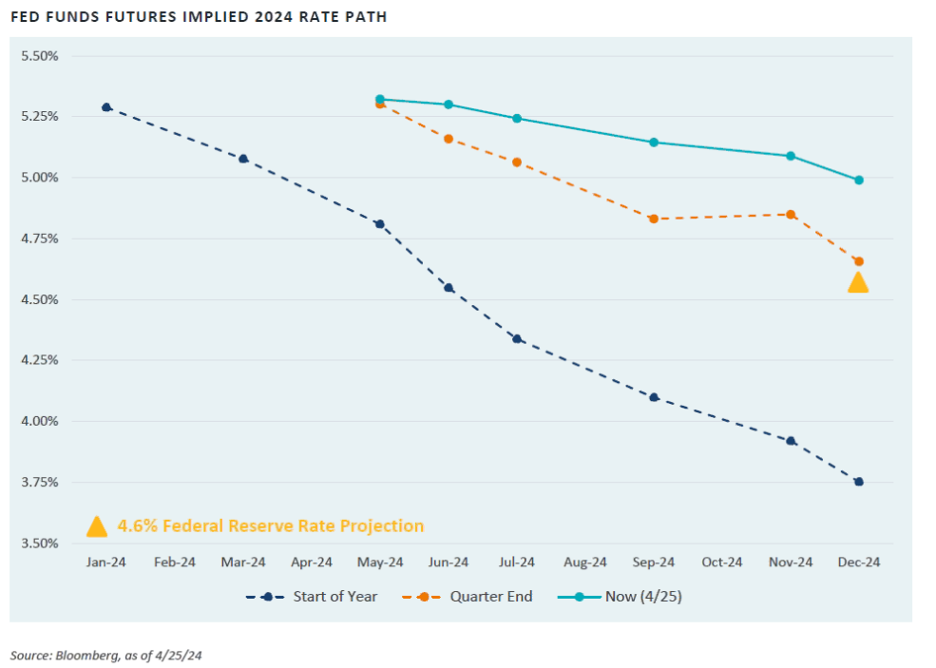
The chart below shows the changing rate expectations. At the start of the year people saw rates falling considerably, perhaps even as low as 3.75% by the end of the year. At the end of Q1 2024, that expectation changed drastically to a future expectation of 4.6%. As of April, the expectation is we will likely see a small rate decrease to 5% from 5.25%. We still believe, and are running our underwriting models on the probability, we see no changes this year.
Equity valuations across multiple asset classes have been in question for some time but keep going up or at least holding their value. With the belief the Fed is not going to ease, will that create pressure on values for the rest of the year? A few things to consider that have and could continue to counter a big fall in valuations.
Strong earnings continue to buoy a broader public market.
Lots of cash on the side lines looking to be invested.
The election is not helping the growing uncertainty investors are feeling this year
Still contemplating Alternative Investments for your Portfolio?
Public Equity markets continue to be strong so why should you still be considering alternatives investments. I never believe in doing all traditional or all alternative in any bucket of an investment portfolio.
With that said, there are some forms of investment that can only be obtained via a private investment platform. Alternative equity investments have a growing market space with the number of private companies now being multiples larger than the available public company options since 2000.
Even though public equity markets have been strong, adding alternative equity investments allows investors to participate in a broad and growing market space while also taking exposures that can lower the overall volatility of the portfolio.
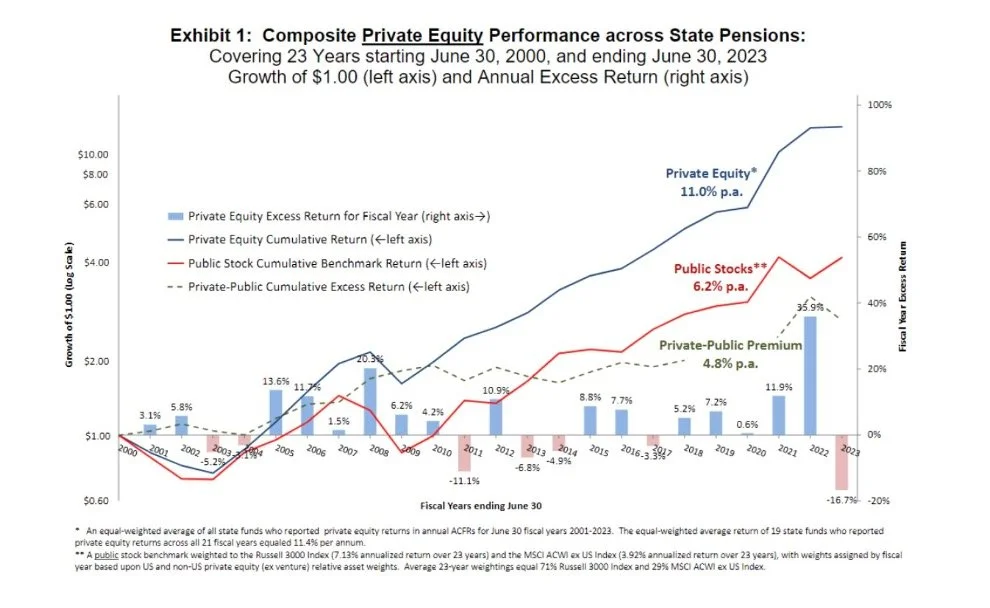
Also, historically Private Equity has outperformed public market equivalents. The chart below is from a Cliffwater report and supplies a great picture of how private equity has outperformed over time.
Alternative investments also give access to greater diversification. Private equity has a historically lower correlation with public traditional investments.
Private Credit can also enhance the return profile and simultaneously increase diversification to an investor’s fixed income allocation. Other alternative investment classes like hedge funds, and real estate, can also be utilized to create enhanced risk-adjusted returns.
As mentioned, Inflation is going to be prevalent for longer and at higher rates than expected. Public investments are certainly earning a return but with investment grade bonds expected to return 4.6% over the next 10 years and expected inflation to be 2.4% for the same period according to JPM. Not much yield left-over net of inflation.
As can be seen in the chart below, alternatives have expected rates in the high single to low double digits.
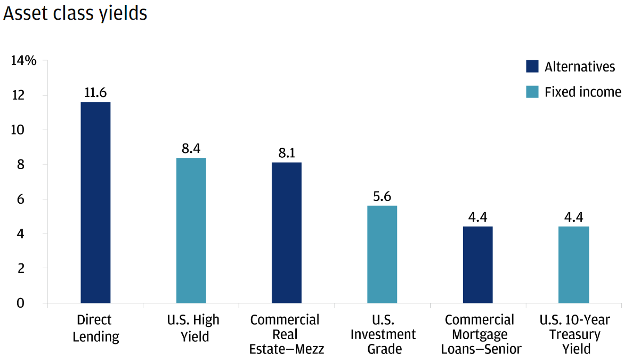
Source: BAML, Bloomberg Finance LP, Clarkson, Cliffwater, Drewry Maritime Consultants, Federal Reserve, FTSE, MSCI, NCREIF, FactSet, Wells Fargo J.P. Morgan Asset Management. *Fixed income yields are as of 11/30/2023. Alternative yields are as of 9/30/2023 and CRE – Mezz, which is as of 10/31/2023. CML – Senior: Gilberto-Levy Performance Aggregate Index (unlevered). Mezzanine commercial mortgage loans yield is derived from a J.P. Morgan Survey and U.S. Treasuries of a similar duration. Direct Lending: Cliffwater Direct Lending Index; U.S. High Yield: Bloomberg US Aggregate Corporate High Yield; U.S. 10-year: 10-year U.S. Treasury yield; Data is based on availability as of November 30, 2023. Past performance is not indicative of future results.
If you are still trying to decide and it is a fit for your portfolio, alternatives can help you battle the erosion of returns from our current stubborn inflation.
When you have any questions about the newsletter or the Kirkland Income Fund, please do not hesitate to reach out or book a call with me.
Chris Carsley, CFA, CAIA
