
June 2026 Newsletter
June brought a more constructive economic backdrop. Inflation moderated, the labor market appeared to stabilize, and interest rates remained relatively steady throughout the month. While market participants continue to debate the timing of future Federal Reserve actions, the overall environment became somewhat clearer than it was earlier in the year.
For real estate credit investors, improving economic conditions are helpful, but successful lending outcomes are ultimately determined at the property level. Factors such as property cash flow, collateral quality, borrower execution, and loan structure continue to play a much greater role in loan performance than broad market headlines alone.
In this month's update, we review June's inflation and employment data, trends in interest rates and commercial real estate lending, and how those conditions influence opportunities in private real estate credit. We also discuss the importance of loan structure, revisit bridge lending fundamentals, and answer an investor question about the difference between a default and a loss.
Economic Overview
Inflation: Cooler Headline, Still Above Target
The June Consumer Price Index fell 0.4% month over month, bringing headline inflation to 3.5% year over year. Core CPI was reported at 2.6% year over year, while shelter increased 0.1% for the month. The direction was constructive, especially after the May reacceleration, but inflation remains above the Federal Reserve’s long-run target.
For investors, lower inflation helps stabilize expectations around future interest-rate policy and economic growth. While inflation does not directly determine private lending outcomes, it influences capital markets, borrowing costs, and overall investor sentiment. A more stable inflation environment can provide greater confidence for both borrowers and lenders when making longer-term investment decisions.
Employment: Slower Job Growth Changes the Risk Mix
June nonfarm payrolls rose by 57,000, while the unemployment rate held at 4.2%. Labor force participation was reported at 61.5%, and April and May payrolls were revised down by a combined 74,000. Average hourly earnings increased 3.5% year over year.
The labor market appears to be moderating rather than weakening. For investors, this distinction is important. A moderating labor market generally means job growth is slowing from a very strong pace, but employment conditions remain stable enough to support consumer spending and household formation. That matters for real estate because people’s ability to earn income influences demand for apartments, retail spending, hotel travel, and the broader economy that supports property cash flow.
Stable employment also reduces pressure on the Federal Reserve to raise interest rates further, which can help borrowers by limiting additional increases in financing costs. At the same time, slower job growth bears watching because a more meaningful deterioration in employment could eventually pressure rents, occupancy, and borrower repayment capacity.
Federal Reserve and Treasury Markets
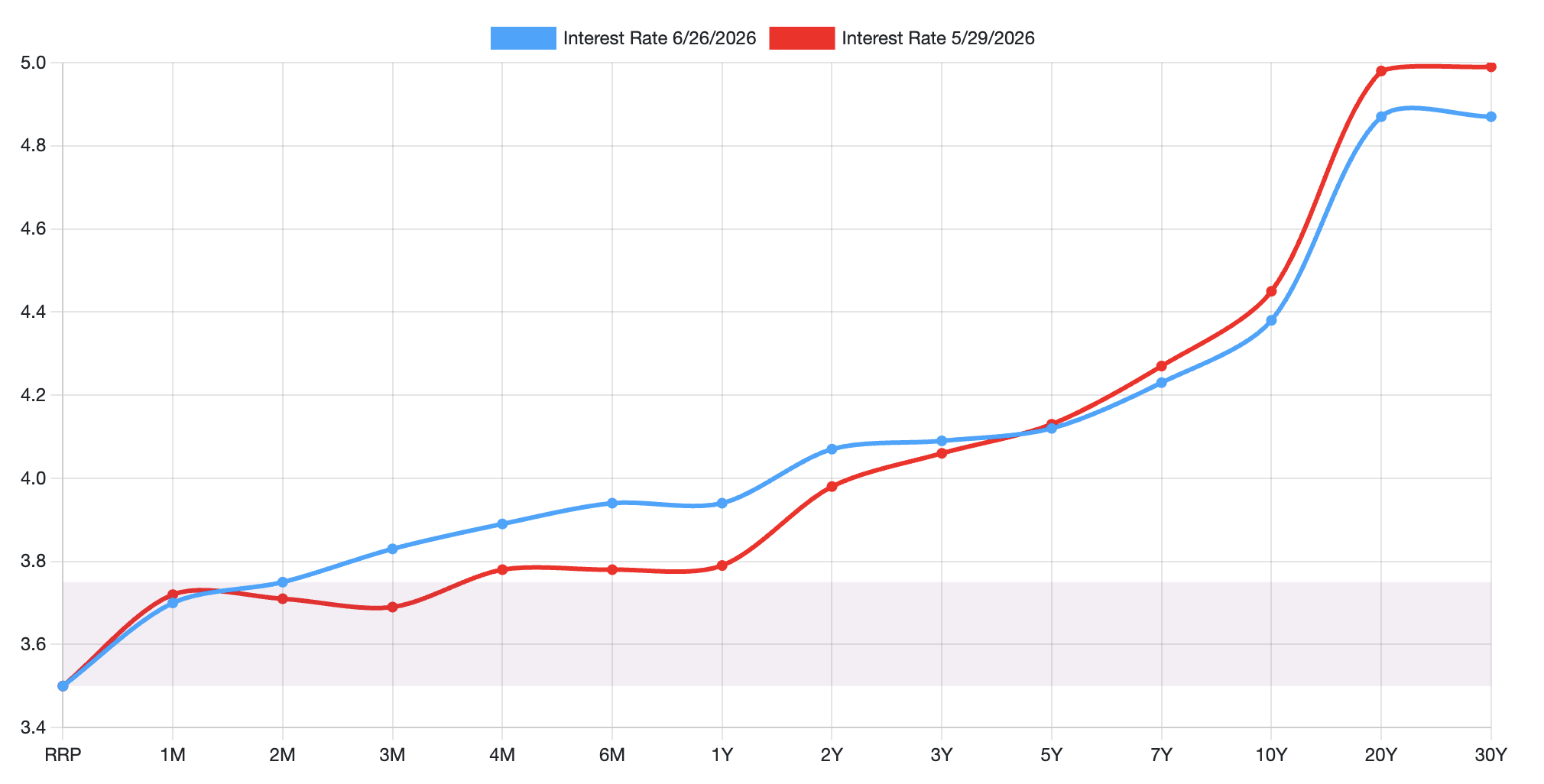
The June Treasury curve remained upward sloping beyond the short end. As of June 30, the 2-year Treasury yielded 4.14%, the 5-year Treasury yielded 4.19%, and the 10-year Treasury yielded 4.44%. Inflation data improved during the month, but the yield curve was little changed on the short end and no change on the long end. The gap from 0.47% to 0.30%. This tightening or flatter curve indicates slower growth and a neutral outlook on traditional bank lending.
|
Equity and Fixed Income Markets
Public markets were mixed in June. The S&P 500 total return index declined 0.95%, while MSCI U.S. REITs returned 2.39%. The Kirkland Income Fund reported a 0.58% net return for the month and a 3.92% year-to-date return.
|
We monitor and report traditional market returns because many investors hold the Fund alongside public equities, bonds, and other portfolio assets. In periods when pressure is visible across multiple markets, diversification becomes especially important.
Although Fund returns are currently under pressure, the Kirkland Income Fund continues to outperform many broader market comparables while maintaining low correlation to traditional markets. Even in tough markets the Kirkland Income Fund continues to combine the role as both a portfolio diversifier and a potential source of enhanced risk-adjusted return.
Real Estate Market Impact
The real estate data continued to show dispersion by property type. Credit pressure remains most visible where maturing debt, lower debt yields, or challenged collateral make conventional refinancing difficult. At the same time, several defensive property types continue to show better valuation or operating resilience.
Commercial Real Estate Credit: Underlying Friction
Trepp reported an effective CMBS delinquency rate of 9.53% in June when matured balloon loans are included. This figure provides a broader view of market stress because it captures both loans that are delinquent today and loans that have reached maturity but have not yet been repaid or refinanced.
Trepp also reported that 11.2% of CMBS loans were in special servicing, meaning the loan is receiving increased oversight due to payment issues, maturity challenges, or other credit concerns. While many borrowers remain current on interest payments, an increasing number continue to face challenges refinancing or repaying debt at maturity.
Rather than focusing solely on the volume of maturing debt, the more important question is whether a property's current cash flow can support replacement financing. Borrowers are not refinancing into the market that existed when many of these loans were originated. Today's lending environment places greater emphasis on debt yield, debt service coverage, collateral quality, and sponsor strength.
As a result, refinancing outcomes are becoming increasingly property-specific. Two borrowers operating in the same market may experience very different refinancing outcomes based on cash flow, leverage, property quality and property type. Well-capitalized borrowers with durable cash flow may continue to access financing, while assets with weaker income profiles may require additional equity, asset sales, restructurings, or alternative sources of capital.
Multifamily Operations Remain Stable, But Revenue Growth Is Uneven
RealPage data showed national effective asking rents up 1.4% in the second quarter but still down 0.2% year over year, with occupancy at 95.5%. In addition, concessions remain widespread with 24.6% of apartments offering concessions, indicating that many operators continue to use incentives to attract tenants.
While those figures suggest that apartment demand remains generally healthy, lenders should focus on cash flow rather than occupancy alone. Concessions, slower rent growth, and elevated operating costs can affect net operating income even when properties appear well occupied.
In today's refinancing environment, that distinction matters. A property's ability to refinance depends less on occupancy and more on the income the property can support. As a result, effective rents, debt yield, and property-level cash flow remain more relevant to credit outcomes than headline occupancy statistics alone.
Retail, Industrial, Hospitality, and Office
Green Street's Commercial Property Price Index (CPPI), which tracks changes in commercial real estate values, was flat month over month and up approximately 4% over the past year. While pricing has generally stabilized, the recovery remains highly uneven across property types.
Among the sectors we follow most closely, industrial continues to show relative strength, with values approximately 11% below their prior peak. Retail has remained closer to prior peak valuations than several other property types, with mall values only 1% below peak levels and strip retail values 2% below peak. By comparison, lodging remains 9% below peak values, while office remains the most challenged sector at 34% below peak.
For the Kirkland Income Fund, these differences reinforce the importance of property-level underwriting. The Fund continues to avoid office lending and instead focuses on situations where collateral quality, borrower demand, and repayment paths remain more predictable. The objective is not to avoid every challenge, but to maintain sufficient collateral protection and credible exit strategies throughout the life of a loan.
Private Credit's Expanding Role
U.S. private credit assets under management have grown to approximately $1.4 trillion, up from roughly $770 billion in 2021 according to the latest data cited by the Fed in their latest Financial Stability Report. The growth of the asset class reflects the increasing role alternative lenders play in providing financing solutions that do not always fit traditional bank underwriting standards.
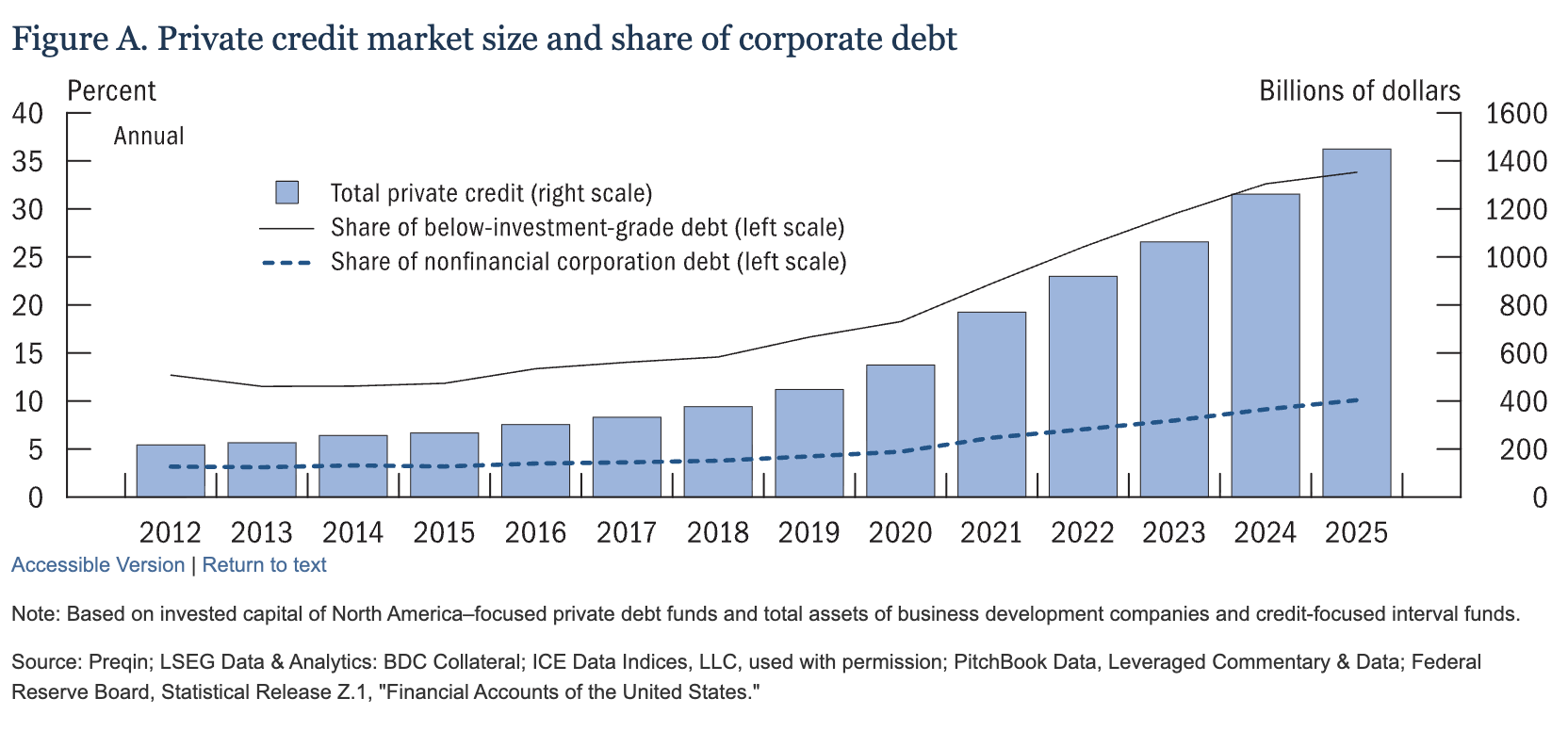
The more important story is not simply that private credit has grown, but that banks and private lenders increasingly serve different roles. Traditional lenders often focus on stabilized properties and standardized loan structures, while private lenders are more likely to provide customized financing solutions for borrowers with transitional assets, unique circumstances, or financing needs that fall outside conventional underwriting standards.
For the Kirkland Income Fund, this trend supports a large and active opportunity set of borrowers and properties. As banks increasingly focus on standardized lending and stabilized properties, many borrowers in secondary and tertiary markets continue to require financing solutions that fall outside conventional lending parameters. The growing role of private credit reflects continued demand for lenders that can provide customization, speed, flexibility, and disciplined underwriting. By focusing on conservative collateral protection and customized loan structures, the Fund can participate in opportunities that may be underserved by traditional lenders while maintaining a disciplined approach to capital preservation.
Educational Insight: Bridge Lending in a Slower-Exit Market
Bridge lending is short-term real estate financing used to carry a property through a transition period. The transition may be a refinance, sale, lease-up, renovation, recapitalization, or another timing gap that prevents conventional long-term financing today. While bridge loans are typically structured as shorter-duration investments, changing market conditions can sometimes extend the time required to reach a successful exit.
The concept is straightforward, but the risk varies widely by structure. A conservative first-lien bridge loan secured by current property value is different from a higher-leverage loan that depends on future rent growth, cap-rate compression, or a best-case sale. The same label can describe very different risk profiles.
In a slower-exit market, properties can take longer to sell, refinance, or stabilize than originally expected. For existing borrowers, that can increase the need for loan extensions or additional time to execute a business plan and demonstrate sufficient property stability to qualify for permanent financing.
When that occurs, lenders must reassess the property, borrower, and market conditions to determine whether extending additional time is likely to improve the outcome or simply delay a problem. Depending on the circumstances, a lender may extend the loan, modify certain terms, require additional borrower support, or pursue other solutions designed to maximize recovery and protect capital.
The same considerations apply when evaluating new bridge loans. Conservative bridge lenders typically favor lower loan-to-value ratios, conservative property valuations, meaningful borrower equity, and adequate reserves. They also place significant emphasis on the property's ability to generate sustainable cash flow, particularly if refinancing is expected to be the primary exit strategy. Together, these factors create an additional cushion that can help absorb delays, increased carrying costs, or changing market conditions while protecting lender capital.
For investors, bridge lending should be evaluated loan by loan and lender by lender. The most important questions are whether the collateral provides sufficient protection, whether the borrower has meaningful equity at risk ("skin in the game"), and whether the expected exit remains realistic under current market conditions. These factors form part of a loan's structure, and in a slower-exit market, conservative loan structures can provide lenders with additional protection when business plans take longer than expected to execute.
What This Means for Kirkland Income Fund Investors
A Market Creating More Lending Opportunities
One of the defining features of today's lending environment is the growing need for financing solutions that fall outside traditional bank underwriting parameters. While banks continue to play an important role in commercial real estate finance, many borrowers require customized structures, transitional financing, or greater flexibility than conventional lending programs can provide.
For disciplined private lenders, this creates opportunities to tailor financing solutions to the specific needs of a property and borrower while maintaining conservative underwriting standards. However, lending outcomes are not determined by opportunity alone. Loan-to-value, collateral quality, sponsor commitment, legal protections, and duration all influence how a loan performs under stress.
For the Kirkland Income Fund, opportunities are often found in secondary and tertiary markets where financing needs may not fit conventional lending standards. The Fund focuses on first-lien full recourse lending, conservative valuations, lower loan-to-value ratios, and shorter-duration loans. These structural protections are designed to help preserve capital while allowing the Fund to participate in opportunities that may be underserved by traditional lenders.
Investor Question
Question: What's the difference between a default and a loss? And how should investors think about principal preservation?
Answer: A default and a loss are not the same thing.
A default occurs when a borrower fails to meet the terms of a loan agreement. A loss occurs only if the lender is ultimately unable to recover the full amount owed after exercising the remedies available under that loan agreement.
In real estate lending, loans are secured by specific collateral, as well as other borrower assets when a personal guarantee is provided. As a result, a default does not automatically translate into a loss of principal. The outcome depends on a variety of factors, including the value of the collateral, the amount of borrower equity, the borrower’s other assets when a personal guarantee is provided, and the lender's ability to recover value through the remedies available under the loan agreement.
For that reason, principal preservation begins long before a loan is made. It starts with underwriting. Loan-to-value, property quality, borrower equity, borrower’s supporting assets exclusive of the property, market conditions, and exit strategies all play an important role in determining how much protection exists if a loan encounters challenges.
For investors, it can be helpful to think about risk through three separate lenses:
Loan performance — whether borrowers are meeting their obligations.
Collateral protection — the value supporting the loan.
Realized losses — any permanent impairment of principal.
While defaults often receive the most attention, long-term lending outcomes are ultimately determined by recoveries and realized losses rather than by default events alone.
Looking Ahead
June's data suggested that inflation may be moving in the right direction, but refinancing conditions remain the central challenge for many commercial real estate borrowers. Lower inflation can improve sentiment and reduce pressure on interest rates, yet borrowers still need sufficient cash flow, property value, and lender demand to successfully refinance maturing debt.
As we move into the second half of the year, the Fund remains focused on opportunities created by that disconnect. Markets may continue to debate the timing of future rate cuts, but lending outcomes will ultimately depend on collateral quality, borrower equity, and realistic exit strategies. Those are factors that can be underwritten directly rather than forecasted.
