
July 2026 Newsletter
For many fixed income investors, 2026 has been a reminder that generating income and preserving capital are not the same thing. As government bond rates have risen, many traditional bond investments have lost value. Yet investors still need investments that can provide income while helping protect their principal.
The question we believe investors should be asking is simple:
Given today's economic environment and where conditions may be headed, why should investors own fixed income? And why might alternative fixed income backed by real estate collateral deserve consideration?
Economic Overview
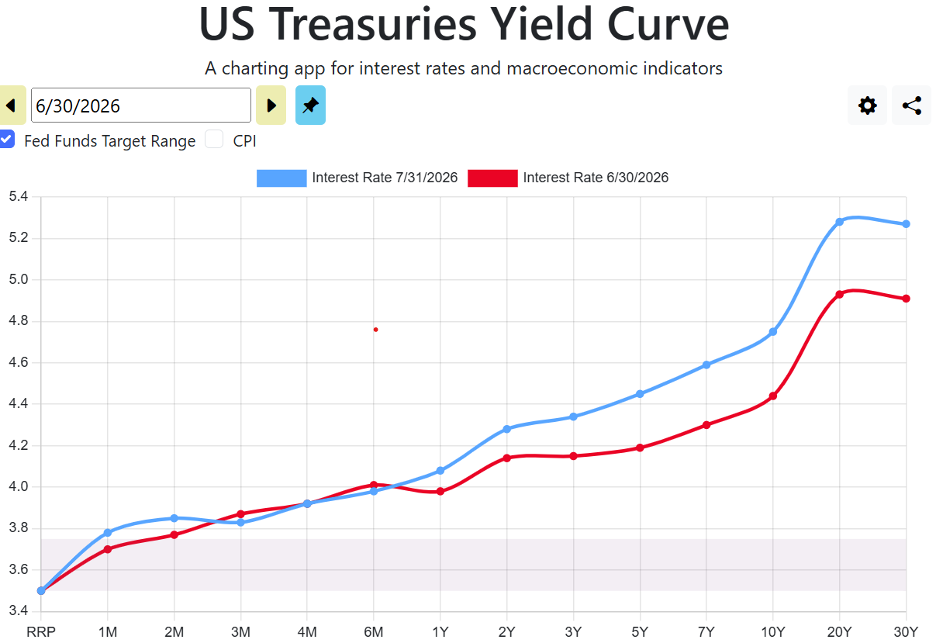
Markets in July 2026 recalibrated around the reality that inflation remained above the Federal Reserve’s long-term objective. Economic activity remained comparatively stable, and interest rates were expected to remain elevated for longer than many investors had anticipated.
|
||||||||||||||||||||||||||||
Implications
Inflation has declined significantly from its post-pandemic highs but remains above the Federal Reserve's target due to supply chain disruptions, fiscal stimulus, labor shortages, tariff impacts, and energy market disruptions associated with geopolitical conflict. At the same time, unemployment remains relatively low. Because inflation remains above target and the job market is still strong, the Federal Reserve is less likely to lower interest rates quickly.
Fixed Income Markets
July was a difficult month for many fixed income investments, including government bonds, corporate bonds, municipal bonds, mortgage-backed securities, and private loans. Many investors assume that if they buy a bond for $100, it will always be worth $100. That is only true if they hold the bond until maturity. In reality, many bonds are bought and sold every day, and their market value can change over time. When interest rates rise, newly issued bonds pay more interest than older bonds. As a result, investors are willing to pay less for older bonds that pay lower rates. This is why many bond investments lost value during July, even though the underlying borrowers often continued making their payments.
The key takeaway is that traditional fixed income investments can provide income, but their market values can still rise and fall as interest rates change. July served as a reminder that investors should look beyond yield alone and understand how an investment may perform in different market environments. Importantly, changes in value can occur even when the underlying borrower continues making all scheduled payments and the investment's credit quality remains unchanged. These differences help explain why fixed income strategies can produce very different results during periods of changing interest rates and market volatility.
The Kirkland Income Fund (KIF) works differently than many traditional fixed income investments. A traditional bond typically pays a fixed interest rate for a fixed period of time. When interest rates rise, those fixed payments become less attractive, causing bond prices to fall.
KIF is an evergreen fund that makes first-lien commercial real estate loans. As loans are repaid, new loans can be added at current market rates. Because the portfolio is continuously changing, the income generated by the Fund can adjust over time as market conditions change. Rather than relying on a fixed payment stream established years earlier, the Fund's income can evolve as the portfolio evolves. This difference in structure eliminates the need for price adjustments that often occur in traditional fixed-rate bond investments when interest rates change.
How Have Different Fixed Income Strategies Performed?
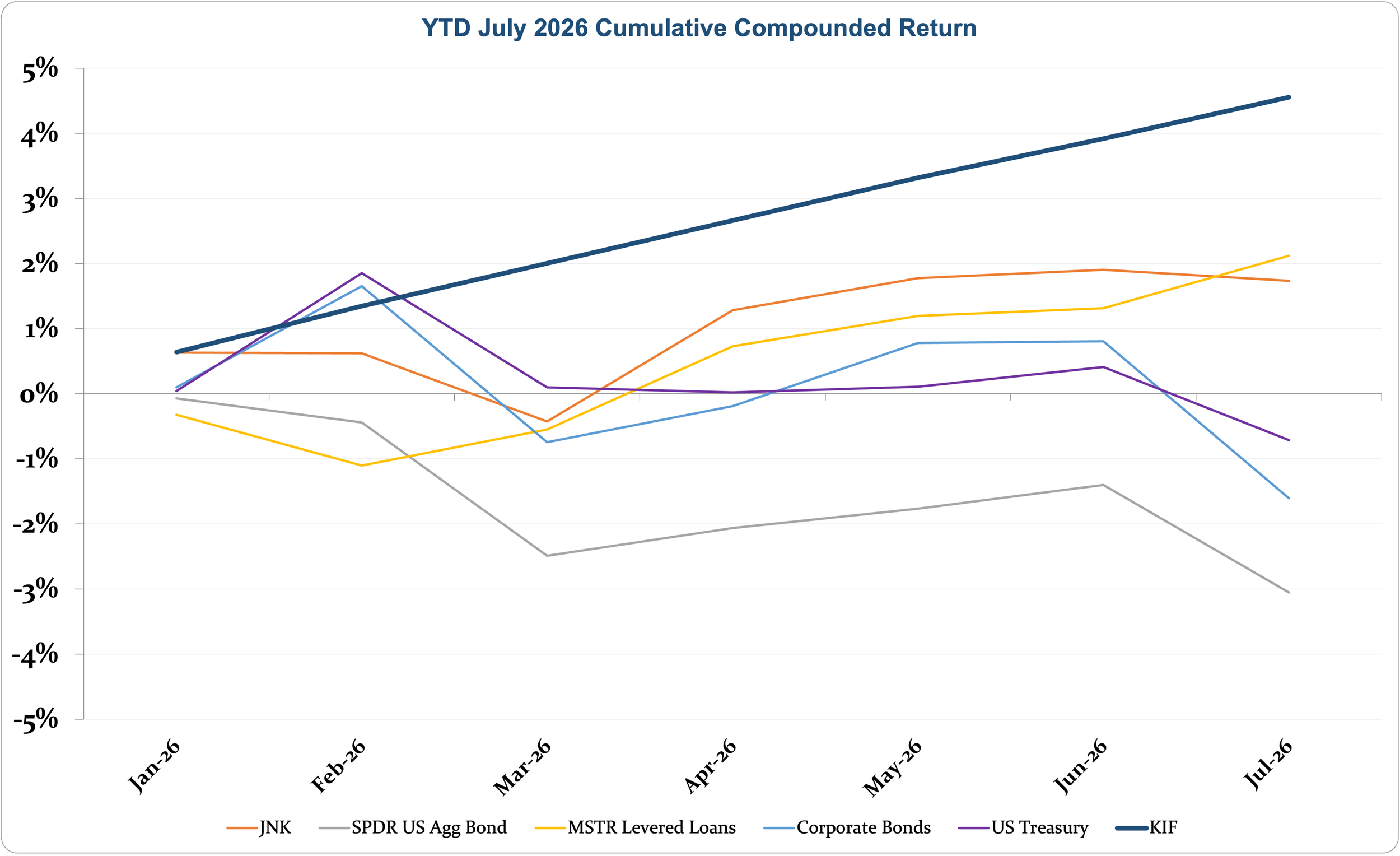
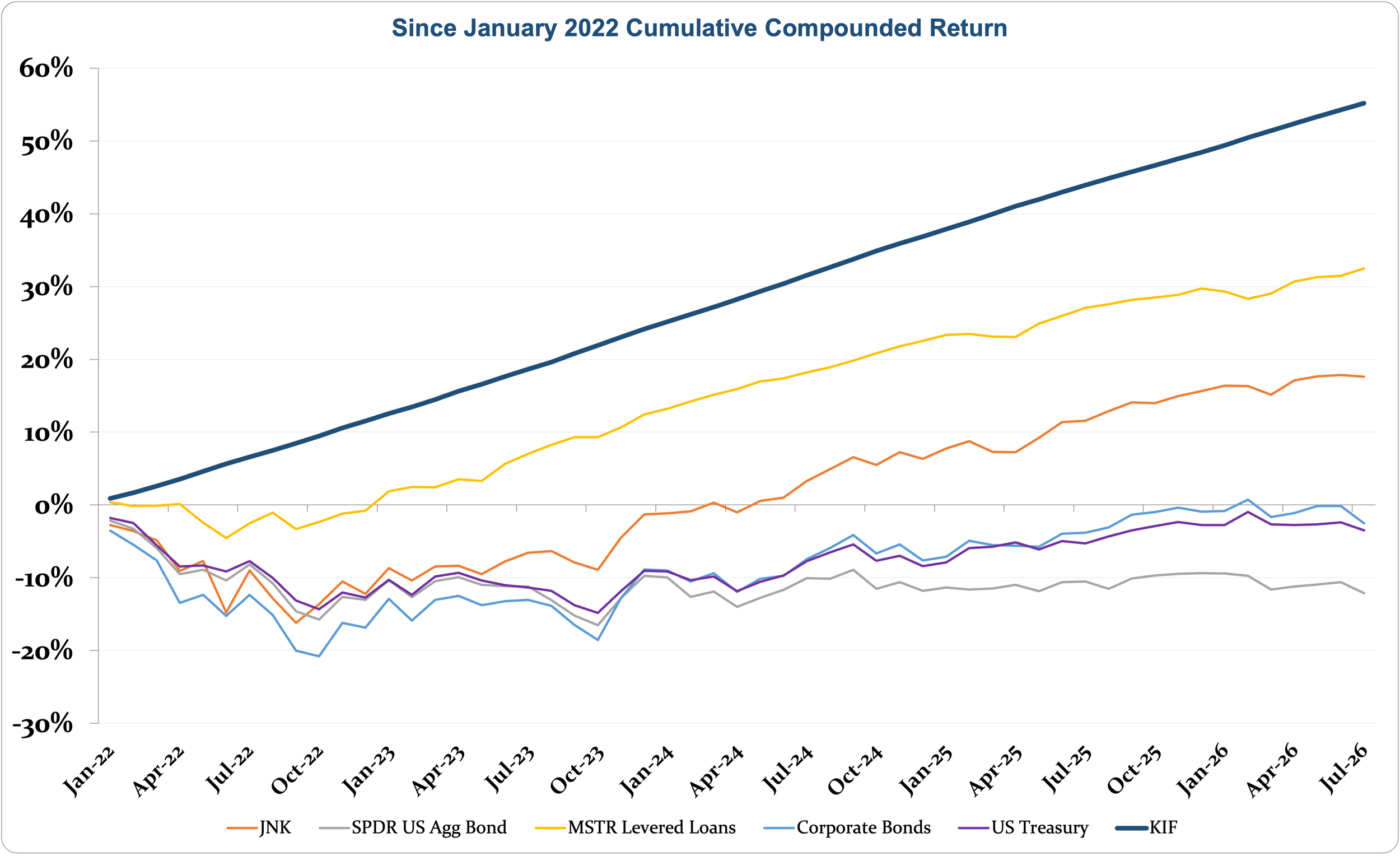
The following charts compare KIF’s performance against several traditional fixed income benchmarks during 2026 and since the last major interest rate disruption in 2022. This comparison helps illustrate how different fixed income strategies have performed across a more challenging rate environment.
Fixed Income Comparison Year to Date (YTD) July 2026
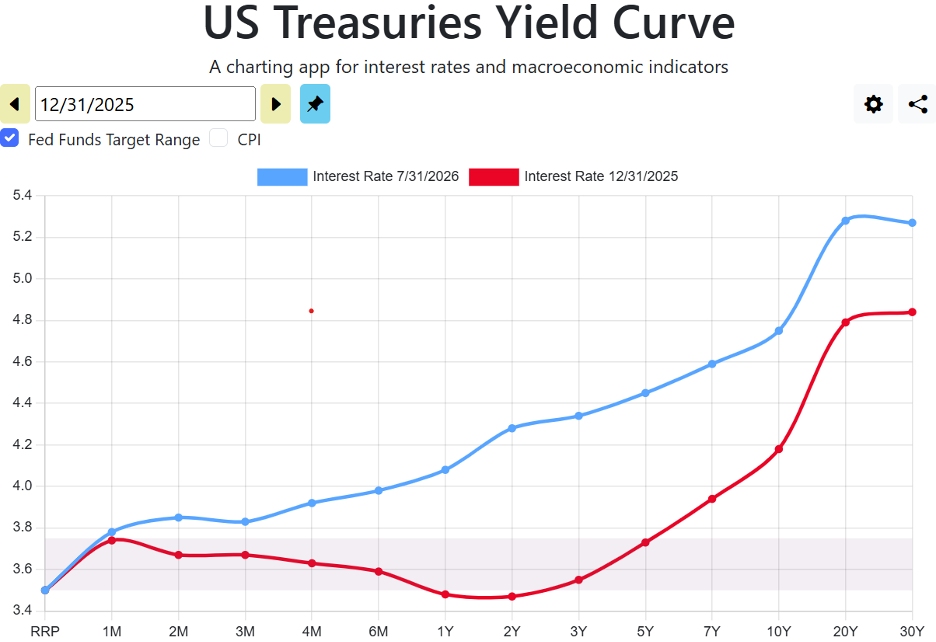
As can be seen in the YTD July 2026 yield curve chart above, interest rates have moved up across the entire curve. This has made 2026 one of the worst performing years for fixed income since 2022 which was devastating to fixed income markets (see chart in the next section). Fixed Income is under pressure yet the Kirkland Income Fund has continued to provide positive returns with little volatility throughout 2026.
Fixed Income Comparison Since January 2022
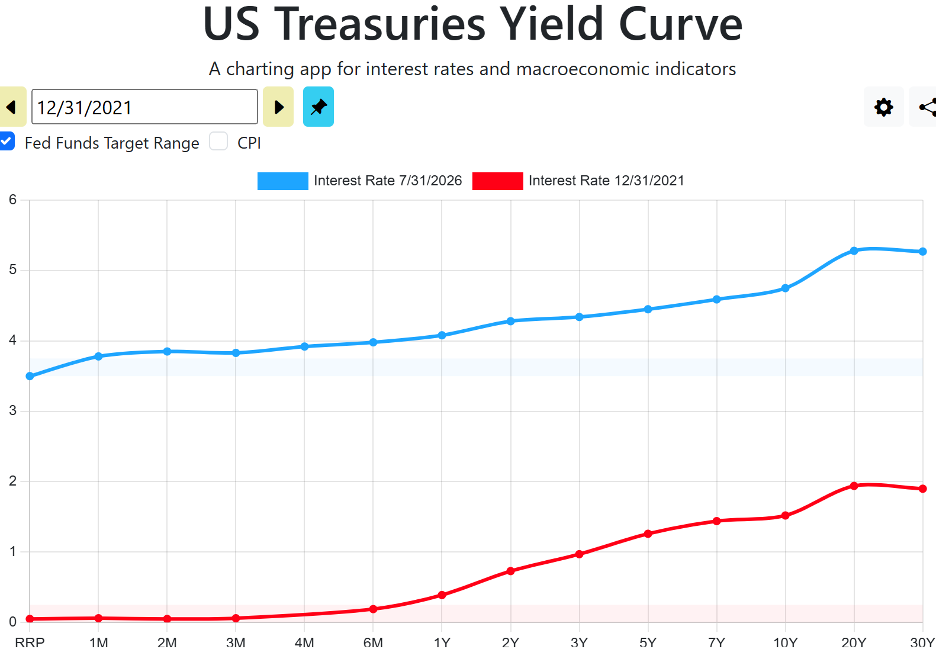
Since January 2022, the interest rate environment has changed dramatically. The Treasury yield curve above illustrates the magnitude of that shift. Treasury yields were near historic lows across nearly all maturities, while today's yields remain significantly higher across the curve.
As can be seen in the chart below, many fixed income indices have yet to fully recover those losses, and the additional pressure experienced during 2026 has further extended the time required for some investors to return to prior highs. The Kirkland Income Fund has produced a different return profile during this period.
Real Estate Market Impact
Across the market, borrowers continued to adapt to higher financing costs in July. There are some shifting tides occurring, based on CRED IQ data multifamily distress has more than doubled since February, from 6% to 13%, while office fell from 21.2% to 16.7%. In July alone, 180 loans totaling $992 million became newly distressed, and roughly 96% of that balance was multifamily.
According to CRED iQ's July reporting period the economics put the Special Servicing Rate up 42 bps to 10.38%. This was the sharpest single-month rise of the year. Delinquency rate climbed a steadier 24 bps to 8.68%. Office is still the most pressured sector at a 16.65% distress rate with industrials down 2.35% and self-storage down 0.28% making them the healthiest real estate sectors by a wide margin.
Why do we have two numbers being quoted here? The two rates measure different stages of loan trouble in lending. They do not occur at the same time. Instead, they generally follow a sequence, with delinquency appearing first, then special servicing.
Delinquency Rate is the percentage of loans that are past due on payments, typically once a borrower has missed two consecutive payments (≈60 days late).
Special Servicing Rate is the percentage of loans that have been transferred to a special servicer because they are in default, imminent default, maturity default, covenant breach, or other distress conditions. Most loans transfer after 60 days delinquent.
Be careful when asking about distressed positions and understand the data and the definitions. As you can see loans under “distress” if defined by the sum of these factors would be closer to 19.06%.
Even with the larger markets still showing increased stress, KIF in this last month had no new distressed positions and we are working out of multiple positions through sales, and refinances that are targeted be concluded in the next few months.
KIF Investor Question
Question: "With interest rates remaining elevated, should investors be concerned about commercial real estate values?"
Answer: Higher interest rates can place pressure on commercial real estate values because they increase borrowing costs and can reduce what buyers are willing or able to pay for a property. However, commercial real estate is not a single market. Property performance can vary significantly based on factors such as location, property type, cash flow, management, and local market conditions.
From Kirkland Income Fund's perspective, our role is fundamentally different from that of a property owner. Property owners often depend on future appreciation to increase value. In contrast, KIF focuses on making loans secured by real estate and generating income from those loans. As a lender, our primary concern is not whether a property's value increases, but whether there is sufficient value in the property to support repayment of the loan.
KIF's portfolio is composed of first-lien mortgage loans that are originated at conservative loan-to-value (LTV) ratios. In simple terms, the amount lent is well below the estimated value of the underlying property. This creates an equity cushion, the difference between the loan balance and the property's value. While property values can rise and fall, a significant decline would generally be required before the collateral value falls below the outstanding loan balance. Portfolio property values would need to decline by approximately 40% before they fall below the loan balance. This equity cushion is intended to provide an additional layer of support for principal preservation during more challenging market conditions.
Looking Ahead
As fixed income investors evaluate opportunities in the second half of 2026, we believe preparation matters more than prediction.
Markets rarely move in straight lines. Inflation may continue moderating, economic growth may accelerate or slow, and capital markets will undoubtedly respond to new information. What remains constant is the value of disciplined underwriting, thoughtful risk management, and a commitment to preserving capital.
At the beginning of this newsletter, we posed a simple question:
Why own fixed income, and more specifically, why consider alternative fixed income supported by stable real estate collateral?
For many investors, the answer remains unchanged. Fixed income serves an important role in generating income, preserving capital, and providing portfolio diversification. However, as we have shown, recent years have demonstrated that not all fixed income investments respond to changing markets in the same way.
This is why alternative fixed income may warrant consideration, particularly, strategies that have demonstrated they can behave differently than traditional fixed income investments. When supported by strong collateral, conservative structures, and disciplined underwriting, alternative fixed income may provide investors with another way to pursue income while reducing exposure to some of the interest-rate volatility that has challenged many traditional fixed income sectors.
At Kirkland Capital Group, our focus remains unchanged. Our goal is to provide investors with an alternative fixed income solution designed to prioritize capital preservation and income generation through disciplined risk management across changing market environments.
We invite you to review our latest fund materials, educational resources, and portfolio updates, or schedule a brief portfolio discussion if you would like to better understand how private credit may fit within your broader investment strategy.
Thank you for your continued trust and partnership.
