
July 2024 Newsletter
Opening Thought
Last month, Brock shared a relevant article with me that strongly resonated with our goals for the Kirkland Income Fund. The article, titled The Magic Behind Bezos and Buffett: Things That Don't Change (fs.blog), emphasizes the importance of focusing on identifying risks and opportunities within a specific niche and staying true to that path.
We are not fortune-tellers, and even those who profess to be often turn out to be one-hit wonders, struggling to replicate successful predictions, particularly as they extend further into the future. Our focus is on pinpointing the risks and opportunities within a specific niche and staying committed to that path.
While acknowledging that we cannot foresee everything, we understand the importance of being adaptable enough to steer clear of significant challenges and seize opportunities as they arise. Equally crucial is the ability to discern what will remain constant in our investment landscape, specifically in the realm of micro-balance CRE lending. A few questions we ask ourselves to ensure we are in a space that is not drastically changing:
Will demand for investment capital in micro-balance CRE continue?
Will secondary and tertiary markets demonstrate growth and economic resilience in the future?
Is it possible for an event or condition to emerge that would make real estate an obsolete component of a diversified investment strategy?
Will investors continue to seek opportunities that provide steady, high returns without the need to undertake undue risks?
Will private lending be eliminated by other lending sources?
There are so many great quotes in this short article but my favorite matches what we are building here:
“While investing in what’s changing is risky, investing in what stays the same is not.”
Kirkland Income Fund Update:
The recent news regarding interest rates has sparked some interest among investors, leading to consistent loan demand from month to month. While private lending options are starting to resurface, securing funding for real estate projects remains a challenge. The Kirkland Income Fund is nearing full deployment, with several loans meeting our stringent underwriting requirements. Although some existing loans are maturing soon, additional funding would allow us to take advantage of these attractive opportunities, characterized by conservative property valuations, substantial borrower equity commitment, and high interest rates.
Sales Volume and Capacity of Kirkland Income Fund
According to Boxwood means research, sales volume in Small Cap Commercial Real Estate (sales under $5 million) continues to increase. Last quarter saw a 13.3% increase in volume to $20.2 billion.
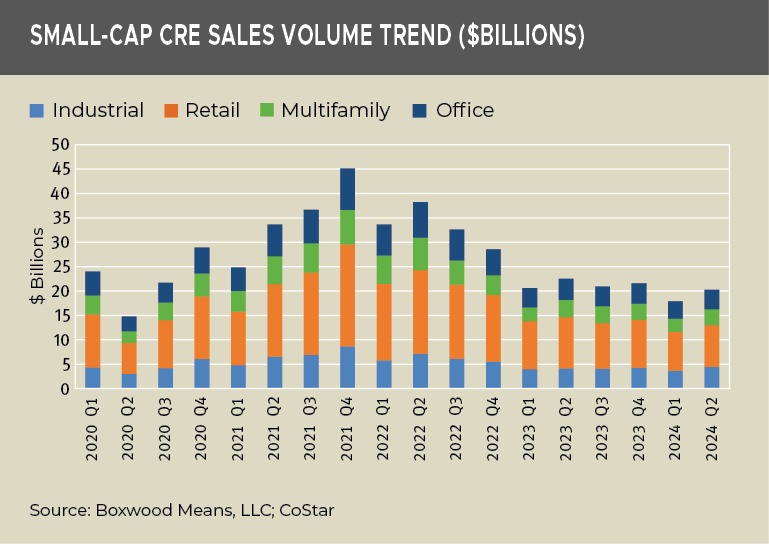
The increasing volume of activity is a step in the right direction, although it is noticeably sluggish when compared to past quarters and falls significantly below the average since 2020. The growth was mainly observed in Multifamily properties, with Office spaces also showing a surprising uptick. Retail properties experienced a slight increase as well. The marginal growth in Retail can be attributed to the limited availability, as investors have shown strong interest in Retail properties in recent years. This trend is reflected in our loan requests, leading to a rise in our exposure to Retail-related properties within the portfolio.
An important point to note is the volume of sales during a relatively sluggish period. The data provided by CoStar and Boxwood includes transactions of a larger dollar size compared to the specific target niche of the Kirkland Income Fund. One frequent query we get pertains to our fund's capacity, which continues to be aimed at $80 to $100 million. The abundance of active sales reaches into the billions. While our top loan size is $1.2 million, meaning not all of this data corresponds with our specific market sector, it still indicates significant potential for expansion, even during periods of market slowdown.
Data on the Small Cap Loan Industry
Below is a chart illustrating Cap Rates for Small Cap (CRE) on a national scale. It is important to note that this overview provides a general perspective and may not account for the specific property dynamics influenced by geographical location and property type. Overall, the data indicates that Small Cap CRE is demonstrating robust fundamentals, as evidenced by a flattening and stabilizing trend.
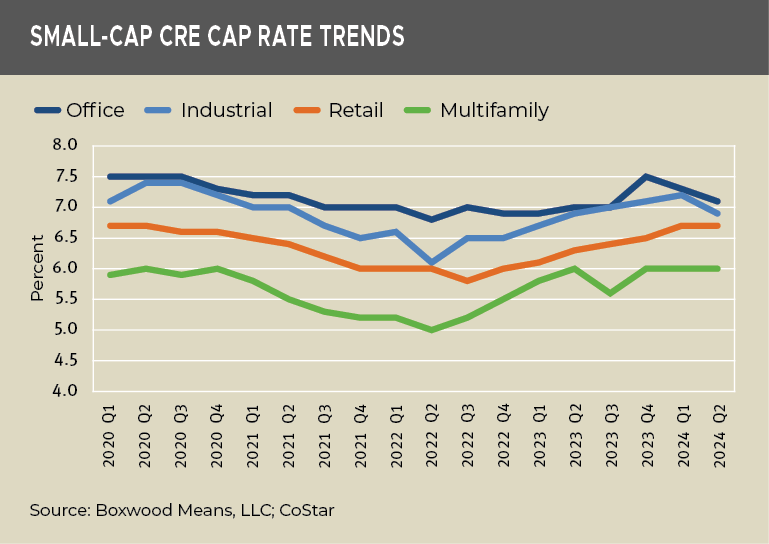
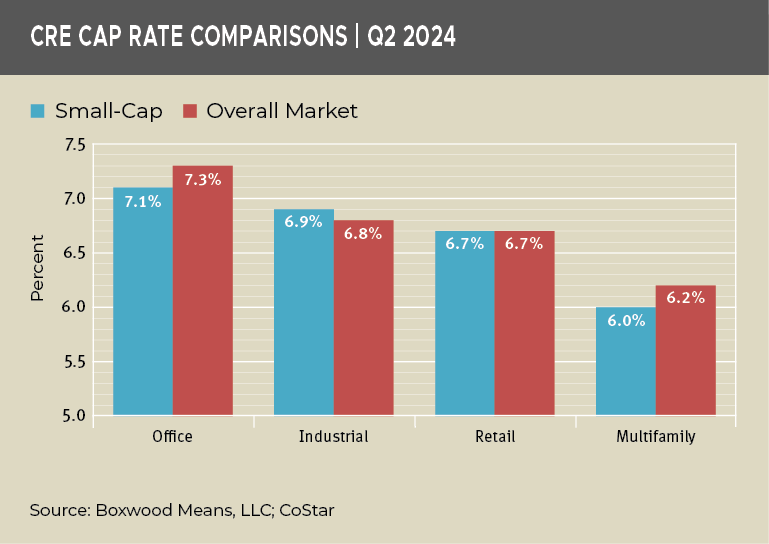
There's a common perception that smaller properties come with certain risks that larger ones don't. If you're still convinced of this, look at a news article on the topic from any time in the past few years. As shown in the chart below, in certain sectors like office and multi-family, small-cap CRE is showing better performance and more robust fundamentals.
Usual Suspects: Is a soft landing in sight for the US?
Inflation
Another key data point aligning with the Federal Reserve's objectives. The July Consumer Price Index (CPI) showed a 2.9% increase over the past 12 months. Interestingly, the traditionally volatile categories of food (+2.2%) and energy (+1.1%) did not drive this uptick. Instead, it was transportation services (+8.8%) and shelter (+5.1%) that fueled the rise, with shelter costs accounting for much of the monthly increase. For the Federal Reserve to meet its target, a moderation in shelter costs will be necessary.
There are still some problems for the Federal Reserve. One of the biggest is the faster growth of wages compared to inflation. Real average hourly earnings saw a 0.1% increase in July, with a year-over-year growth rate of 3.9% as of the end of June. In July, the unemployment rate stood at 4.3%, up from 4.1% in June. The Federal Reserve would like to see wage growth to remain below inflation, coupled with a slightly higher yet stable unemployment rate.
Interest Rates
With the positive economic indicators continuing to roll in for July, the visual representation below offers a consensus on the future direction of interest rates.
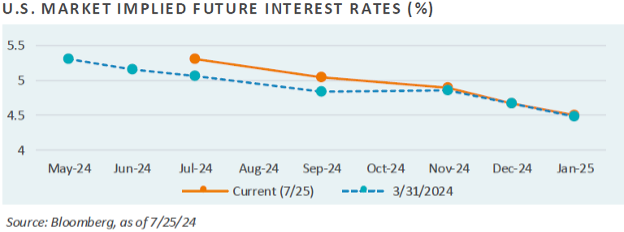
Next question people are already starting to ask: Will the size of the rate reduction be enough to help struggling investments?
Global
Many potential risks still loom that could potentially disrupt economic and investment outcomes in the near future.
Global growth is slow. In the US, we are witnessing a slowdown, whereas many countries on a global scale are experiencing even slower growth. Global growth currently stands at 2.2%, marking its lowest point since the time period spanning from 1990 to 1994.
Wars. The potential escalation of tensions in the Middle East could lead to a rise in energy costs, which may disrupt the Federal Reserve's inflation management strategies. Moreover, such conflicts could also pose challenges to global supply chain operations.
China’s economic slowdown. China plays a significant role in the global export market, with a large percentage of goods being exported to the country. Should the Chinese economy experience a slowdown, the reduced demand for imports could have negative implications for global growth. Developing countries would be particularly impacted, given that China accounts for almost 20% of all export demand.
We live in a global world, and monitoring these risks is certainly helpful, but remember we are not trading for the short term; we are investing and positioning for the long term.
When recently talking about risks, I was asked, “What do you think the next big surprise will be that affects markets?” My answer, “If I knew that, it would not be a surprise.”
When you have any questions about the newsletter or the Kirkland Income Fund, please do not hesitate to reply or book a call with me.
