January 2024 Newsletter
Month of January Index Returns vs KIF:

January was a successful month for us in all areas. We established the Sub-REIT and are currently in the final election process. The fund has reached $30 million in AUM, so we appreciate your ongoing support.
We continue to see an increase in loan demand, indicating ample room for growth for this fund. As the fund grows, all investors benefit from broader diversification. In January, we received 54 new loan requests, the highest number since the fund's inception. We have always maintained strict risk controls and are increasingly utilizing more data to identify the best properties and borrowers for lending. In January, we closed three new loans for the portfolio. These were loans from December that underwent underwriting and met all the criteria. While many of the loans we received in January will not qualify, we are excited about the high level of interest and a consistently strong pipeline of potential loans.
In January, we also received repayment for two of our loans. This demonstrates that our borrowers can still stabilize their properties and obtain long-term financing, even in a challenging banking environment.
As we mentioned in a previous email about Blackrock's research on expected asset returns, investing in private debt, particularly in niche and fragmented areas, can provide investors with higher returns compared to other asset classes and help diversify their portfolio. If you have not yet invested or need to adjust your investment allocations, please contact us with any questions to determine if the Kirkland Income Fund is suitable for your portfolio.
Markets
US stocks had a strong performance last year and continued to rise in January. Bonds also made a good recovery in the latter part of the year. What can we expect for 2024? It's difficult to predict, but Goldman Sachs provided some reasons why they still have confidence in and prefer the US markets for the long term. Do you have a long-term investment horizon?
US is the largest Economy in the World with 26% of global GDP.
Highest GDP per capita. (Except a few small resource rich and tax haven countries that amount to less than 1% of global GDP.)
Largest, most liquid financial markets that support public and private activity.
Most favorable demographics of all major countries except India.
Highest labor productivity.
Strong culture of promoting and supporting innovation.
Persistent and diverse corporate earnings growth.
Extensive natural resources.
Safe-Haven Status.
All the above creates resilience.
Keep in mind that these reasons explain why the US markets might outperform other global markets in the long run, rather than providing short-term predictions.
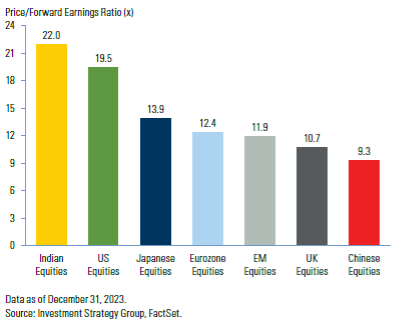
We must keep an eye on many things that are uncertain in the markets: One of them is Equity valuations. As you can see in the chart below, the US markets are not "inexpensive" on a relative basis.
Besides valuations, we have the usual suspects, Middle East conflicts, Russia-Ukraine war, US Government closure, China economy, China–US friction, increasing cyber security issues, US Elections, and...
Regional Banks are still in the crosshairs.
The commercial real estate sector remains unstable. Regional bank indices have been fluctuating as loans go bad in 2024. Some believe that the defaults for commercial real estate could surpass $700 billion. I want to point out that this primarily affects big commercial properties in major cities and urban areas, where prices have risen sharply, and debt levels have also increased. Regional banks do not have diverse sources of income to handle large losses from loans. It is possible that we will witness more bank failures and the FDIC stepping in to secure assets and encourage bank mergers to strengthen their financial position.
New York Community Bank’s stock dropped in January due to losses and anticipated losses from loans on office buildings. They reported “general office weaknesses throughout the country.” We still dislike Office and have avoided any office loans since we started. We expect more bank weakness and negative news in 2024.
Technology and Real Estate
I was waiting to see how this was going to unfold. Investors who had funds misappropriated from Nightingale's failed bid to acquire the Atlanta Financial Center have filed an arbitration claim with the Financial Industry Regulatory Authority against CrowdStreet.
Here are some articles that report on the recent developments.
Investors Seek To Shut Down CrowdStreet After Nightingale Fiasco (Bisnow)
Investors try to shut down CrowdStreet after Nightingale scandal (TRD)
Rates and Inflation
The FOMC Policy Decision was on January 31st. The labor market remains robust. Total nonfarm payroll employment increased by 353,000 in January, close to the increase of 333,000 in December. Nonfarm payroll employment rose by an average of 255,000 per month in 2023.
Inflation has decreased but remains higher than the target 2%. The economic outlook still has some uncertainties, and the main focus is on controlling inflation. The Fed Fund's rates were as predicted, staying within the range of 5.25 to 5.50. The Fed will monitor incoming data but has reiterated their previous statements from the end of 2023, emphasizing that there are no immediate plans to lower rates until inflation is brought under control.
Next FOMC meeting is March 20th. I would not expect much new information or a change of course.
It is only one data point, but the Federal Reserve reported that total consumer debt increased by $1.561 billion, resulting in a much lower total than the expected $15.9 billion. This is the third largest monthly decline since Covid affected the economy. A glimmer of hope as this could indicate that consumers are spending less, which might be wise since the average interest rate on revolving credit is 21.47% according to Federal Reserve data.
Regulations and Laws in Real Estate
In January, the house passed a legislation that will extend 100% bonus depreciation for real estate investors. Waiting for Senate to pass the Tax Relief for American Families and Workers Act of 2024. If you are an equity investor in real estate, this is very important.
