December 2023 Newsletter
Month of December Index Returns vs KIF:

Updates: Same Lingering Challenges All Year but a Hint of Holiday Glee.
Federal Reserve
Having three consecutive meetings without a raise is definitely helpful, but taking a pause won't be the fix for equity investors as they truly require. The public and private equity markets are still expected to experience more difficulties in the future. Powell has acknowledged that they are either at or very close to the conclusion of rate increases.
Inflation
The Consumer Price Index (CPI) rose slightly to 3.4% in December. The main causes of this increase were housing and food costs. Surprisingly, the price of car insurance jumped by over 20% from one month to the next. However, several factors suggest a future with lower inflation. Job figures have stabilized, and rental prices are either stable or decreasing.
Commercial Debt
We continue to deal with the issue of maturing commercial debt. Interest rates are likely to remain high for a longer period than most investors would like. This implies that refinancing the hundreds of billions in commercial debt due from 2024 to 2028 will be challenging. Additionally, the refinancing will cost much more than the current debt encumbrance. Higher rates have already led to numerous defaults in the large commercial sector. Are there more on the horizon? We will definitely tackle this debt burden in front of us, but it will be painful for some.
Private Debt
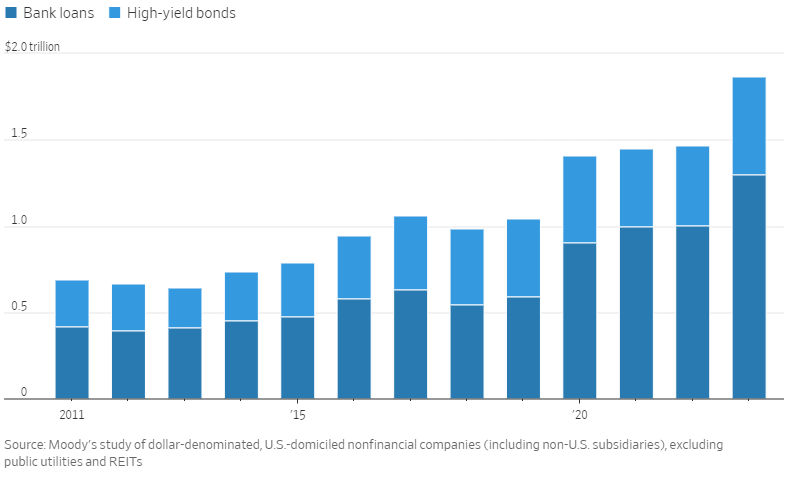
The big guys are diving into the pool quickly. In 2022 alone, private and public business development companies (BDCs) raised 25 billion. In 2023, they raised 14 billion. This often signals upcoming trouble. I hope their aim isn't to exploit investors' desire for yield and liquidity but to establish a long-term investment opportunity. Do your homework and realize that some investment products are created only to ride the recent wave.
Markets
The market always appreciates potential lower rates and some reduction in uncertainty. December brought strong returns across several indices. Specifically, I'd like to highlight that the S&P 500 has seen an annualized return of 19.19% and a Sharpe Ratio of 1.04 over the past 46 months. This is impressive for the "60%" allocation.
Now, let's talk about the "40%" allocation to fixed income. Traditional fixed income indices performed well in December, driven by the belief that the Fed is finished, and we might witness a decrease in rates. However, their annualized returns have remained negative over the last 46 months. It's time to think about alternative fixed income investments. Make sure to discuss the different options with your financial advisor. If they lack knowledge about alternative investments or don't have a platform to offer, work to broaden your network to gather the necessary information you need. If it would be helpful, book a call with me or reply to this email with your questions.
I usually avoid making predictions, but I have one crucial piece of advice. Be cautious if your investment plan is to adjust your allocations in 2024 to potentially benefit from falling interest rates. This choice involves timing the market. After 28 years of experience, I've learned a valuable lesson. A strategy that includes diversification and suitable risk sizing is superior to trying to predict complex, uncontrollable factors such as timing the market.
Kirkland Income Fund
I won't reveal too much before our upcoming KIF quarterly update next week, but I'll touch on some crucial points that we will explore further in our webinar. In December, we saw a robust demand for loans, with 42 new requests. The interest rates varied between 13% and 16.5%. The average Loan-to-Value (LTV) ratio for new loans stood at 54.29%. To meet the strong loan demand, we are expanding the team and are currently interviewing several candidates for an additional analyst and underwriting position. We remain cautious as the economic turmoil is still causing stress for some borrowers.
The fund performed well in December. We forecast the need for micro-balance bridge loans will keep growing into 2024 and further drive robust performance. Private Debt is set to yield another year of strong risk-adjusted returns, surpassing many conventional and private investment options. If you're interested in capturing returns from private debt in real estate or wish to boost your allocation, feel free to get in touch.
Interval Funds and BDCs
There has been lots of discussion, launches, and money raising around interval funds and BDCs. I wanted to give a quick introduction and overview.
Interval Funds
Interval funds are a new structure of SEC-registered, closed-end funds that fall under the regulations of the Investment Company Act of 1940. The structure was created to supply greater access to illiquid alternative investment strategies for investors. Some of the key characteristics are structured liquidity, low investment minimums, more frequent valuations, and 1099 tax forms rather than a K1. The objective of interval funds was to package an alternative investment into something that looked similar to what RIAs, broker dealers and retail investors were used to seeing, like a mutual fund.
Many new alternative investments have struggled to raise funds from RIAs, broker dealers, and wealth managers. Interval funds have certainly been a near term answer to bridge this gap as they have grown quickly and as of June 30th, 2023, there was a reported $87.8 billion in total assets.
Generally, the liquidity is structured quarterly but redemption amounts are restricted. Based on my analysis of various PPMs, most of them only allow a 5% quarterly redemption. This is within the regulatory requirement of 5% to 25%, but it’s common for funds to choose the lowest limit due to the illiquid nature of many alternative investments in the funds.
Interval funds are a new kind of alternative investment that combines many features. They could be a useful tool for investors. However, like anything new, make sure you are working with a reputable operator that has sound process and procedure. And don’t believe everything you hear. Do your research and know the opportunities, risks, and costs of what you’re getting into. Remember SPACs? They were all the rage but carried more risk and costs than many investors were aware of.
Business Development Company (BDC)
These investments are often seen as "alternative" and can provide substantial returns. However, for the purpose of my definition of alternative investments, they must not be publicly traded. Business Development Companies (BDCs) are publicly traded entities, registered with the Securities and Exchange Commission (SEC) and subject to the Investment Company Act of 1940. Being publicly traded exposes these entities to the emotional fluctuations and volatility of public markets, thereby negating many of the diversification benefits associated with alternative investments. BDCs are obligated to invest more than 70% of their assets in private companies based in the U.S., and they often provide operational and management support to these companies. Although BDCs primarily provide debt, they have the flexibility to hold a mix of assets in their investment structure. Similar to Real Estate Investment Trusts (REITs), BDCs can leverage their enhanced tax structure by distributing at least 90% of their taxable income as dividends to investors.
These are public companies, so you can find a lot of information about them. You need to perform thorough fundamental analysis to understand the risks involved. You should also determine if the current value justifies the investment. Don't get drawn into the high yields these instruments often show. Instead, explore how they generate and pay these yields so you can determine if they are sustainable.
