
August 2026 Newsletter
For investors focused on cash flow, August was another reminder that not all fixed income investments respond to market conditions in the same way. Treasury yields moved higher across much of the curve compared with the prior month, while investors continued to evaluate inflation, interest rates, and the durability of the economy. These factors affect both cash flow and market values.
In this month’s update, we look at how several fixed income strategies responded through August, what the current environment may mean for commercial real estate lending, and why understanding the source of income remains important when evaluating income-producing investments.
Economic Overview
August’s economic data suggested that inflation pressure remained present but did not materially change the broader picture from July. Headline CPI remained at 3.4% year over year (same as July), while core CPI eased slightly from 2.5% to 2.4%. The labor market also remained relatively stable, with unemployment holding at 4.1% and payrolls increasing during the month.
The takeaway is that inflation remained above the Federal Reserve’s long-term target, but the data did not point clearly toward either a more aggressive or more relaxed policy path.
|
||||||||||||||||||
Treasury Yield Curve Moved Slightly Higher in August
The chart below compares the U.S. Treasury yield curve at the end of July and the end of August.
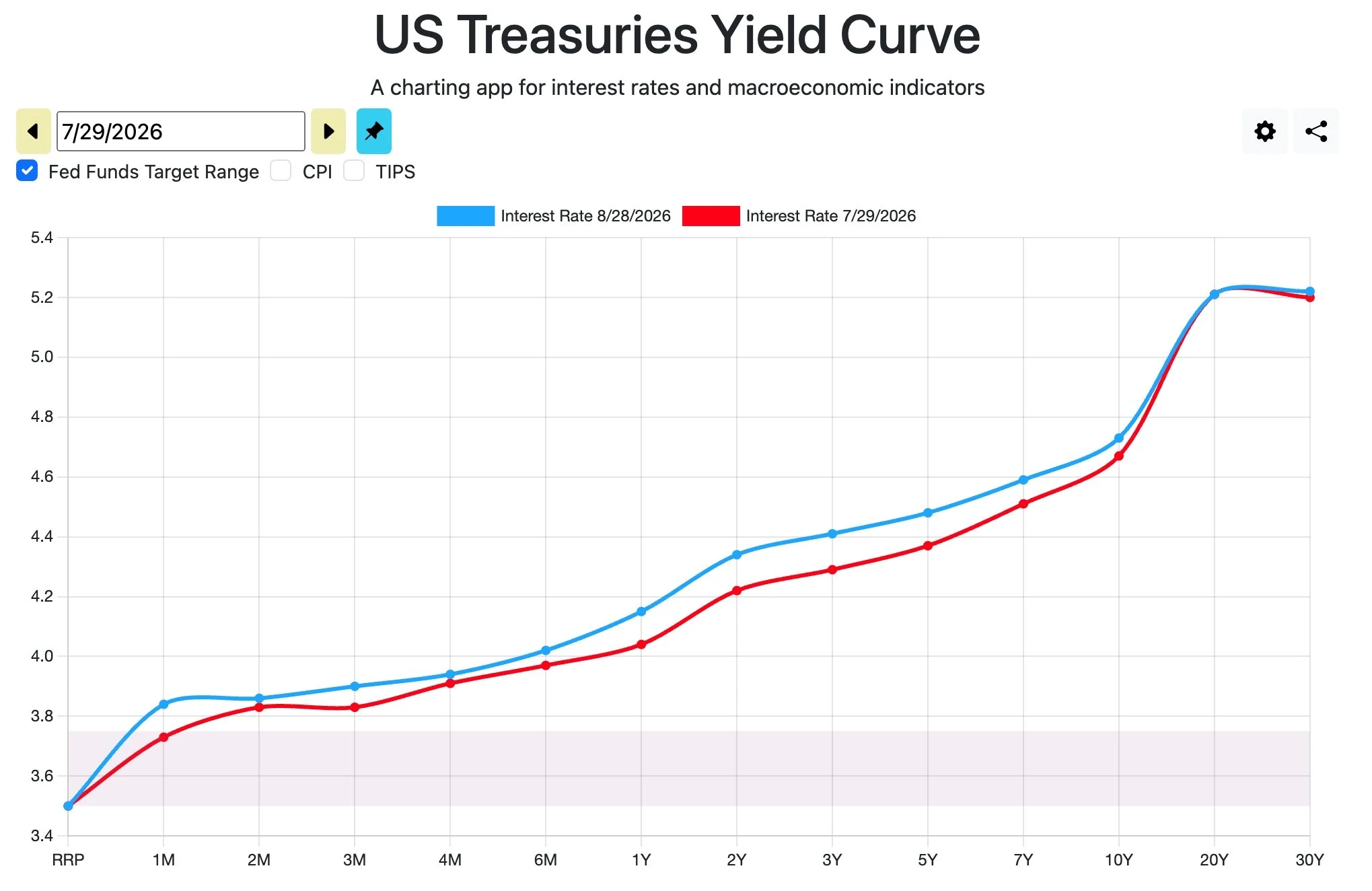
Treasury yields rose at many short and intermediate-term maturities during August, while changes at longer maturities were more limited. The key point is that a sustained higher-rate environment can put pressure on the pricing of many traditional bond investments, even when issuers continue making all scheduled interest and principal payments.
This rate-and-price relationship remains one of the key factors affecting fixed-income performance and helps explain why different bond strategies can produce different results in the same interest-rate environment.
How Have Fixed Income Investments Performed in 2026?
In the July newsletter, we compared the Kirkland Income Fund (KIF) against broad fixed-income indices to provide a market-level reference point. You can still see the updated index comparison below.
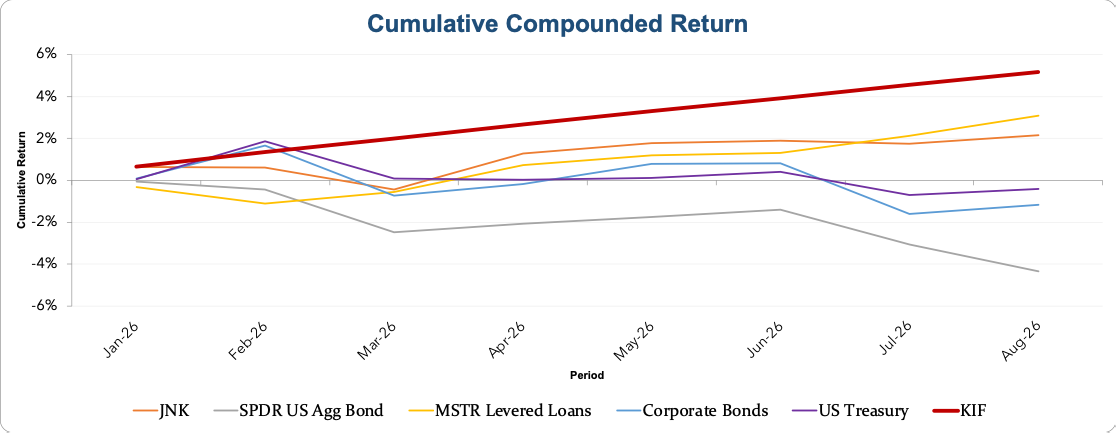
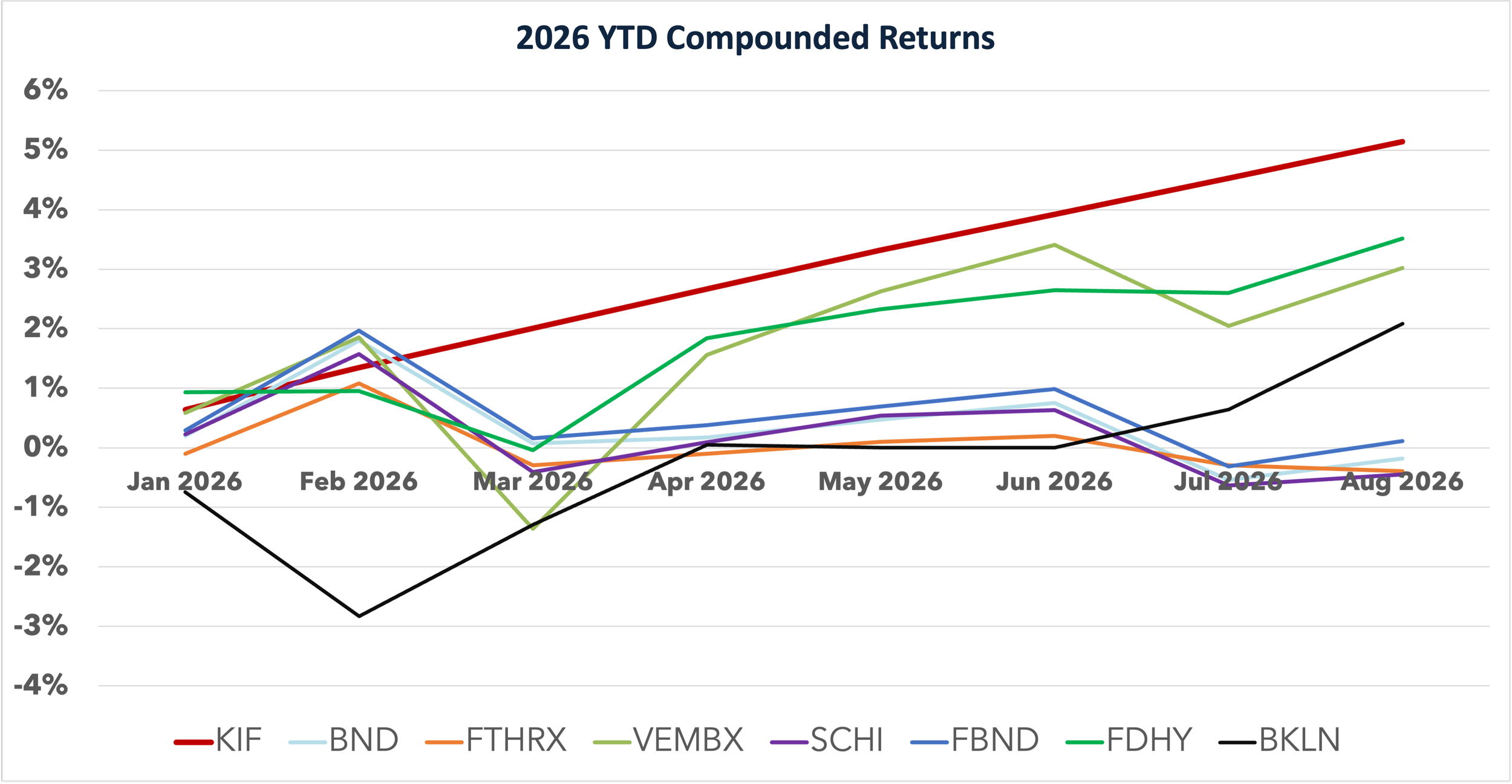
For this newsletter, we are expanding the comparison by using selected publicly available bond mutual funds and ETFs to show how different income-oriented strategies behaved during the year.
Kirkland Capital Group is NOT recommending any brokers, mutual funds or ETFs listed below and this analysis and comments are purely for illustrative purposes.
In a third-party survey of high net worth (HNW) and ultra-high net worth (UHNW) investors, it was discovered that a bulk of investment dollars are still allocated to traditional investments. These investors favored two brokerage houses specifically: Charles Schwab and Fidelity. The survey also pointed out that many of the investors also utilized Vanguard mutual funds and ETFs for investment exposures.
We compiled the highest-rated fixed income funds for these various shops. These funds are not direct benchmarks for KIF. They have different objectives, holdings, liquidity, fees, valuation methods, and risk profiles than the fund. The comparison is intended to help investors understand two key ideas:
The range of outcomes across different types of fixed income investments within the current environment.
That one of the Kirkland Income Fund’s primary objectives is to outperform traditional fixed income investments.
What is interesting to note is that even as the Treasury yields moved higher across much of the curve from July to August, the selected public fixed-income funds' returns improved over the same period, though at different levels. That is because fund returns depend on more than Treasury-rate movement alone. Income earned during the period, changes in credit spreads, portfolio duration, active management decisions, and floating-rate exposure can all affect a fund’s return.
Fund Descriptions
BND — Vanguard Total Bond Market ETF: A broad U.S. investment-grade bond ETF holding government, corporate, and mortgage-backed bonds.
FTHRX — Fidelity Intermediate Bond Fund: An actively managed intermediate-term bond mutual fund investing mainly across U.S. government, corporate, and securitized debt.
VEMBX — Vanguard Emerging Markets Bond Fund: An actively managed bond mutual fund investing primarily in fixed-income securities issued by governments, agencies, and companies economically tied to emerging-market countries.
SCHI —Schwab 5-10 Year Corporate Bond ETF: An ETF focused on investment-grade U.S. corporate bonds with five- to ten-year maturities.
FBND — Fidelity Total Bond ETF: An actively managed core-plus bond ETF investing across a broad range of debt securities, including investment-grade bonds and a limited allocation to below-investment-grade debt.
FDHY — Fidelity Enhanced High Yield ETF: A high-yield bond ETF investing primarily in below-investment-grade corporate debt, with a factor-based process that considers credit quality, valuation, and issuer fundamentals.
BKLN — Invesco Senior Loan ETF: An ETF holding senior secured floating-rate leveraged loans, mainly to below-investment-grade companies.
Through August 2026, KIF generated a compounded net year-to-date return of 5.14%. Over the same period, the selected public fixed-income funds produced total returns, including reinvested distributions, ranging from -0.45% to 3.51%.
To give a broader view, we also included a performance summary beginning in April 2020, the Kirkland Income Fund’s inception.

The main point for investors is that they should look beyond the stated yield and ask what risks are being taken to earn that income. Traditional fixed income can play an important role in a portfolio, but alternative fixed income strategies may also help improve overall income, and risk through diversification.
As stated above, one of Kirkland Income Fund’s objectives is to produce returns that are consistently higher than those of traditional fixed income instruments. Despite not being best fit benchmarks for KIF, the comparison shows that the objective has been met since inception against both traditional and alternative comparative indices, mutual funds and ETFs offered by major investment shops.
Commercial Real Estate Market Update
Higher Treasury yields, persistent inflation, and uncertainty about the future path of interest rates continued to affect commercial real estate in August. For borrowers, the challenge was not simply whether a property had tenants or demand. The larger question was whether the property could generate enough cash flow to cover today’s higher financing costs and still attract new capital on terms that supported the owner’s business plan.
Recent market data suggests that stress has broadened across several property types. Cred iQ reported $4.6 billion in new troubled commercial real estate loan balances during August, including industrial, hospitality, retail, and self-storage properties. Industrial accounted for $1.41 billion, hospitality added $1.17 billion, and retail added $951.4 million.
Troubled loans generally mean the borrower or property is showing signs of financial stress, such as difficulty making payments, refinancing the loan, or meeting the original loan terms. Even though this data is in a market segment KIF does not operate in, it is a useful reminder that stress is not isolated to one corner of the market. We have also seen over the past few years that this stress can even affect niche markets such as micro-balance CRE bridge loans.
The August data also showed that different property types face different pressures. Industrial properties may benefit from long-term demand for logistics, warehousing, and distribution, but they can still experience stress if a loan matures at a time when refinancing is more expensive or less available. Hospitality properties can continue to be more sensitive to travel demand, daily room rates, and operating expenses. Retail properties can be affected by consumer spending, tenant quality, and the strength of local shopping patterns.
What investors need to remember is that commercial real estate is a large market made up of many property types, borrowers, locations, and loan structures. A well-located property with conservative debt and a strong sponsor may have a very different risk profile than a highly leveraged property with weak cash flow or an uncertain refinancing plan.
For KIF, these conditions reinforce why loan-level underwriting is more important than trying to make a broad market forecast. KIF does not need every part of the commercial real estate market to improve at the same time. Instead, the Fund focuses on whether each loan has the characteristics needed to preserve investor capital and produce income. Those characteristics include the quality and value of the collateral, the amount of borrower equity invested in the property, the sponsor’s ability to execute the business plan, the strength of the loan documents, and the credibility of the repayment path. In a market where refinancing is harder and property performance can vary widely, this disciplined approach is intended to help KIF identify loans where the potential return is appropriate for the risks being taken.
KIF Investor Question
Question: "Why Are Institutional (Professional) Investors Increasing Their Allocation to Private Credit?"
Answer: Institutional investors, including pensions, insurance companies, endowments, and foundations, have continued to increase allocations to private credit because it can provide a source of return enhancement beyond traditional fixed income. Traditional bonds can still play an important role in a portfolio, but their values are often affected by changes in interest rates and daily public-market pricing. Private credit may offer a different source of income because loans are typically negotiated directly with borrowers and may include features such as floating rates, collateral support, lender protections, and customized repayment terms.
Private credit can also serve as a diversifier within an existing fixed income portfolio. In simple terms, diversification means not relying on one type of investment with similar risk factors to produce all of a portfolio’s income. While traditional fixed income is often driven by interest-rate movements and credit spreads, private credit is more closely tied to borrower repayment, collateral value, loan structure, and the manager’s underwriting discipline. This does not make private credit risk-free. It still involves credit risk, limited liquidity, valuation uncertainty, borrower concentration, and manager-selection risk. Some structures can also include multiple financing layers that make the underlying risk harder to evaluate.
This is where the Kirkland Income Fund’s approach is relevant. KIF is a private-credit strategy focused on micro-balance commercial real estate bridge loans. The Fund is not designed to replicate a traditional bond portfolio. Instead, it seeks to generate income from carefully underwritten loans where repayment is supported by collateral, borrower equity, conservative loan-to-value levels, and a realistic exit strategy.
The growth of institutional interest in private credit reinforces that many sophisticated investors view the asset class as a useful complement to traditional fixed income. The main takeaway is that private credit should not be viewed only as “higher yield.” It should be understood as a different type of fixed income tool that may enhance returns and improve diversification.
Looking Ahead
We believe the next year may continue to be shaped by elevated interest rates, higher Treasury yields, and periods of market volatility. The path of rates remains uncertain, but borrowers are still operating in a financing environment that is more expensive and more selective than it was several years ago. If these conditions persist, refinancing activity, lender appetite, and the availability of flexible capital will remain important factors to monitor.
For investors, this environment makes the source of income increasingly important to understand. A higher yield may reflect greater interest-rate risk, borrower risk, reduced liquidity, or a more complex investment structure. It may also reflect a supply-and-demand imbalance in a lending market where borrowers need capital and fewer lenders are willing or able to provide it. The question is not simply whether an investment offers attractive income, but whether that income is supported by risks the investor understands and is willing to accept.
For the Kirkland Income Fund, this outlook reinforces the importance of disciplined underwriting rather than interest-rate forecasting. KIF expects to continue maintaining conservative loan-to-value ratios, applying careful valuation review, and placing significant emphasis on collateral support, borrower equity, and realistic repayment or refinancing plans. The objective is to identify loans where the potential return is appropriate for the risks being taken.
The section above was written before we had this news, but even though this event occurred in September, we just had to mention it as it is pertinent to our view moving forward. On September 16, the FOMC decided to raise rates (25 bps/0.25%). It is the first increase in three years. At the highest level of explanation, the Fed raised interest rates because inflation has stayed higher than they want, geopolitical shocks to energy costs have occurred, and the economy is still running stronger than expected. In real estate, this means mortgages and commercial loans cost more, new construction might slow, property values will be under pressure, and refinancing existing debt will be more difficult. The positives are that the rates we can charge will potentially rise, and we have stronger negotiating power, which pairs well with the statements we have had throughout this paper and the planned stricter underwriting and loan terms we have been planning going forward.
