March 2023 Newsletter
Clearly many public market investors are concerned about real estate investments. This can be seen by this month’s decoupling of broad equity indices and the US REIT market. These two indices are usually very correlated (0.90) but moved in opposite directions last month.
This year so far has been a bit of a circus. At every turn another absurd event. I am not going to list all the circus acts we have seen, as I have mentioned them in previous letters, but I will tell you one thing, this circus ride is not over. When free money goes away and it is no longer “easy” what happens is weak systems break, investors that chose to extend risk and live on the edge of a knife suffer, frauds and bad actors are brought to light. The problem is that when all of these happen it causes what some of you might now recognize as contagion. One failure causes other failures in the system, and if not stopped it continues to spread. This was seen with the recent bank failures that could lead to more failures, and consolidations of banking operations to ensure survival. Congratulations, we are living through another “cycle.”
For many of us this is not the first one. Amazingly for many investors, managers, and financial advisors, this is their first cycle. Many who have extended their risk too far will lose money for the first time and many of them will not survive. Good! I know that sounds mean. However, this has all happened before and needs to happen again. This downward cycle makes the market and its constituents stronger, and exposes the surviving capable managers for investors going forward.
I heard in the Dot com era that, “no one needs an investment manager, all I have to do is buy a name with .com on it.” Then in pre-2008 it was the same story as money was cheap and plentiful and you just had to deploy it to make a return. We are at a point in time again where it was easy for a very long time but now it is going to be harder to generate outsized returns. You are going to have to work to find that inefficient investment and a team with the edge to capture it. Good news is those opportunities are out there.
In March, the Fed stuck to its focused battle against inflation and raised 25 bps. They did this even in the face of multiple bank failures. With this move we have an even stronger belief that the Fed will look to raise another 25 bps, as they have mentioned on many occasions. Even though this is not a big move it will come down like a hammer on multiple areas that are already on the edge.
We are seeing multiple multifamily syndications go into foreclosure, and many others are running at a loss each month, caused by the rapid increase in cost of leverage. Rate Caps have helped many but left the investment potential of the projects thin and unable to distribute any interest payments to investors.
More banks will struggle with whispers of new regulations. We were already seeing so many loans headed our way. Now we are starting to see loan requests from borrowers that have failed to obtain a loan from major regional and super regional banks. Historically, these are loans that would have qualified for conventional loans from major banks but now are showing up in our box. I know I have said this before, but private debt has always been a good risk-reward asset class. Now we are seeing loans that are widening that risk reward spread to levels we have not seen for some time. If you are looking for high passive income returns that are backed by real assets this is the time to deploy capital.
Venture and private equity are under valuation pressure. Many private equity managers have not materially marked their portfolio down but if the rates go up again, and we are looking at a higher cost of capital environment for longer, I’m not sure they can hold off much longer on marking their investments down.
All these occurrences are creating opportunities for us in the private lending space. If you are looking to enhance the return of your fixed income portfolio while offsetting risk across your portfolio, please reach out.
In the last newsletter, I talked about ways of organizing your due diligence of investments. In this letter I want supply information and discuss the Endowment Model of investing. Some of you might have heard of this method of investing and perhaps even been told it is the way investors should structure their portfolio for the future. For some that might be true but for many that is not the case.
What is the definition of the Endowment Model. It is an investment style that allocates a large portion of the assets to alternative assets in a hope to capture illiquidity premiums and capture inefficiencies that can be found in illiquid and fragmented markets. As this was initially utilized by university endowments, it was labeled the “Endowment Model.”
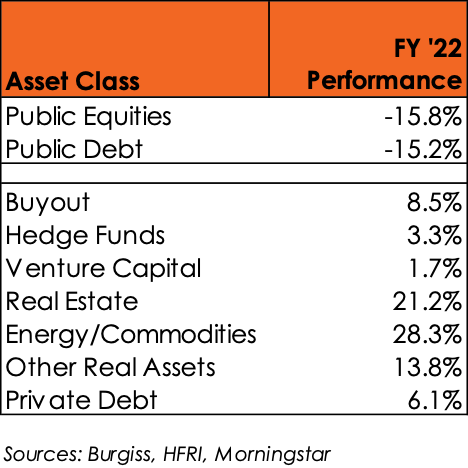
Here are some recent facts about the endowment investment model as sourced by the CAIA. In 2022 the large endowments outperformed smaller endowments as they had greater allocation to alternative investments. In 2022 large endowments (Over $1 billion) averaged -4.5% while small endowments (Under $25 million) averaged -10.5%. These large endowments had over 60% of their assets invested in alternatives. As a reminder, public equity in 2022 was -15.8% and public debt was -15.2%. So, even the small endowments greatly outperformed traditional investments in 2022. In a CAIA survey they discovered endowments are looking for uncorrelated sources of return. The two primary areas of focus are Private Debt and Infrastructure. Below you can see all alternative assets classes generated positive returns.
I believe investors should have some exposure to alternatives. What should the exposure be and is the endowment theory right for you as an individual or a family office? These are questions investors will need to answer based on their own situation. Again, for a lot of investors the answer will be "Probably not" and this is due to several reasons.
Endowments are immortal and hence have investment horizons that do not match an individual or even a family that is looking one generation out.
They have controlled liquidity needs that do not match a person or a family’s liquidity needs as they progress through their investment life cycle. In general, an endowment will have a 4% liquidity requirement annually. Depending on the size of your nest egg and your financial needs you might need more than that.
Risk tolerance most likely is different due to the difference in time horizon.
They have access to teams that can perform complicated and on-going due diligence. It is tough for an individual or even a family office to achieve the level of understanding required to effectively perform due diligence on multiple complicated private asset classes.
The reason I wanted to bring this subject to light is alternatives are clearly an asset that can perform well and are not generally correlated to traditional investments. This combination makes alternatives generally a good addition to an existing traditional investment portfolio. What should be your allocation to alternatives and what types of alternatives should you have? That is dependent on your individual investment parameters, and don’t let someone sell you on one investment theory or another as the best for you. Educate yourself on the different portfolio allocations theories and investments and perhaps come up with your best model and investment choices.
