June 2023 Newsletter
In the month of June, kids are out of school, and many are on vacation, so you may think the headlines would slow down. Unfortunately, this is not the case. High interest rates, recession, inflation (Core Inflation at 4.8%), bank failures, regional bank exposure to CRE debt, US debt level, global head winds for the USD, and global strife are still on many people's minds. To make matters worse, there have been continued failures in large commercial real estate and fintech platforms. (See my PeerStreet comments.)
The Federal Reserve's comments on inflation, combined with strong corporate earnings and a tail wind of Generative AI, drove equities up considerably. The S&P was up 8.3% for the quarter, with a majority of that return driven by seven tech stocks. Risk is still on investors' minds, so we can expect to see continued volatility across markets. Many investors are still seeking defensive investments, and even gold has seen solid price appreciation this year.
Below is a great chart showing an array of YTD performance metrics:
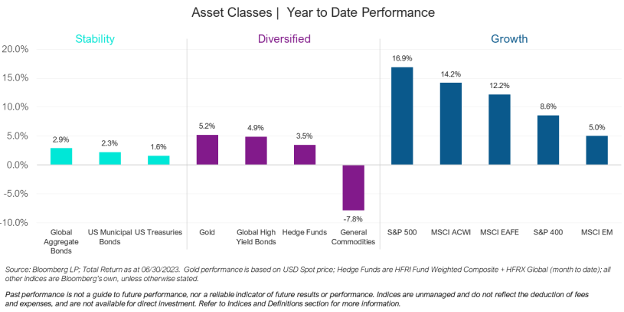
Certainly, there has been strong performance YTD and many are pleased to have equity out of a hole. I am also pleased, though I may be biased, and would still prefer Private Debt considering the upcoming uncertain events, such as the FOMC meeting on July 25th and 26th, as well as potential bank regulations and extension of the credit crunch.
We had an Investor Family Social event last week in Seattle. I understand that many of you are not located in the upper left-hand corner of our country, so Brock and I are planning other social events closer to other investors in the fund. Stay tuned for more information!
At the event, a good line of questioning came up about inefficient and fragmented market spaces, which we certainly are in. Large amounts of money to invest can cause returns to decrease drastically in niche investment spaces, and in some cases, it can cause trade or operational failure. To prevent this, investors need to understand how managers view their investment space and what their understanding of capacity for the trade is. As an example, early in my career, I worked with a very talented manager who managed roughly $200 million and was putting up returns of 30 to 40%. However, when the fund grew to $4 billion, his returns fell to 8% on average. Even though he was still a very talented individual, the most lucrative trades he traded when he was smaller were no longer viable for the amount of money he needed to deploy.
Recently, we have seen crowdfunding sites struggle. Although these tech platforms have their own unique issues, I found a write up that I enjoyed. They highlighted two issues they were facing:
Too much money for the near-term capacity. This is leading to the inability to scale and maintain quality of trades. As these platforms attract more money, they are allowing more trades that may not meet previous risk and investment standards, resulting in a decrease in overall quality.
Some Fintech platforms are started by tech entrepreneurs who hire the top tech talent. However, when it comes to hiring top investment and finance personnel, they may not know who they need to hire, not want to pay the salaries, or even believe they can create a software program and put it in the hands of a less experienced person. This may work in good times, but it has proven to fail in times of uncertainty.
One more I wanted to add is if the platform is venture or private equity backed. In this case, it's important to understand the goals of that private equity company and what board influence they have that might affect investment performance or risk controls.
It's important to recognize that private investments can often fail due to operational issues. We recommend that you take the time to understand the company's structure, who is running it, and their background and focus. With the current global market, it's not surprising that some investment platforms are struggling. More failures may be on the horizon as they will not be able to patch their boat with low-cost capital.
We are looking forward to solid performance for the rest of the year as the tail winds we have had all year are likely to continue. If you have questions about your statements, specific questions about the fund or markets, please reach out.
Thank you for being part of the KCG Investor Family!
